Production inkjet has grown steadily in recent years and forecasts single out inkjet as the fastest growing printing technology by far. When talking about inkjet, the large, continuous feed presses and high-volume sheet-fed presses get almost all the attention. There is an often overlooked light-to-mid-production market which is less glamorous, but easily outsells the heavy iron in terms of installations.
The offerings in light and mid-production inkjet have several things in common. They print on SRA3-sized paper and predominantly uncoated paper is supported. The print quality is more geared towards business quality, with print resolutions up to 600 dpi. Speeds range from 150 to more than 300 ipm, fast enough to beat almost all SRA3-based colour toner presses. When judging speed versus price of the devices, all the printers offer excellent value for money when compared to any digital colour toner press. They even beat the price-performance ratio of higher priced continuous or B2/B1 sheetfed inkjet presses. The print quality and paper support can be a limiting factor for a range of applications. However; both are more than adequate when upgrading from monochrome toner printing.
These lighter production devices should not be confused with office printers. Inkjet is already widely used in office markets. With the usage of page-wide inkjet heads, office devices can reach high speeds as well. Offerings from Epson (WF-C21000) reach 100ppm in colour. However; the differences between an office device and a production printer are clearly visible. Office printers lack the sturdiness to print higher volumes continuously. They lack high volume paper decks, finishing options and professional controller options. The latter has a major impact on productivity, print quality and processing of files.
The most established vendor in light-to-mid-production inkjet is RISO. The company has a long heritage in manufacturing digital duplicators, but that has limited its offerings to monochrome or spot colour devices. Still the devices proved successful in print rooms of education, governmental, legal and other organisations. In 2003 the company took a plunge and launched their first full colour production inkjet devices. In the course of the years since then, RISO literally installed 10,000s of production printers and kept on improving the performance with several generations of devices since.
[caption id="" align="aligncenter" width="702"]
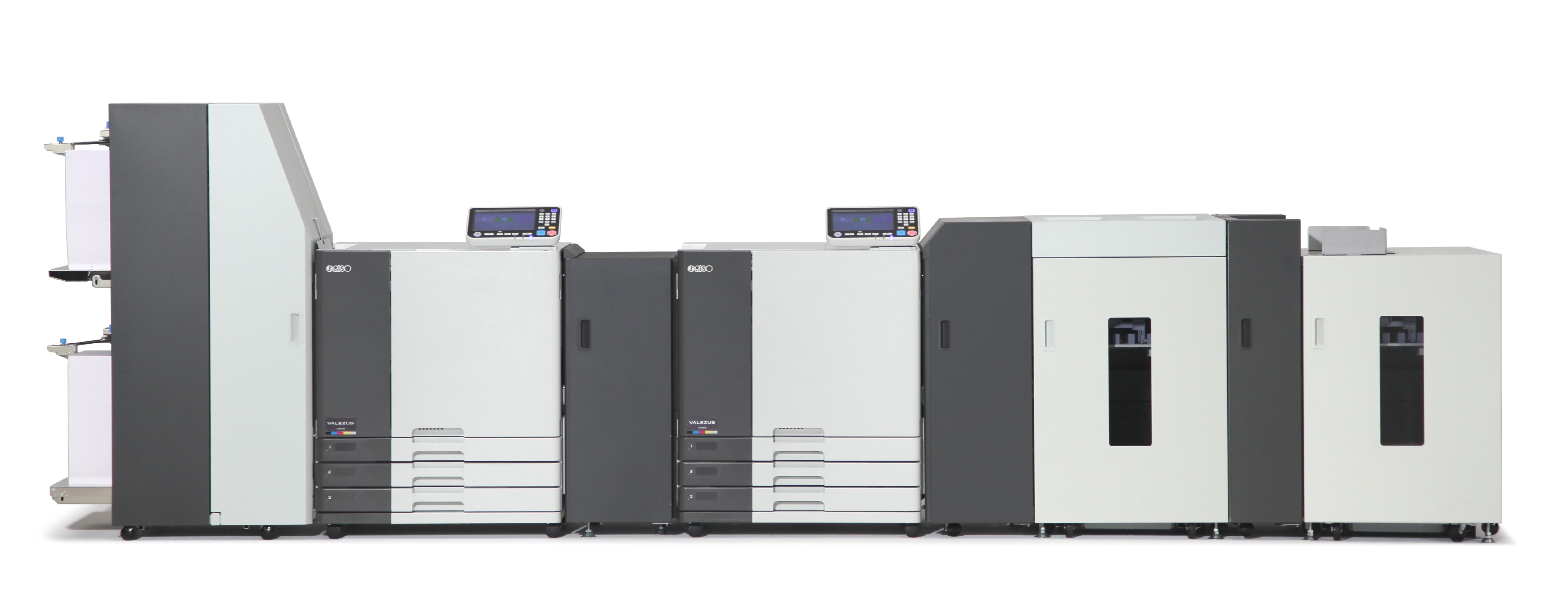
Valezus T2100[/caption]
Currently RISO offers two inkjet solutions for the production market: the light production GD 9630 and the mid-production
Valezus T2100. The GD9630 is the top speed model of the GD-line with 160 ppm - lower speed models are targeted for office printing. The Valezus T2100 is the new flagship model from RISO. The speed of 320 ipm is achieved by coupling two GD engines together – a similar approach used in other twin-engine printers such as the Xerox Nuvera 200/288/314. Accordingly, paper size, paper types, resolution and inks are the same as the GD 9630. Obviously, the full speed is only achieved in duplex print.
Typical customers are in direct mail, hybrid mail and transaction, but RISO inkjet printers are used in all kinds of print rooms as well. A big driver is moving mono volumes into colour with the Valezus speed matching even top speed mono sheetfed toner printers. But, the RISO printers also serve as reprint solution for continuous feed inkjet and in lower volume environments appropriate for cut-sheet. Typical reprint runs range up to 15,000 for the GD and up to 30,000 for the Valezus. The GD is designed for volumes from 200k to 600k impressions/month, while the Valezus allows for up to 1.5 million, with an average of 1.2 million achieved currently. The Valezus was
announced in August 2019 and s
hown at Printing United in 2019 a formal launch was planned for drupa 2020. The press has been available since Q2 2020. Pricing ranges from £120k to £200k ($170k - $250k US), depending on the configuration and in-line options such as dynamic perforation and reel to cut-sheet.
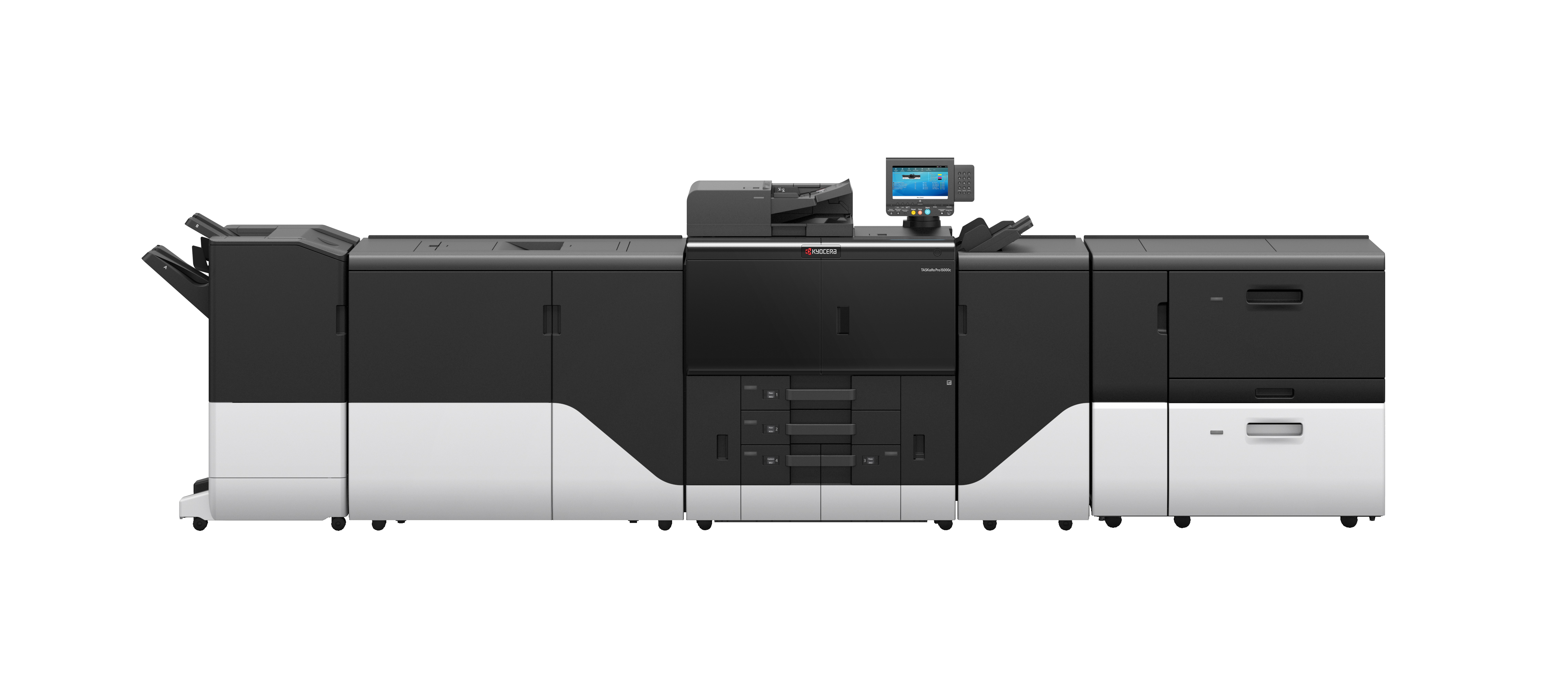
For many years RISO was the only provider of light to mid-production colour inkjet solutions. Last year Kyocera joined the market. The Kyocera TASKalfa Pro 15000c is now the company’s top line product and offers a speed of 150 ppm A4 (146ppm letter size). It ups the print resolution to 600 x 600 dpi and uses waterbased inks. We
covered the product in more detail previously
[caption id="attachment_4100" align="aligncenter" width="500"]
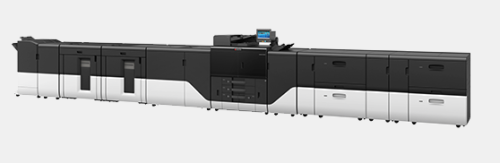
Kyocera Taskalfa 15000c[/caption]
The roll-out started end of 2019, but like many other launches it was hampered by the Covid-19 pandemic, which held up shipping, training and support. Over 20 devices have been shipped in Europe so far, but the speed of sales is expected to pick up now. Kyocera keeps on investing by hiring dedicated staff and educating country organisations. The company plans to double the number of installations by end of March next year. Users have been happy so far with uptime and consistent quality. The first user in Europe already installed a second device and is routinely achieving volumes of 1.8 million impressions per month on both devices.
The majority of users are in direct mail and transaction, but some users are in commercial print, quick print or corporate print rooms as well. Kyocera states that many 15000c users replace colour toner or BW volumes with the device, but some users also divert lower run offset volumes to the 15000c. While the roll-out is still picking up steam, Kyocera is looking into upgrading the device already. More 3
rd party in-line finishing solutions are being added currently, while support for coated stocks is on the roadmap.
[caption id="" align="aligncenter" width="701"]
MCS Merlin K146C[/caption]
MCS is providing its own version of the TASKalfa Pro 15000c as
Merlin K146c. There are a couple of important differentiators, however. MCS has a long history in inkjet, providing products since 1997, but the Merlin is the first standalone sheetfed inkjet solution. Based on the experience serving the mailing industry MCS decided for a shared maintenance model, where the operator can do most maintenance and ink is sold based on consumption. Especially for lower coverage jobs this allows for very competitive print costs and new business models. MCS reckons that a mailing printer can achieve $20,000 to $30,000 higher revenues per million sheets by printing customer logos on blank paper, instead of buying preprinted stock.
MCS does not see the Merlin as any competition for the CF solutions, instead CF users invested into the Merlin to have a reprint and back-up solution for their CF device. For other users the Merlin is the first inkjet device and users are still building up volume or have limited volumes of up to 2 million impressions/month. Most users so far are in direct mail and transaction markets. Shipping started end of 2019 and unfortunately the Covid pandemic slowed down the roll-out as well. Still about 15 devices have been installed in the US and MCS reckons they will deliver 4 to 5 installs per month next year. The Merlin is available in the US only so far, but MCS is looking to expand the coverage.
While high-end production inkjet printers getting the limelight in the market, it can be worthwhile to have a look at these lower priced solutions as well. The user cases are manifold: from reprint to BW to colour conversion to providing an economic starting point for full colour digital print. If the output suits your application requirements, those printers have the best price-performance ratio available.
For more coverage on the lighter side of inkjet, see also
2019 Production Inkjet Tradeshow Shopping Guide highlighting devices with a price tag under $1million US and
What's Happening in Sheet Fed Inkjet which also covers several entry-level devices