Thomas Printworks is a different kind of printing company that takes an unusual perspective on print markets. While many companies categorize themselves as a particular type of printer, direct mail, commercial books, etc., Thomas Printworks looks at the customers they want to capture and how to do the most for those customers. In terms of printing applications and technology, they simply look at large format and “small format.”
“Our focus is to support different vertical markets and provide everything they need in those spaces rather than producing a specific set of work for a wide range of verticals,” according to Trevor Hansen, Chief Revenue Officer of Thomas Printworks. “Our offers are very diverse. We can print anything from the size of a business card to the size of a building."
[caption id="attachment_3977" align="aligncenter" width="200"]

Trevor Hansen, Chief Revenue Officer[/caption]
Overall, the company has 25 physical locations across 8 markets: Dallas, Houston, San Antonio, Austin, Orlando, Miami, Minneapolis, and Phoenix. Hansen clarified, “We have large production operations in each city plus satellite retail print shops for walk-up type of work to support our long-term customer base in construction and infrastructure.” The company was founded in 1956 to provide blueprint solutions to the construction industry and that remains a strong market for them with a smaller percentage of overall revenue, but a wider range of solutions with strong customer loyalty. They also serve hospitality and retail, events and venues, commercial and nonprofit, media and agencies. The distinctiveness of each of the markets allows the company to shift resources and focus on the industries with the most demand at a particular time.
This diversity and flexibility has provided the company with resiliency during the pandemic. According to Hansen, “Construction is down but doing well. Restaurants are struggling but they are putting a lot of effort into COVID related signage, marketing and getting people back in restaurants using coupon offers. For events we have shifted to providing sports stadium section covers - big vinyl banners to cover sections of the stadium with sponsor logos - and seat fills, barriers and signage, particularly safety signage.” Hansen also noted that activity in the fundraising sector is a mixed bag as most areas other than food banks are struggling. Those that rely on fundraising from businesses are particularly challenged because direct mail will not reach potential donors working remotely.
Thomas Printworks was not always this diversified. They have worked strategically to add value and reduce risk in their services portfolio. This approach has driven the acquisition of a wide variety of equipment, as well as, the acquisition of other printing companies. “Until 2016, we had limited offset and direct mail capabilities so in February of that year we acquired Seebridge Media in Houston,” explained Hansen. Seebridge had HP Indigo, sheet-fed offset presses as well as some black and white toner based equipment. Prior to the acquisition, Seebridge had acquired large format equipment but were struggling with gaining market share. Thomas Printworks had deep experience in the large format space and was able to leverage that equipment while gaining a valuable foothold in aspects of direct mail that they had previously outsourced. Last year, the former Seebridge and Thomas Printworks facilities in Houston were merged.
Across all of their facilities is a wide array of production equipment. About 65 to 70 percent of overall business is produced on web or sheet large format equipment. The
HP PageWide XL aqueous inkjet press is in heavy use for construction customers producing full-color construction plans and even some point of purchase graphics for short term use. They also produce a lot of work on rigid substrates such as signage using Canon Arizona UV flatbed printers and deliver wallpaper and custom graphics applications on a Canon Colorado roll-to-roll large format device.
The small format part of the business is also the smaller part of the overall business, but it is growing and changing. Adding to a portfolio of older Xerox iGen and HP Indigo toner devices, two years ago Thomas Printworks acquired a
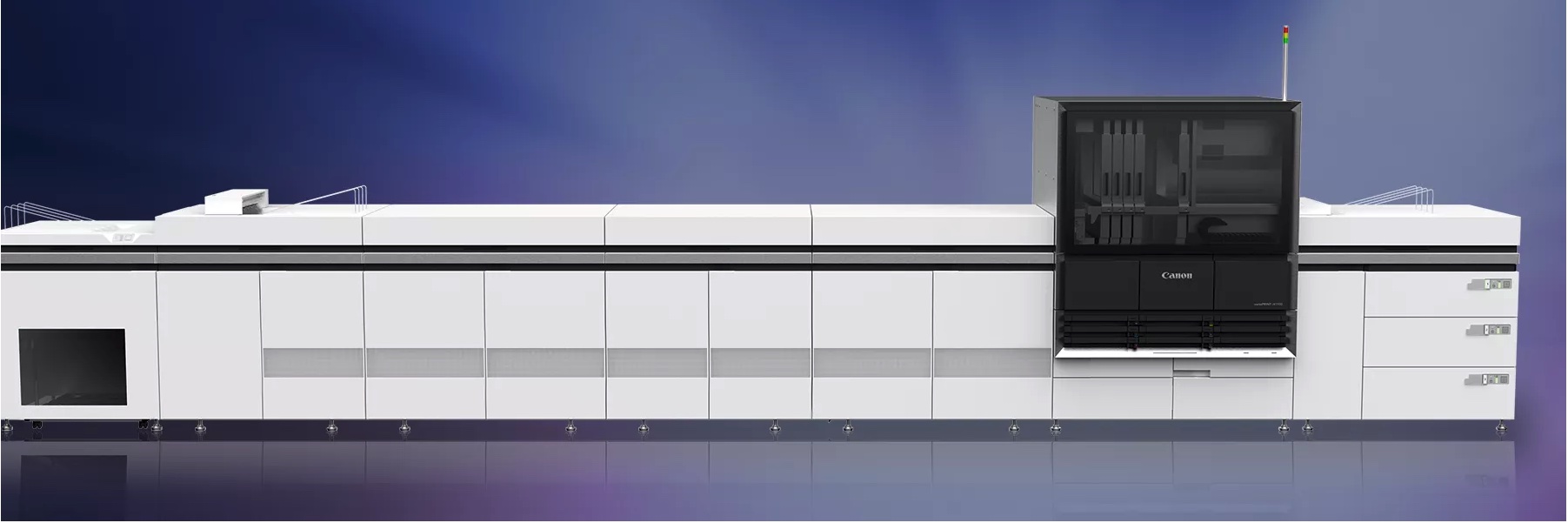
Canon i300 sheet-fed inkjet press. Justified to support variable, data driven direct mail work, the company found that they also had a lot of demand for workbooks and manuals on the press. “Almost all of the volume on the i300 was transitioned from color toner devices, or from processes using offset shells with mono toner,” Hansen notes. “Quality differences between the i300 and the iGen and the Indigo are still a work in progress, but Canon has worked with us to expand the capabilities.”
It's notable that Canon has delivered a field upgradable version of the iSeries (
iSeries+) as well as the new
iX Series platform in the past 2 years. The latter delivers huge leaps from the first generation of iSeries in terms of color gamut, resolution and media compatibility. Hansen believes that the original iSeries is meeting their needs and there is still great demand for it with their customers. “We recently did a large job producing all the curriculum for a charter school with multiple campuses and it all required digital output,” Hansen told us. “Without the i300, we wouldn’t have been able to do that.”
Another side-benefit that came out of the inkjet implementation was enhanced automation to support more high-volume data-driven jobs. “It created a stronger internal push to offer some automated solutions to our customers with the expanded capacity. Now customers can drop an XML feed with artwork for variable data prints into a hot folder, run it through [EnFocus] Switch get it automatically impositioned, and end up on the i300 and the operator just has to load the correct media,” Hansen explained. While automation was available on some devices, driving volume to inkjet required a commitment to drive out manual processes.
One of the strategic lessons that Thomas Printworks learned about inkjet is that it was different from any device they had ever bought before. Even though they used both aqueous and UV inkjet in the large format part of the business, they wished that they had spent more time on planning and training months ahead of installation. Hansen says, “You need a strong marketing plan, training plan, and less focus on
‘look we have this new shiny tool,’” said Hansen. “We wished we had planned much earlier to say ‘
here are the new services and new price points’ to make sure the sales team was up to speed and to make sure that other internal resources understand that as well.“
Having inkjet has allowed Thomas Printworks to deliver many of the customer solutions they provided previously in less time while providing digital long runs at closer to offset pricing than was possible on the other device options available in house. They now have an extremely flexible device that complements a diverse equipment and customer portfolio.
We love talking to customers about their business and their uses of inkjet. If you have a story to tell, please get in touch.