Managers cringe when they learn their inkjet technology vendors are consolidating. Whether a merger, acquisition, or partnership, they fear monopolistic practices that increase costs, reduce choice, and constrain innovation will result. But should they worry?
The printing industry has a long history of mergers and acquisitions, from the earliest letterpress manufacturers through the digital age. And, yes, when a merger or acquisition reduced the number of vendors in a region, monopolistic practices sometimes arose. However, while many of us are willing to focus on one or two suppliers of our critical printing and finishing equipment, software, and supplies, most managers and purchasing professionals prefer to keep their options open.
On the surface, the impact of vendor consolidation is like flipping a coin. Heads and a narrow list of suppliers forces the equipment and supply redundancy that minimizes your production risks but at a higher operating and capital cost. Tails and the consolidated vendor is more cost-effective and able to reduce the market risks from non-print media with innovative products and services.
But are those the only results? The answer depends on why the vendors combined.
Deloitte surveyed managers in the tech industry for its report, “The state of the deal: M&A trends 2020”. They found that the primary methods executives expect to utilize to achieve their company’s M&A strategy were:
- Expand/diversify products or services
- Technology acquisition
- Digital strategy alignment
Komori’s recent acquisition of MBO is an example of a company’s diversification into products and services that logically expand its offering. Komori is a highly regarded manufacturer of robust and productive printing presses capable of producing high-quality output. The synergies become apparent when you realize that about 60% of MBO’s market is the high-speed inkjet market that uses its unwinding and rewinding equipment and complex folding systems.
Komori’s acquisition enabled the closely-held company to acquire a paper processing technology manufactured with the same quality ethos that the Komori family has imbued their company with. Jacki Hudmon, Senior Vice President of Sales and Marketing at Komori America, noted that acquiring MBO also brings a presence in high volume inkjet printing that strengthens Komori while providing long-term market opportunities. Inkjet printing technology enables Komori to establish a more significant presence in the overall digital printing market, going beyond its long time partnership with nanographic technology provider, Landa.
[caption id="attachment_3905" align="aligncenter" width="1172"]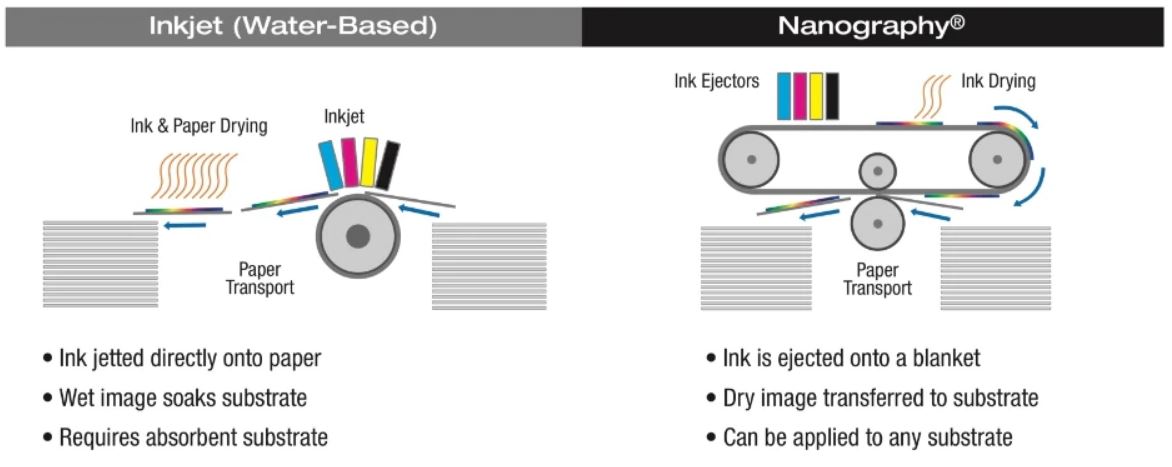 Comparison of Inkjet and Nanography Technologies. Source: Komori[/caption]
In the Komori/MBO example, the acquisition of one highly regarded inkjet technology provider of another well-regarded provider is reassuring to managers who understand the value of using quality equipment in their operations. Because the product offerings are complementary, there is little concern that Komori will eliminate MBO’s product offerings. Moreover, if the Komori/MBO combination lives up to its potential, high-speed inkjet print managers will benefit from innovative integrated press frames, imaging devices, transport mechanisms, and finishing systems.
Technology acquisition is a common reason for mergers, acquisitions, and partnerships among both printing companies and technology providers. For example, Kodak, in collaboration with Uteco, recently launched the Sapphire EVO W flexible packaging press, the first to use Kodak’s continuous inkjet technology ULTRASTREAM and the second digital press developed by the partnership. Uteco’s expertise is in traditional flexographic and gravure printing presses for food packaging, flexible films, bottle shrink film, and bags.
Sapphire EVO W
[caption id="attachment_3906" align="aligncenter" width="9825"]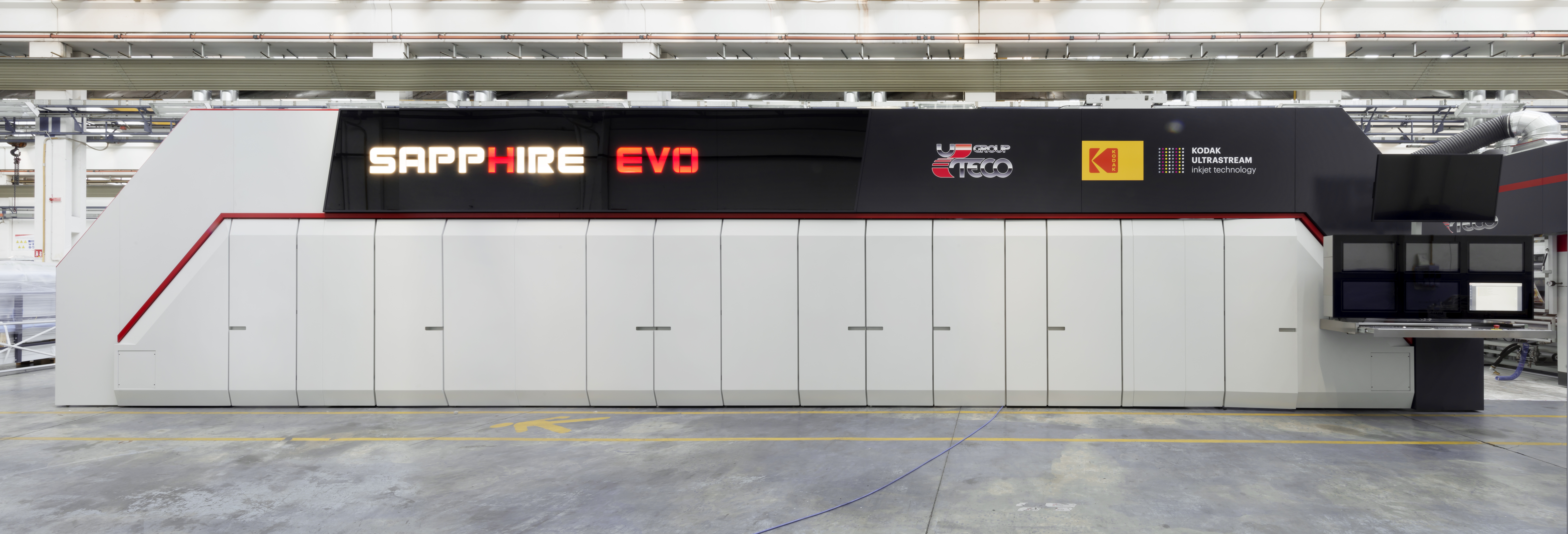 Source: Kodak[/caption]
According to Randy Vandagriff, Kodak’s Senior Vice President – Print, the partnership enables Kodak to focus on its core strengths as a print, chemical, and film technology provider. Uteco will employ Kodak’s inkjet technology, fluids, and digital workflow, taking Kodak into application spaces where it does not have the application expertise or go-to-market reach. The partners are sharing investment costs as Kodak finances the technology and Uteco the integration for flexible packaging applications.
As the range of inkjet applications expands, partnerships such as Kodak’s and Uteco’s will become more common. For the inkjet technology provider, the arrangement provides access to potential buyers of their hardware, software, and inks without having to develop the marketing and sales programs. The printing press and finishing technology partner, who knows the market and already has credibility among those prospects, gains access to digital technology without a massive investment in inks, printheads, or substrates.
Printing company managers must monitor the new inkjet applications that provider partnerships nurture by, when the time is right, acting on the technology advances brought to market. Some printing companies will be beta testers, striving to be a market leader while knowing the technology’s potential may not live up to its promise. In contrast, other firms will stand on the sidelines until the press is proven and the customer acceptance of the digital applications materialize. In either case, managers must monitor the results of provider partnerships by listening to buyers’ experiences and extensively testing the inkjet press’s actual throughput, operating cost, and imaging quality.
Digital strategy alignment is why Sun Chemical acquired Sensient Technologies. Peter Saunders, Global Director – Digital Businesses, noted the company “wanted to establish a significant presence in the digital textile ink market, the fastest-growing large inkjet market in which Sun Chemical had yet to be involved.” Interestingly, the acquisition also included edible inkjet as well as a complimentary presence in packaging and industrial inkjet printing. Fundamentally, the purchase aligns well with Sun Chemical’s existing business and offers additional support for its growth strategy.
Print managers always take note when a supplier purchases another supplier of very similar products. Is there a chance that prices will go up and service will go down? Will innovation languish? While that is always a possibility, in Sun Chemical’s case, it seems unlikely to happen. Jetting technologies – by that, I mean 2D printing, 3D printing, bioprinting, printed electronics, and even edibles – have the highest upside potential of all physical imaging technologies.
Combinations such as Sun Chemical and Sensient often work to the inkjet printing market’s benefit. First, there are enough alternative imaging system providers that no one vendor can corner the market. Second, small technology innovators often do not have the financial resources to sustain research and development as well as market development. Their acquisition can bring about jetting advances much faster by consolidating research efforts that ultimately reduce the time to market.
“As strategic inkjet ink makers,” says Saunders, “we will provide partner companies with leading products and access to technology, combined with global supply and service.” The partnerships, especially in new and emerging markets, could enable Sun Chemical to rapidly innovate and reduce the time to market while generating an acceptable return on its product development investment.
No doubt, a merger, acquisition, or partnership will impact your business. Some products will disappear as the acquiring technology provider reviews with a bright light the products that it purchased. Trusted sales and service people are let go. Should you worry when your suppliers combine? Absolutely yes, whether the suppliers are inkjet technology providers or vendors of other products and services. But there is potentially more in the combination for you than many sleepless nights.
The upside of vendor combinations, especially when it comes to jetting technologies, is higher than the downside. Even if your local market is squeezed, too many jetting technology providers are hungry for growth for any of them to be a monopolist for long.
Look at the particulars and, especially when one or both companies are your suppliers, approach the combined firm with ideas on how you can help them to grow the market to everyone’s advantage. Be proactive with the supplier and their peers to make a positive case for the products you care about. Make the case that there is an application for the products you use and that you and your customers will benefit from innovative new products.
Pg. 11; Access the full report: www.deloitte.com/us/ma-trends-report