There were three guys, Larry, Jerry and Harry
1 back in World War II who had to find work-arounds for shortages of supplies and labor to keep their manufacturing operation going in Connecticut. What started as substitutions out of necessity, in some cases, became the selections of preference because they worked better than what the guys had thought was “best.” They started systematically testing various combinations of substitute resources and “best” resources and looking at the resulting impact on product value. They called their technique "value analysis" and became very successful executives at General Electric.
On the other side of the country and quite a few decades later, a guy named Billy
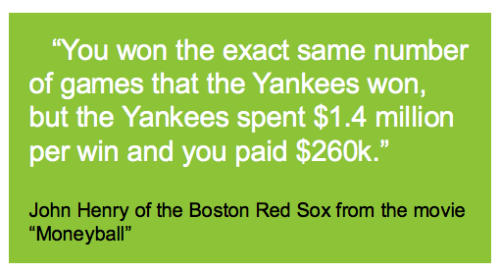
2 read a statistical analysis of the relative value of baseball players written by a guy named Paul
3 who believed, among other things, that on-base percentage was an undervalued asset while home run hitters were overvalued. Billy hired Paul and Michael Lewis wrote the book “Money Ball” about them and the success of the Oakland Athletics in getting more valuable players for less money.
Both of these are examples of people trying to figure out how to get more value for less money.
Sounds good, right?
But, here’s the thing, you need to be able to define what “value” is, and with inkjet it’s often about more than one thing. Happily, the guys at GE had a way to make this objective. They looked at
value as the ratio of function to cost.
If we're doing the math, it's
V = F / C where:
V = value
F = function
C = cost
You don’t have to do the math like they did in the 1940's, there are spreadsheets for that now. The key point is to think about value in terms of the amount of function you get for the cost. Most people think they are doing that when they bargain down the price of something, but it’s not just about getting be best price for a particular bucket of stuff – it’s about looking at the different combinations of things to put in the bucket that will deliver the most value. Remember Larry, Jerry and Harry? They never would have looked at some of the options that turned out to deliver the most value if there hadn’t been shortages. And everyone thought that Billy and Paul were nuts because they released some of the As’ most popular players in exchange for players who could “get on base.”
I’ve said this before, and I will say it again:
there is no best inkjet solution. There is a best inkjet solution for your particular situation. It will take some work and time to test the combinations like the boys at GE did to figure out which combination of options delivers the most function for the least cost.
If you’re considering investing in inkjet, or any other major print-related purchase, function and cost tradeoffs are what it’s all about. You probably have in mind some basic functions you need:
- Produce a minimum number images per minute
- Match color within a tolerance of a certain Delta E
- Deliver a certain level of print quality
Maybe you also want things like MICR ink or UV ink for security printing, or maybe you want to make sure that it’s compatible with your existing finishing line.
But, what if you can add even more function at fractionally more cost?
This is where you get into options like composition and forms conversion software, finishing options, color management tools, output management software and professional services to get you up and running faster.
Getting back to the value formula, consider that the following options technically have the same value:
- Function = 100 and cost = 1 million;
- Function = 50 and cost = 500,000
- Function = 10 and cost = 100,000
Of course, if you only have 100k to spend, the other points are moot. By the way, the full title of Lewis' book is actually, "Moneyball: the Art of Winning an Unfair Game." If you are a small printer or an in-plant operation, it can feel like a pretty unfair game when you are competing with companies who can buy 5 or 10 inkjet printers at a time. If you can't out spend them, you'd better out-think them. Looking at all the ways to evaluate inkjet value can help you spend like the Athletics instead of the Yankees and get the same value.
Since the running costs of inkjet drop significantly at higher volumes, adding functions that allow you to take on more kinds of business and keep the press running longer are good opportunities to greatly increase function with marginally increased cost - leading to a measurably more valuable solution. If you apply a weighting to each function you are considering, you can easily come up with mathematical comparisons of the value of different configurations. This is how you find the combinations that allow you to add more function at proportionally less cost.
- How much more business could you land if you could print on offset coated stock, or even uncoated offset?
- What if you could batch small jobs together seamlessly into larger jobs?
- Are there particular types of finishing that would open doors?
In a previous post I talked about the ways that improving up-time can
justify the cost of software that helps keep the press running continuously. The other part of the justification is making sure that you have business to run on the press during that expanded up-time. The ability to bring in more business is a great way to justify additional function that can drive higher value at a similar overall, volume-rationalized total cost.
Once a company invests in an inkjet press, they sometimes forget all about the value and function discussion and just focus on cost. They simply think of their new press as a “lower cost” solution for producing output. However, value analysis works from the customer’s perspective too. If your new press configuration increases function for your customers at the same price, or even a slightly higher price than they are paying now, it should have higher value. So, what might be some of these functions from the customer perspective?
- Faster turn times –significantly reduced SLAs
- Full-color personalization
- Combining documents in a single job
So, when you are creating and weighting the list of functions that your inkjet configuration needs to satisfy, also consider those options that allow you to increase value for your customer. That will allow you to lower your costs without a corresponding decrease in the price you charge the customer – and that’s the formula for profit with inkjet. As Marco Boer says, “if you want to compete on delivering the most beautiful quality at the lowest cost, you will lose.”
However you measure it, inkjet is about value – for you and your customers. So, look at all the options and choose wisely.
Meanwhile, we'll keep coming up with tools like
Device Finder,
Paper Finder and
Software Finder to make it easier and faster for you to compare options.
Footnotes:
- Value Analysis and Value Engineering are concepts first established by Lawrence Miles, Jerry Leftow, and Harry Erlicher of General Electric.
- Billy Beane, Manager of the Oakland Athletics
- Paul DePodesta, Harvard trained economist and sports enthusiast