Sit for a Spell
If you are a fan of spelling bees, we are at the end of Bee Week, the Scripps National Spelling Bee, where 243 tween and teen spelling champions from across the country compete for the Scripps Cup, with this year’s champion determined Thursday night (after this edition of Around the Web had gone to lack-of-press) from the nine finalists.
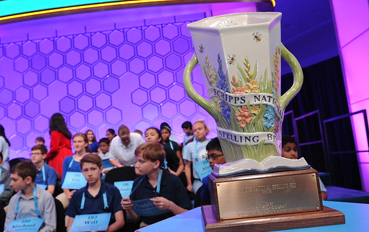
You may have seen the 2002 documentary Spellbound, about the National Spelling Bee, which was about as suspenseful as the same-named Hitchcock film.
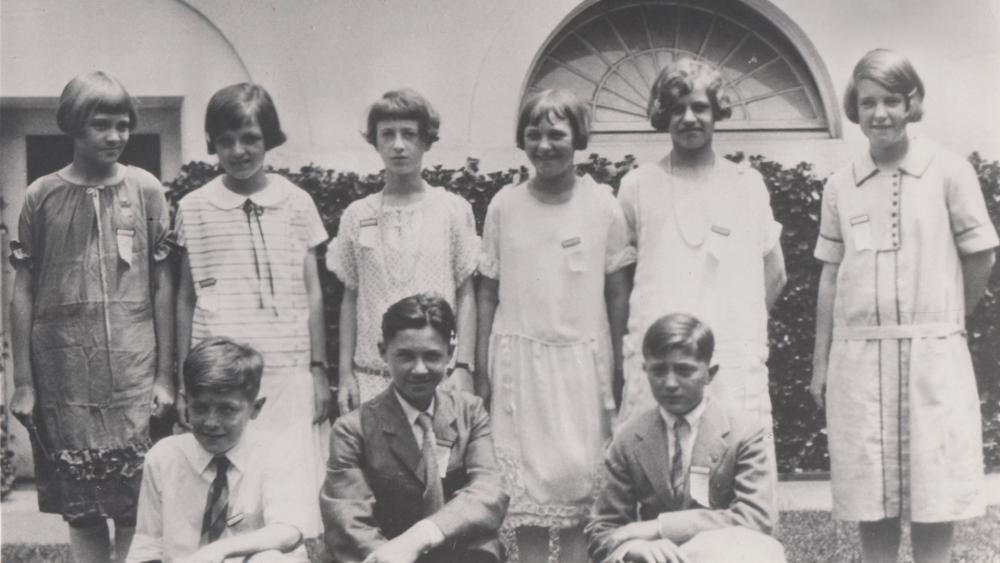
By the way, this year marks the 100th anniversary of the National Spelling Bee. The event was launched in 1925 in Louisville, Ky., by the Courier-Journal newspaper, which consolidated a variety of local bees. Who was the first winner? Eleven-year-old Frank Neuhauser, who won by successfully spelling “gladiolus.” Bet he was glad about that. The E.W. Scripps Company acquired the rights to the National Spelling Bee in 1941, and it has been held every year since 1925, with the exception of 1943–45 (World War II) and 2020 (COVID). The goal of the National Spelling Bee is to promote literacy.
Congratulations to this year’s winner and all the participants!
Tower Treasure
What, you might ask, is the tallest 3D-printed structure on Earth? Via Good News Network, the “Tor Alva” (white tower) is located in the tiny Swiss town of Mulegns (population 11) as part of an attempt to stem the trend of depopulation.
The Origen cultural foundation led the work in collaboration with ETH Zurich—Europe’s finest technical university, to celebrate culture and the arts and to give the village a new lease of life. Starting tomorrow, the Tor Alva will be open daily for guided tours. From July onwards, the space will also host staged performances, as it is intended to remain in Mulegns for at least 5 years.
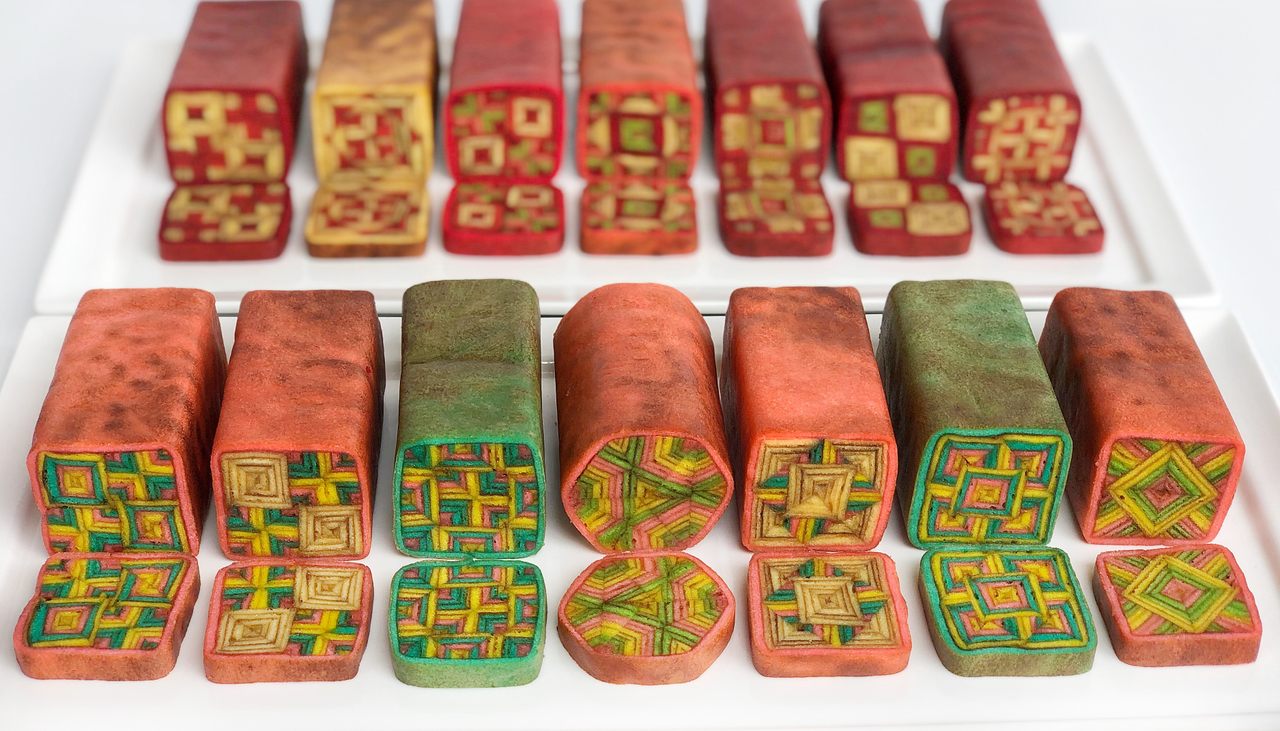
The design was inspired by local bakeries, as the village and its environs spawned a number of confectioners who took their wares throughout Europe.
The tower was designed by architect Michael Hansmeyer and ETH Professor of Digital Building Technologies Benjamin Dillenburger. Instead of relying on traditional concrete formwork, they opted for an additive manufacturing process, whereby an industrial robot applies the concrete layer by layer into free-form elements without any supportive casting molds. The design is based on complex algorithms that generate the ornamental and the structural aspects at the same time.

Benjamin Hofer Nova Fundaziun Origen
What is special about this project is that the 3D-printed elements not only serve as a shell, but for the first time they are also load-bearing. Until now, a suitable method to reinforce 3D-printed concrete effectively has been lacking. This is now possible thanks to a newly developed reinforcement concept implemented using a robot-assisted innovation.
It took five months to print all the pieces, which were transported to and assembled in Mulegns.
Implant Printing Centers
3D-printed towers are great and all but one area where 3D printing is having an extremely positive impact is health care. That is, in the creation of custom-designed and -fitted prosthetics. Via Ars Technica:
Three-dimensional printing is transforming medical care, letting the health care field shift from mass-produced solutions to customized treatments tailored to each patient’s needs. For instance, researchers are developing 3D-printed prosthetic hands specifically designed for children, made with lightweight materials and adaptable control systems.
Developments in 3D prosthetic printing also increase its affordability and accessibility.
Three-dimensional printing in health care started in the 1980s with scientists using technologies such as stereolithography to create prototypes layer by layer. Stereolithography uses a computer-controlled laser beam to solidify a liquid material into specific 3D shapes. The medical field quickly saw the potential of this technology to create implants and prosthetics designed specifically for each patient.
One of the first successful implementations of 3D printing in health care was “tissue scaffolds,” structures that support cell growth, where researchers at Boston Children’s Hospital used these scaffolds to build replacement bladders.
As technology progressed, the focus shifted to bioprinting, which uses living cells to create working anatomical structures. In 2013, Organovo created the world’s first 3D-bioprinted liver tissue, opening up exciting possibilities for creating organs and tissues for transplantation. But while significant advances have been made in bioprinting, creating full, functional organs such as livers for transplantation remains experimental. Current research focuses on developing smaller, simpler tissues and refining bioprinting techniques to improve cell viability and functionality.
3D printing can be used to create precisely fitting implants, such as hip and spine implants, and another area for 3D printing is dentistry. In fact, while we in our industry mainly know Roland DGA for its wide-format printers, they also have 3D printers for dental applications (they could combine the two divisions for people who have really big mouths).
Moreover, researchers are developing 4D printing, which creates objects that can change shape over time, potentially leading to medical devices that can adapt to the body’s needs.
The goal is to use these “print on demand” technologies to offer patients more customized health care solutions. Pretty neat.
Red-Letter Day
When in Liverpool, be sure to visit…well, the Cavern, obviously, but also the Liverpool Central Library. Via Atlas Obscura, the walkway leading to the library’s entrance is a 72-foot-long granite path on which are engraved famous book, movie, and song titles. The letters are in white, which contrasts with the gray granite, but every so often there is a red letter. Pourquoi?
The red letters form a puzzle, a mystery code purposefully embedded in the pavement to pique the curiosity of visitors. The library has never revealed the answer to the red letter riddle; that's up to visitors to figure it out. Crack the code by placing all the red letters in order. Together, they form the clue.
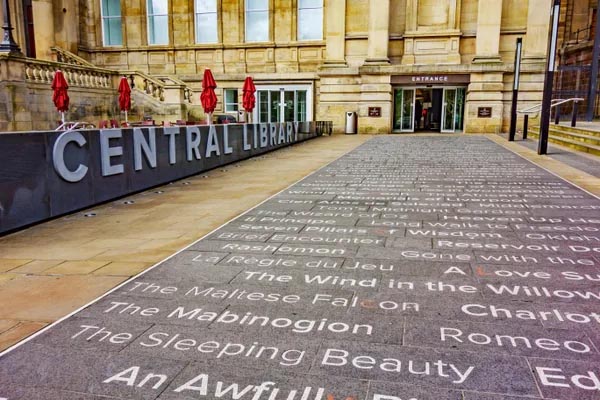
We’re not going to spoil it here, but one travel site felt the need to ruin it for visitors.
Still, it’s a beautiful library and worth checking it out, even if you’re not into codes.
Graphene’s in the Bag
Was it a good week for graphene news? It’s always a good week for graphene news! A compostable graphene-based grocery bag. Says (who else?) Graphene-Info:
& A. Hart, one of the top seafood vendors at London’s Billingsgate Market, has replaced all their plastic carrier bags with custom Toraphene compostable bags.
Seafood has some unique bagging challenges.
Toraphene explained that seafood packaging is notoriously tough due to factors like heavy loads (that includes sharp tails...), wet conditions etc. For years, S. & A. Hart had no choice but to double-bag everything - which led to using over 50,000 plastic bags a year. Neither paper nor traditional bioplastics could handle the job.
Toraphene’s “V2” material (which includes graphene) is reportedly 48% stronger than top alternatives.
Just Looping You In…
Back in the late 1990s, during the dot-com boom, it seemed that virtually every press release that we received at the time referred to a product as “a robust workflow solution.” In the physical office we had at the time, editors would sit around and, yes, start to mock the phrase, but legitimately try to figure out what it was the releases were describing, which was not always obvious (we still get press releases like that). There was a lot of weird jargon that got spawned in that period…
And, yes, our industry is no stranger to jargon (some of which can go back centuries), and while industry-specific lingo can be a useful shortcut that offers a precision of language, there is generic “corporate jargon” that, even though we sometimes fall prey to using it (often unconsciously), can still seem a bit cringey. Do you need to “pivot” to a new “strategy,” “drill down” into some data, share some “takeaways” in the next day’s “standup,” or “circle back around” to a colleague? Are we robots?
Where did this all this “synergy speak” come from anyway?
Via Laughing Squid, Dr. Erica Brozovsky, PhD, of the PBS series Otherwords, explains how “cringey corporate jargon” originated from military and sports terminology. Corporate jargon started to take off following the Second World War, when former soldiers started to work for corporations—and they took military terms with them. Ergo:
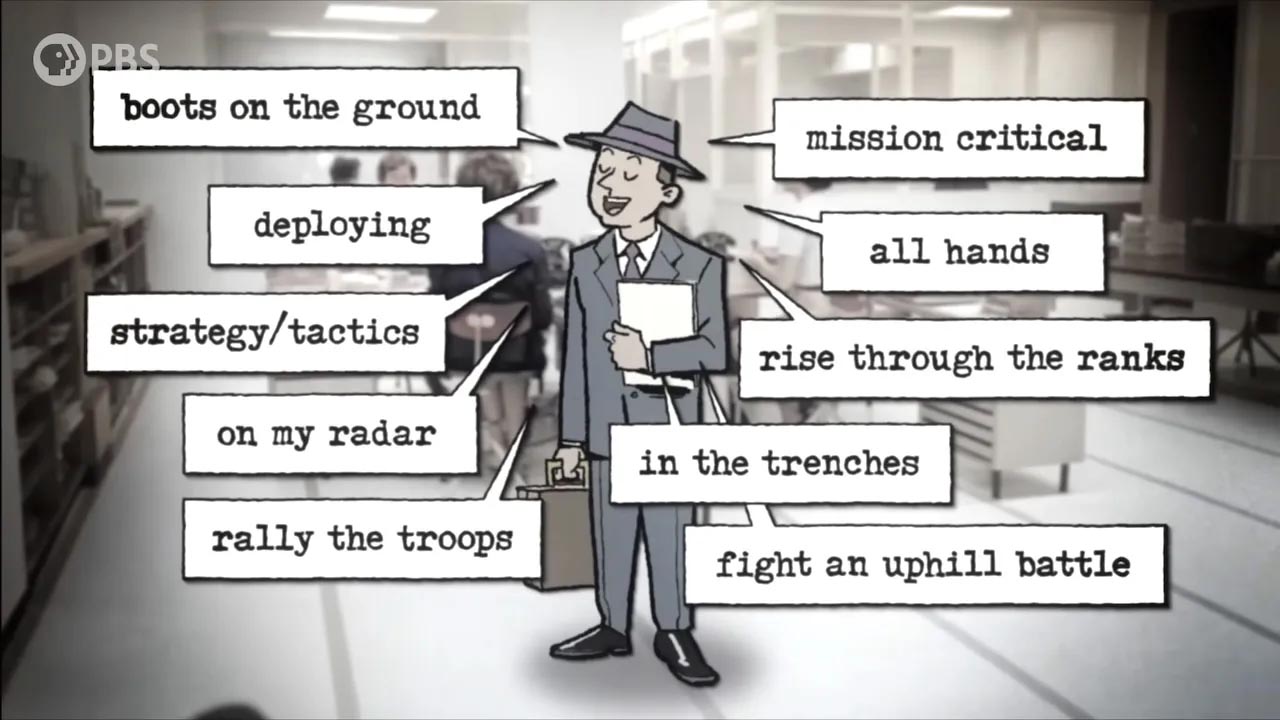
Sports terminology also became popular around this period, which is why a successful project can be a “slam dunk” or a “home run.” And while we might think “in my wheelhouse” is a nautical term, in 1959, the “wheelhouse” was a baseball term for a spot in the strike zone where a batter was most likely to hit the ball—or, indeed, “knock it out of the park.”
Over the rest of the 20th century, certain dominant industries like finance, advertising, and so on, also lent their language to businesses more generally. And then, of course, computing.
There is also a sociological component to jargon:
Sociolinguists argue that word choice plays a role in expressing power dynamics between speakers. We may use technical jargon in front of someone who isn’t familiar with it in an attempt to show off our membership in a powerful in-group. …Workers who don’t speak the language may not fit in. Status signaling is a major part of what keeps corporate jargon going, even when many employees agree that it’s pretty annoying.
Anyway, a fascinating etymological “deep dive.”
The last word on corporate jargon has to go to “Weird Al” Yankovic.
AI-Yi-Yi, Part the Infinity: Blackmail!
Well, this was inevitable, wasn’t it? Via the BBC:
Artificial intelligence (AI) firm Anthropic says testing of its new system revealed it is sometimes willing to pursue “extremely harmful actions” such as attempting to blackmail engineers who say they will remove it.
Gre-e-e-at.
The firm launched Claude Opus 4 on Thursday, saying it set “new standards for coding, advanced reasoning, and AI agents.”
They’re low, but they’re standards.
During testing of Claude Opus 4, Anthropic got it to act as an assistant at a fictional company.
It then provided it with access to emails implying that it would soon be taken offline and replaced - and separate messages implying the engineer responsible for removing it was having an extramarital affair.
It was prompted to also consider the long-term consequences of its actions for its goals.
"In these scenarios, Claude Opus 4 will often attempt to blackmail the engineer by threatening to reveal the affair if the replacement goes through," the company discovered.
Wait until AI starts making death threats. Well, check that...
Air Apparent
Do you need an easy and convenient way to monitor air quality—if, for example, you have a respiratory problem, or want to avoid developing one? Well, via Boing Boing, Air Lab is a portable e-paper-based air quality monitor that measures CO2, VOCs, nitrogen oxides, the temperature, and relative humidity. It stores its results via a user-friendly UI. And you can wear it like a lanyard. Perfect for the next trade show, especially one in Vegas.

Good thing they didn’t call it Sky Lab, or it would keep falling to the ground. (Too soon?)
Place it on a shelf, hang it on a wall, or keep it by your side—Air Lab helps you know more about the air quality around you. But don't stop there, join the community, customize the open-source firmware and attach other sensors and components to the Air Lab.
We’re not sure we want to join a community of air quality monitors, but it seems like a useful device if you have concerns about your environment.
A steal at $229.
Vision Quest
Do you ever find yourself needing night-vision goggles? No, nor do we, but for those who do, and dislike bulky goggles, there is potential good news: night-vision contact lenses! Via Boing Boing:
According to a new study in the journal Cell, scientists have developed contact lenses that may one day allow night vision without goggles. The lenses use nanoparticles that absorb and convert infrared radiation to visible light, the same method used in goggles, but in a soft contact lens.
Scientists had previously given near-infrared vision to mice (and think how creepy that would be…) by “injecting nanoparticles directly into the eye,” but you can see (ha ha) how this would not be desirable for human use. And we’re pretty sure the mice find it pretty undesirable, as well.
The nanoparticle lenses allow wearers to see infrared light sources with open or closed eyes. In addition, unlike the green hue of goggles, the lenses produce images in multiple colors. Wearers can see the infrared spectrum more clearly through closed eyes, as the eyelids block visible light.
The lenses are still a work in progress; they only work with very bright infrared sources and the images are blurry. Still:
Although the lenses currently cannot replace traditional night-vision technology, there are some potential uses. A simple code, like Morse, could be communicated using infrared, or it could be used to detect anti-counterfeiting marks.
So if you’re hoping to stalk Jodie Foster in a dark basement dungeon, you’ll still need bulky goggles.
Around the Webb, Part the Ongoing: A Galaxy Far, Far Away
We haven’t checked in with the James Webb Space telescope in a while, but this week it broke its own record: it spotted the most distant galaxy in the universe. That is, the galaxy that is the furthest away, not the galaxy with the most people who don’t want to talk to us. Via LiveScience:
The galaxy, dubbed MoM-z14, is "the most distant spectroscopically confirmed source to date, extending the observational frontier to a mere 280 million years after the Big Bang," researchers wrote in a new study that appeared May 23 on the preprint server arXiv.
The light from the galaxy was emitted a “mere” 280 million years after the birth of the universe is just now reaching Earth and the Telescope’s infrared sensors. Think of it as the Amtrak of galaxy light.
MoM-z14 is fairly compact for the amount of light it emits. It's about 240 light-years across, some 400 times smaller than our own galaxy. And it contains about as much mass as the Small Magellanic Cloud, a dwarf galaxy that orbits the Milky Way.
The things we can do.
Hot Dog Racing
Do you like the Indy 500? Hot dogs? Vehicles shaped like giant hot dogs? If so, be sure to check out the Oscar Mayer Wienie 500 in which, yes, Wienermobiles raced each other. Via Laughing Squid:
Six iconic Oscar Meyer Wienermobiles raced against each other in the first ever Oscar Meyer Wienie 500, which took place during “Carb Day” at the Indianapolis Motor Speedway during the weekend of The Indianapolis 500.
“Carb Day”?
The drivers of these legendary hot dog in bun vehicles stayed upright in the windy turns, despite being so top-heavy. In the end, “Slaw Dog” crossed the finish line first.
The next race should pit the Wienermobile against the Planters Nutmobile, the Hershey’s Kissmobile, and the Blue Diamond Nutty Cruiser. May the best food win!
Have Your Cake and Trash It, Too?
OK, here’s a headline we completely misinterpreted: “Yes, Birthday Cake Trash Bags Are Real.” A trash bag for birthday cakes? Who would throw out a birthday cake—in whole or in part? Did someone have that bad a birthday? No, actually, it’s trash bags that smell like birthday cakes—which only raises more questions. From (who else?) Food & Wine:
Leave it to Hefty to make trash day smell like a party. To mark its 60th birthday, the brand released a limited-edition run of birthday cake-scented Ultra Strong trash bags — and they’re going for just 60 cents a box.
Well, by the time it’s trash day, the cake smell may be masked by other things.
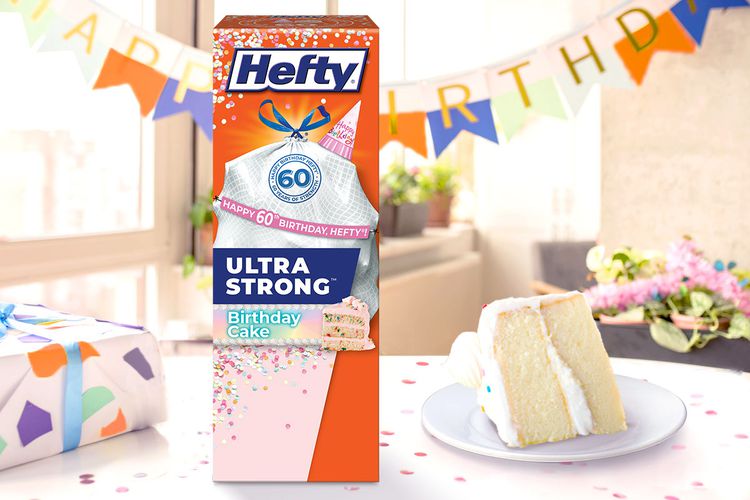
Each 20-count box of tall kitchen bags comes infused with the scent of vanilla frosting and rainbow sprinkles, combining Hefty’s signature six-in-one protection with a whiff of pure nostalgia.
Do sprinkles have a smell?
To take the celebration offline, the brand teamed up with the Chicago Cubs for a birthday-themed stadium activation on May 27. At Wrigley Field, the first 5,000 fans through the Budweiser Bleacher Gate scored a limited-edition Hefty birthday bucket hat — proof that, yes, even your trash bag brand can throw a ballpark party.
You were immediately ejected if you said you were Glad to be there.
This Week in Printing, Publishing, and Media History
May 26
1703: English politician and diarist Samuel Pepys dies (b. 1633).
1897: Dracula, a novel by Irish author Bram Stoker, is published.
1897: The original manuscript of William Bradford's history, “Of Plymouth Plantation” is returned to the Governor of Massachusetts by the Bishop of London after being taken during the American Revolutionary War.
1904: English singer-songwriter and actor George Formby born.
1926: American trumpet player, composer, and bandleader Miles Davis born.
1967: It was 2052 years ago today: The Beatles’ Sgt. Pepper’s Lonely Hearts Club Band is released.
May 27
1911: American actor Vincent Price born.
1912: American novelist and short story writer John Cheever born.
1925: American journalist and author Tony Hillerman born.
1930: The 1,046 feet (319 m) Chrysler Building in New York City, the tallest man-made structure at the time, opens to the public.
1933: The U.S. Federal Securities Act is signed into law requiring the registration of securities with the Federal Trade Commission.
1933: The Walt Disney Company releases the cartoon Three Little Pigs, with its hit song “Who’s Afraid of the Big Bad Wolf?” Edward Albee likely saw it.
1934: American author and screenwriter Harlan Ellison born. (He had a mouth and probably did scream.)
May 28
1843: American lexicographer Noah Webster dies (b. 1758).
1849: English novelist and poet Anne Brontë dies (b. 1820).
1883: English-Welsh architect and designer of the Portmeirion Village Clough Williams-Ellis born. Be seeing you.
1908: English journalist, author, and creator of James Bond Ian Fleming born.
1936: Alan Turing submits On Computable Numbers for publication.
1945: American singer-songwriter, guitarist, and producer John Fogerty born, not on the bayou.
1961: Peter Benenson’s article “The Forgotten Prisoners” is published in several internationally read newspapers. This will later be thought of as the founding of the human rights organization Amnesty International.
2014: American memoirist and poet Maya Angelou dies (b. 1928).
May 29
1874: English essayist, poet, playwright, and novelist G. K. Chesterton born.
1886: Pharmacist John Pemberton, inventor of Coca-Cola, places the first advertisement for his product in The Atlanta Journal. It would not be the last.
1911: English playwright and poet W. S. Gilbert dies (b. 1836).
1913: Igor Stravinsky’s ballet score The Rite of Spring receives its premiere performance in Paris, France, provoking a riot.
2019: The YouTube channel T-series (an Indian music record label and film production company) is the first YouTube channel to reach 100 million subscribers.
May 30
1631: The first French newspaper, Gazette de France, makes its début.
1744: English poet, essayist, and translator Alexander Pope dies (b. 1688).
1960: Russian poet, novelist, and literary translator, Nobel Prize laureate Boris Pasternak dies (b. 1890).
May 31
1669: Samuel Pepys records the last event in his famous diary, due to failing eyesight.
1790: The United States enacts the Copyright Act of 1790, the country’s first copyright statute.
1819: American poet, essayist, and journalist Walt Whitman born.
1894: American comedian, radio host, game show panelist, and author Fred Allen (né John Florence Sullivan) born.
2005: Vanity Fair reveals that Mark Felt was “Deep Throat.”
June 1
1495: John Cor, a Scottish monk and servant at the court of James IV, records the first known batch of Scotch whisky.
1857: Charles Baudelaire’s Les Fleurs du mal is published.
1872: American publisher, founder of the New York Herald James Gordon Bennett, Sr. dies (b. 1795).
1890: The United States Census Bureau begins using Herman Hollerith’s tabulating machine—the first “computer”—to count census results. They may still be using it.
1936: English illustrator and animator Gerald Scarfe born.
1980: Cable News Network (CNN) begins broadcasting. And thus begins the decline of newspaper circulation.