Font for Thought
Here’s an interesting design term: “hamburgerfont.” The first thing that comes to mind is a tipped over capital H, which would have the middle bar sandwiched between two “buns.” Are we overthinking this? As it turns out, yes. Via Print magazine:
Designers often use ‘Hamburgervons’ to assess the appearance and function of typefaces.
Do they? Anyway, Contrast Foundry (aka CoFo) came up with the idea of the “Hamburgerfont” for a new specimen book as a fun way to demonstrate font pairings.
Based on layering ingredients as you would when assembling the project’s namesake, proteins become display type, veggies form the body, and condiments add a little something on top as supporting type. The concept, designed by TOOOT’s Johnny Gage, Camilla Gwise, and Giorgia Sage, isn’t simply about imagining your perfect burger, in theory; the piece is interactive, like an old-school children’s mix-and-match book.
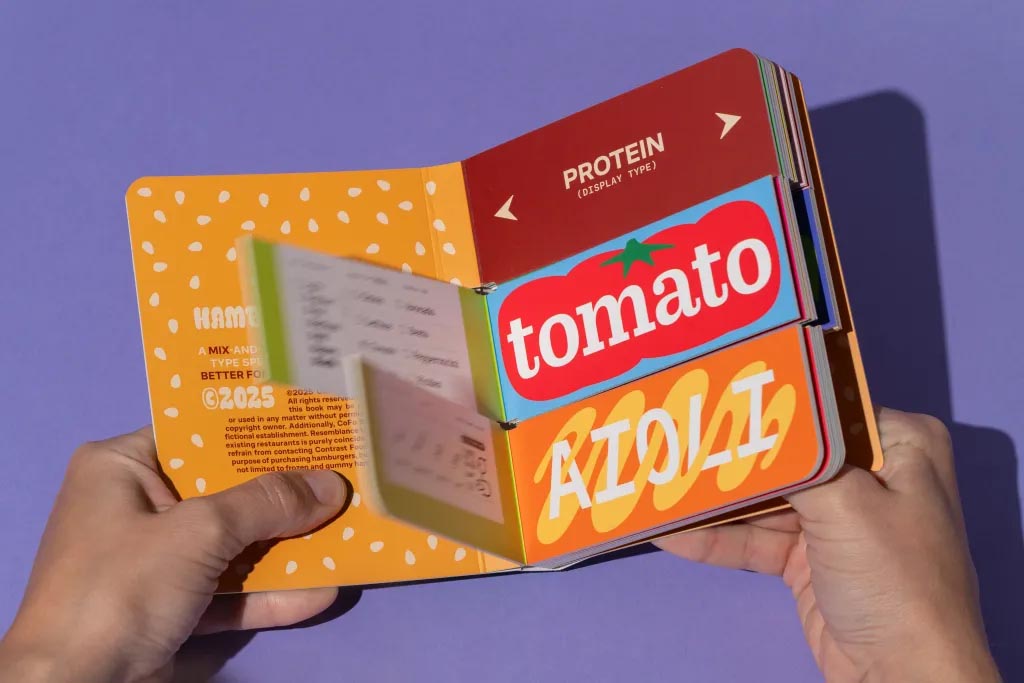
Love the organic repetition of CoFo FlicFlac? CoFo Sans Black might be an ideal counterpoint. Add a grid-like element with CoFo Sans Pixel, or a variable industrial quality with CoFo Peshka. With CoFo’s 19 typefaces (and counting), you can customize the pairings to your heart’s delight.
Sort of like an infinite salad bar, if we can mix our metaphors.
Cooking (up) the Books
Now, come on. Really? From Ars Technica: “Chicago Sun-Times prints summer reading list full of fake books.” Three guesses how this happened.
On Sunday, the Chicago Sun-Times published an advertorial summer reading list containing at least 10 fake books attributed to real authors, according to multiple reports on social media. The newspaper's uncredited “Summer reading list for 2025” supplement recommended titles including “Tidewater Dreams” by Isabel Allende and “The Last Algorithm” by Andy Weir—books that don't exist and were created out of thin air by an AI system.
Sigh.
The creator of the list, Marco Buscaglia, confirmed to 404 Media that he used AI to generate the content. “I do use AI for background at times but always check out the material first. This time, I did not and I can't believe I missed it because it's so obvious. No excuses,” Buscaglia said. “On me 100 percent and I'm completely embarrassed.”
Guess the only solution is to have AI actually write those books, although Isabel Allende, Andy Weir, et al. might be a little miffed.
The Basement Types
Unless you’re Frank, the chances of finding something like this in your basement are pretty slim. From the Good News Network: “The Sole Prototype of the First Chinese Typewriter Was Discovered in a New York Basement.” New Yorker Jennifer Felix and her husband apparently found a mysterious typewriter in their basement, and posted its discovery on social media. “Is it even worth anything? It weighs a ton!” Felix’s husband wrote along with pictures of it. Actually, as it turned out, yes.
one of the commenters pointed the couple to a book by Stanford history professor Thomas Mullaney called The Chinese Typewriter: A History. Inside, a whole chapter was dedicated to the [Ming Kwai] which Stanford University Press wrote is typically just called by the first two characters which mean “bright” and “fast”—Ming Kwai.
The Ming Kwai was the first Chinese typewriter ever to include a keyboard. It was invented by Chinese-born author, translator, and cultural commentator Lin Yutang in the 1940s.
It was no small feat to create a Chinese typewriter as the language contains around 80,000 written characters—even Rick Wakeman never had a keyboard that big. What Lin did was create the 1940s equivalent of a digital database: a mechanical hard drive.
“The depression of keys did not result in the inscription of corresponding symbols, according to the classic what-you-type-is-what-you-get convention, but instead served as steps in the process of finding one’s desired Chinese characters from within the machine’s mechanical hard drive, and then inscribing them on the page,” Mullaney wrote in his book.
So the Ming Kwai’s keys are a mixture of characters and other elements found in a variety of different Chinese words.
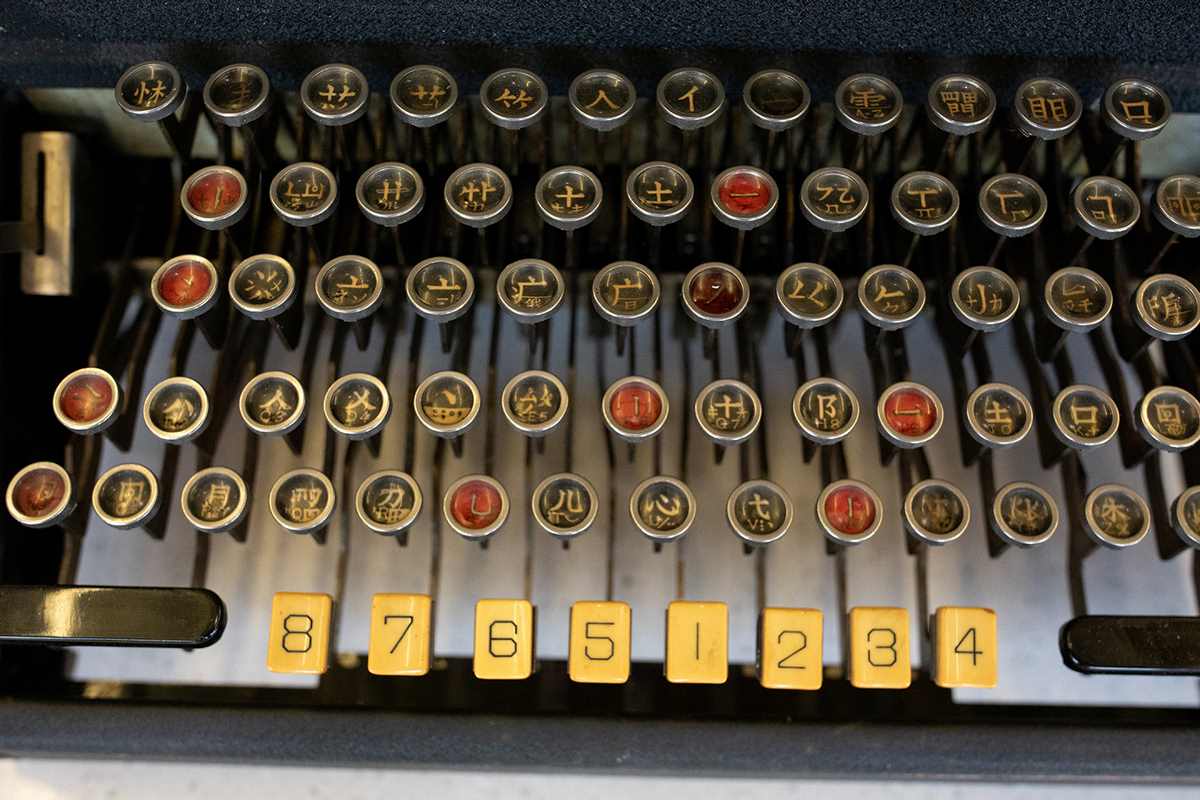
For example, in the center of the bottom row, the left-most keys between the two red ones are “er” and “xin,” both of which are characters themselves, but also can be component to larger, more complex characters. Xin, for example, means “heart” but when placed below “ni” forms the character “nin” which is a formal way to address someone.
However, it never got beyond the prototype stage.
“In 1947, the Carl E. Krum Company built what is believed to be the sole prototype of Lin’s invention,” Stanford press wrote. “A year later, in debt and unable to generate interest in mass producing his machine, Lin sold the prototype and the commercial rights to the Mergenthaler Linotype Company, where Felix’s grandfather worked as a machinist.”
And somehow it ended up in the Felixes basement. But there’s a happy ending.
With the help of a foundation established by two Americans of East Asian heritage, Stanford University was able to acquire the Ming Kwai and pay for its maintenance, but Mrs. Felix felt that Stanford were the most suitable custodians of the machine, since it was Mullaney’s book that helped clue her in on what it was she and her husband found in their basement.
Paperback Righter
Think about this: a new book format hits the market and completely upends the publishing industry. We’re talking about ebooks, right? Nope—actually, we’re referring to paperback books. Via Mental Floss, flash back to 1939. The country is still in the grip of the Great Depression. Gas costs 10¢ a gallon, a movie ticket 20¢. But a book? If you wanted a hardcover book—all there were at the time—the cover price of John Steinbeck’s The Grapes of Wrath, the year’s bestselling book, was $2.75.
Enter Robert de Graff. Starting out in 1922 as a salesman for book publisher Doubleday, Page and Company and by 1925, he had become president of its subsidiary Garden City Publishing Company. As a result, he knew intimately the economics of books.
He knew that printing costs were high because volumes were low—an average hardcover print run of 10,000 might cost 40 cents per copy. With only 500 bookstores in the U.S., most located in major cities, low demand was baked into the equation.
So in 1939, he hit upon an idea that would help boost book sales and change the economics of book publishing: the paperback. Now, granted, it was not an entirely new idea, at least overseas.
[In the UK], four years prior, Penguin Books founder Allen Lane had started publishing popular titles with paper bindings and distributed them in train stations and department stores. In his first year of operation, Lane sold more than 3 million “mass-market” paperbacks.
De Graff seized on this idea and, with financial support from Simon & Schuster, founded Pocket Books.
Starting with a test run of 10 titles, which included classics as well as modern hits, de Graff planned to unleash tote-able paperbacks on the American market. But it wasn’t just the softcover format that was revolutionary: De Graff was pricing his Pocket Books at a mere 25 cents.
As any printer can tell you, the print run length is the key.
De Graff knew that if he could print 100,000 paperbound books, production costs would plummet to 10 cents per copy. But it would be impossible for Pocket Books to turn a profit if it couldn’t reach hundreds of thousands of readers.
And there he ran into a distribution problem. If he had rely solely on bookstores—remember, there were only 500 in the country at the time—the plan would never work. So he found an additional way to distribute Pocket Books:
Using magazine distributors to place Pocket Books in newsstands, subway stations, drugstores, and other outlets to reach the underserved suburban and rural populace. But if Pocket Books were going to sell, they couldn’t just stick to the highbrow. De Graff avoided the stately, color-coded covers of European paperbacks, which lacked graphics other than the publishers’ logos, and splashed colorful, eye-catching drawings on his books.
The publishing literati scoffed, but it took only a week for Pocket Books to sell out its initial 100,000 copy run. Even so, hardcover publishers still scoffed, but they were happy enough to sell paperback reprint rights to hardcover titles for 1¢ royalty per copy, which it split 50-50 with the author. Pocket books also made about 1¢ in profit on every copy sold. That doesn’t sound like much, but when you’re selling hundreds of thousands of copies, it adds up.
Since de Graff offered refunds for unsold copies, carrying the books was a no-brainer. In 1939, de Graff told Publishers Weekly that he’d been deluged with requests from “out-of-town dealers.” And from the get-go Americans devoured every 25-cent paperback de Graff could feed them. By the time Pocket Books sold its 100 millionth copy in September 1944, its books could be found in more than 70,000 outlets across the U.S. They might not have had the glamour and sophistication of hardcovers, but paperbacks were making serious money.
And, not surprisingly, other publishers decided to jump into the game and the “paperback gold rush” was underway, with new paperback houses like Popular Library, Dell, Fawcett Publications, and Avon Pocket Size Books sprouting up.
Read the whole thing to see how the market ultimately developed and helped spawn the “trade paperback,” as distinct from the “mass market paperback.”
Semicolonoscopy
We confess: we are very fond of semicolons. They’re almost always used incorrectly (i.e., they are not interchangeable with commas), but in certain circumstances, they’re perfectly fine. As the OED defines it, a semicolon is “a punctuation mark indicating a pause, typically between two main clauses, that is more pronounced than that indicated by a comma.” It must just be us, however, because, via The Guardian, semicolon use is declining dramatically.
the semicolon seems to be in terminal decline, with its usage in English books plummeting by almost half in two decades – from one appearing in every 205 words in 2000 to one use in every 390 words today.
Interestingly, the semicolon first appeared in the work of Italian scholar and printer Aldus Manutius in 1494.
[T]he form of punctuation also has its staunch supporters: along with Charles Dickens, Mark Twain and Jane Austen, Abraham Lincoln stood strong on the issue. “I have a great respect for the semicolon; it’s a very useful little chap,” he said.
And of course if you’re not afraid of Virginia Woolf, she perhaps overdosed on semicolons; in Mrs Dallowayalone she used more than 1,000 of them. However, there is no truth to the rumor that she died when she walked into a river with her pockets filled with semicolons. (Too soon?)
Driven Mad
Now, granted, we are more likely to find ourselves in possession of an actual jaguar than the Jaguar automobile, but we were bemused to read about a botched rebrand, which went so badly that they fired their ad agency. From The Truth About Cars:
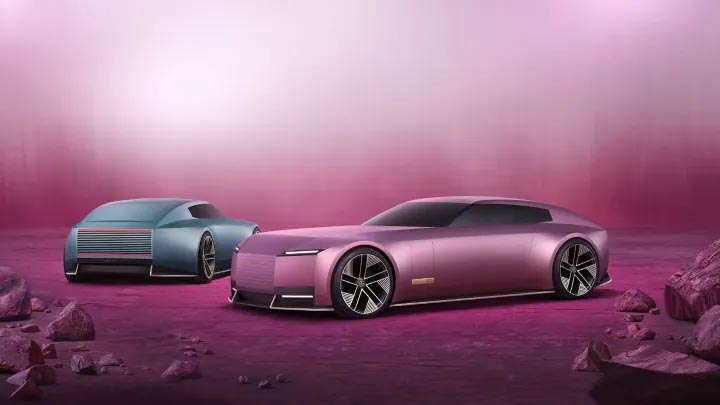
Jag took heat from every corner of the media and car enthusiast worlds over its change, which saw it shift to electric vehicles and abandon any sense of traditional auto design. The vehicles it showed were comically overdone and painted in Easter Egg pastel colors, leading many to note that the automaker had left its core audience behind.
Bleh.
As for the rebrand, it’s unclear where Jaguar goes from here. It’s stopped almost all vehicle production activities as it targets a shift to an all-electric lineup, but the company has already invested in the new designs, creating concept cars and other ads to go with the reveal.
Kudos to Jaguar for going electric, but surely by this time they know how to design a decent-looking car.
Adds Boing Boing:
Storied British automaker Jaguar recently rebranded itself with a new logo featuring the letters of its name in a rounded and mixed-case typeface, a lurid color scheme, and gibberish vibe slogans such as "create exuberant." More suggestive of fashion or sexual wellness branding than fast cars, the campaign was a dud.
Yeah, that logo…
Deep Tissue Message
Sure, some of us count on our fingers, but did you know that human tissue in general can be used for computing? Say what? Via Popular Science, a new study published in the journal IEEE Access (we rather like pronouncing “IEEE!!!” at the top of our lungs) investigates the possibility of living tissues developing computational abilities. He starts with a framework called “reservoir computing.”
The idea is that data can be fed into complex “reservoirs” capable of encoding rich patterns. By analyzing human tissue, Yo Kobayashi—the lone author on the paper—discovered that the soft biological structures possessed many of the properties that would make them particularly adept at this type of computing.
How?
Kobayashi’s technique involved gathering biomechanical data by asking participants in the study to bend their wrists at various angles. Then, Kobayashi took various ultrasound images to capture all of the miniscule muscle deformations in the wrist, which allowed him to construct a “biophysical reservoir” for data processing.
OK, we’re getting a little deep in the weeds here.
“An ideal reservoir possesses both complexity and memory,” explains Kobayashi. “Since the mechanical responses of soft tissue inherently demonstrate stress—strain nonlinearity and viscoelasticity, muscular tissue easily satisfies these criteria.”
“Viscoelastic” means that the “reservoir” is both viscous like a liquid and elastic, so it can physically remember its past deformations.
Kobayashi benchmarked his breakthrough by testing the human tissue using complicated nonlinear equations, and the model using the biophysical reservoir turned out to be more accurate than a model that used standard linear regression. If this type of computing can be improved, it could a big deal for a variety of technologies.
Like wearables.
“In the future, it may be possible to use our own tissue as a convenient computational resource. Since soft tissue is present throughout the body, a wearable device could delegate calculations to the tissue, enhancing performance.”
So would that make the wearer technically a cyborg?
Graphene Is Up on Current Events
Was it a good week for graphene news? It’s always a good week for graphene news! Graphene-enhanced zinc-ion batteries are a safe, scalable, and high-performance energy storage solution. Says (who else?) Graphene-Info:
Zinc-ion batteries based on water-based electrolytes are inherently safe, environmentally friendly, and economically viable. They also mitigate fire risks and thermal runaway issues associated with their lithium-based counterparts, which makes them lucrative for grid-scale energy storage. Furthermore, zinc has high capacity, low cost, ample abundance, and low toxicity. Unfortunately, current collectors utilized in zinc-ion batteries, such as graphite foil, are difficult to scale up and suffer from relatively poor mechanical properties, limiting their industrial use.
You know where this is going…
In a new study, a team of researchers from the Republic of Korea, led by Associate Professor Geon-Hyoung An at the Department of Energy and Materials Engineering at Dongguk University, has proposed graphene-coated stainless steel foil as a novel alternative current collector.
This material avoids the corrosion and poor conductivity that tend to occur in water-based systems.
“This technology is highly suitable for grid-scale energy storage systems, especially in the context of renewable energy integration. By enabling the use of water-based zinc-ion batteries, our approach provides a non-flammable, cost-effective, and environmentally friendly alternative to traditional lithium-ion systems,” said Prof. An.
You go, graphene!
Long Distance Voyager
On September 5, 1977, NASA launched Voyager 1, a space probe designed to explore the furthest reaches of the Solar System. It did some ground-breaking flybys of Jupiter, Saturn, and Saturn’s largest moon, Titan. On August 25, 2012, it crossed the heliopause and entered interstellar space. And nearly 50 years after it launched, it’s still going—and we still hear from it. Via Gizmodo, NASA engineers managed to bring the spacecraft’s old thrusters back to life after being inoperable for decades.
NASA’s engineers revived a set of thrusters on board the Voyager 1 spacecraft to use as backup while the mission goes offline for ongoing upgrades to a radio antenna used to communicate with deep space missions, the space agency revealed this week. Voyager’s primary roll thrusters had stopped working in 2004 after losing power in two small internal heaters, but the team managed to restart the thrusters while the spacecraft cruises through interstellar space at a distance of 15.14 billion miles away (24.4 billion kilometers).
There was actually a deadline on fixing the thrusters.
The engineers behind the mission needed to get it done before May 4 when a 230-foot-wide (70-meter-wide) antenna in Canberra, Australia—part of NASA’s Deep Space Network—would begin undergoing upgrades. The pause in communication will last until February 2026, with brief periods of operation in August and December. This particular radio antenna is the only dish with enough signal power to send commands to the Voyagers.
Can Voyager 1 (and its sister probe, Voyager 2, which is also still trucking along through space) last forever? Alas, no.
The Voyagers are powered by heat from decaying plutonium, which is converted into electricity. Each year, the aging spacecraft lose about 4 watts of power. In an effort to conserve power, the mission team has turned off any systems that were deemed unnecessary, including a few science instruments. With the current energy-conserving plan, NASA engineers believe the twin spacecraft could continue operating into the 2030s, just making it past their golden anniversary in space.
And contrary to popular belief, it was neither of these two Voyagers that will be intercepted by a race of alien machines, reprogrammed, and sent back to Earth as V’Ger.
By a Dam Site
We have no other reason to link to this article other than we can’t resist repeating the phrase “salmon cannon.” Via Boing Boing:
The salmon cannon is an ingenious device that routes salmon around dams that would otherwise prevent them from reaching their spawning grounds. It's really just a tube, but cannon sounds so much better. The device's actual name is "passage portal," but even Whooshh, the manufacturer, calls it a salmon cannon in their promotional video.
Almost as good is the official, technical term “fish passage system”
Originally, the salmon had to be placed in the cannon by hand, which is not fun for either human or fish. They upgraded the salmon cannon/fish passage system so the fish can swim into it on their own. And it’s actually a more sophisticated system than it sounds:
Multiple high-definition photographs are taken of each fish, identifying its species, whether it is native or from a hatchery, and if it is injured. The system will also identify invasive species, allowing them to be returned to where they came from or removed.
Looks kind of like a salmon thrill ride.
Food Check
Fortunately (or maybe unfortunately), save for these Around-the-Web items, we at WhatTheyThink don’t usually need to write the names of foods. While keeping equipment and software vendors and equipment models typo-free is work enough, we’re happy we have never needed to use “bourguignon” or “focaccia” regularly. (Unless we learn next week that some manufacturer’s new wide-format printer line is the Bourguignon 850UV—we’d have a real beef with that.)
Anyway, we sympathized with Food & Wine contributor Kat Kinsman this week, who asks, “What Food Words Do You Always Have to Spell-Check?”
there are certain food words that I'm going to have to look up no matter how many times I type them, and that bugs me — or it did until very recently.
…Consequently, I am also far too smug when I am able to type "fettuccine," "Worcestershire," "hors d'oeuvres," and "focaccia" without Google Docs adding a squiggly red, "You mucked this up," line under them. Granted, there's one under the word "phyllophorous," but that's only because, shockingly enough, it's not common enough to be in the Google Docs dictionary. I'm adding it to my personal dictionary right now, and if you care, the word means producing leaves, or leaf-bearing.
Every writer and editor has their spelling bugaboos.
"'Hors d'ourves' is one I always screw up including here," our editor in chief Hunter Lewis admitted on a Slack thread, before adding that that "muffaletta" was a constant trip-up. (In his defense, there are multiple spellings of the latter considered to be valid, and several colleagues responded with a "same" emoji on the former.) Associate editorial director Chandra Ram quickly shaved "prosciutto" onto the pile, while senior drinks editor Prairie Rose chokes on Daiquiri, Curaçao, Caipirinha, Sbagliato, and Boulevardier.
With us, it’s not always “how do I spell that?” it’s “what letters get capitalized?” because we hear about it!
Social Norm
George Wendt, who played Norm on Cheers, sadly passed away this week. Norm was a perhaps underused character throughout the show’s run, but a running gag throughout the series was his entrance, the crowd shouting “Norm!”, and a never-unfunny quip. Aia Laughing Squid, Peacock put together a nostalgic compilation featuring every single Norm Peterson entrance. Let’s raise a beer to an iconic TV character.
This Week in Printing, Publishing, and Media History
May 19
1743: Jean-Pierre Christin developed the centigrade temperature scale.
1864: American novelist and short story writer Nathaniel Hawthorne dies (b. 1804).
1941: American director, producer, and screenwriter Nora Ephron born.
1963: The New York Post Sunday Magazine publishes Martin Luther King Jr.’s Letter from Birmingham Jail.
May 20
1570: Cartographer Abraham Ortelius issues Theatrum Orbis Terrarum, the first modern atlas.
1609: Shakespeare’s sonnets are first published in London, perhaps illicitly, by the publisher Thomas Thorpe.
1660: English-American printer William Bradford born.
1799: French novelist and playwright Honoré de Balzac born.
1806: English economist, civil servant, and philosopher John Stuart Mill born.
1851: German-American inventor, and inventor of the Gramophone record, Emile Berliner born.
1873: Levi Strauss and Jacob Davis receive a U.S. patent for blue jeans with copper rivets.
1891: The first public display of Thomas Edison’s prototype kinetoscope.
1908: American actor James Stewart born.
1983: First publications of the discovery of the HIV virus that causes AIDS in the journal Science by Luc Montagnier.
1985: Radio Martí, part of the Voice of America service, begins broadcasting to Cuba.
2019: The International System of Units (SI): The base units are redefined, making the international prototype of the kilogram obsolete.
May 21
1471: German painter, engraver, and mathematician Albrecht Dürer born.
1688: English poet, essayist, and translator Alexander Pope born.
1703: Daniel Defoe is imprisoned on charges of seditious libel.
1927: Charles Lindbergh touches down at Le Bourget Field in Paris, completing the world's first solo nonstop flight across the Atlantic Ocean.
1932: Bad weather forces Amelia Earhart to land in a pasture in Derry, Northern Ireland, and she thereby becomes the first woman to fly solo across the Atlantic Ocean.
1981: Transamerica Corporation agrees to sell United Artists to Metro-Goldwyn-Mayer for $380 million after the box office failure of the 1980 film Heaven's Gate.
1992: After 30 seasons Johnny Carson hosted his penultimate episode and last featuring guests (Robin Williams and Bette Midler) of The Tonight Show.
May 22
1783: English physicist and inventor (the electromagnet and electric motor) William Sturgeon born.
1804: The Lewis and Clark Expedition officially begins as the Corps of Discovery departs from St. Charles, Mo.
1813: German composer Richard Wagner born.
1859: British writer Arthur Conan Doyle born.
1885: French novelist, poet, and playwright Victor Hugo dies (b. 1802).
1900: The Associated Press is formed in New York City as a non-profit news cooperative.
1906: The Wright brothers are granted U.S. patent number 821,393 for their “Flying-Machine.”
1907: English actor, director, and producer Laurence Olivier born.
1927: American novelist, short story writer, editor, and co-founder of The Paris Review Peter Matthiessen born.
1967: American poet, social activist, novelist, and playwright Langston Hughes dies (b. 1902).
2010: American mathematician, cryptographer, and author Martin Gardner dies (b. 1914).
May 23
1752: English-American printer William Bradford dies (b. 1660).
1829: Accordion patent granted to Cyrill Demian in Vienna, Austrian Empire.
1906: Norwegian director, playwright, and poet Henrik Ibsen dies (b. 1828).
1911: The New York Public Library is dedicated.
1934: Electronic engineer and inventor of the Moog synthesizer Robert Moog born.
1995: The first version of the Java programming language is released.
May 24
1595: Nomenclator of Leiden University Library appears, the first printed catalog of an institutional library.
1683: The Ashmolean Museum in Oxford, England, opens as the world’s first university museum.
1686: Polish-German physicist, engineer, and developer of the Fahrenheit scale Daniel Gabriel Fahrenheit born.
1830: “Mary Had a Little Lamb” by Sarah Josepha Hale is published.
1844: Samuel Morse sends the message “What hath God wrought” (a biblical quotation, Numbers 23:23) from a committee room in the United States Capitol to his assistant, Alfred Vail, in Baltimore, Md,, to inaugurate a commercial telegraph line between Baltimore and Washington D.C.
1895: American publisher and founder of Advance Publications Samuel Irving Newhouse Sr. born.
1941: American singer-songwriter, guitarist, artist, writer, producer, and Nobel Prize laureate Bob Dylan born.
1956: The first Eurovision Song Contest is held in Lugano, Switzerland.
1958: United Press International is formed through a merger of the United Press and the International News Service.
1963: American novelist, short story writer, and screenwriter Michael Chabon born.
May 25
1803: English author, poet, playwright, and politician, Secretary of State for the Colonies Edward Bulwer-Lytton born.
1803: American poet and philosopher Ralph Waldo Emerson born.
1878: Gilbert and Sullivan’s comic opera H.M.S. Pinafore opens at the Opera Comique in London.
1895: Playwright, poet, novelist and aesthete Oscar Wilde is convicted of “committing acts of gross indecency with other male persons” and sentenced to serve two years in prison.
1898: American publisher, television game show panelist, and co-founder of Random House Bennett Cerf born.
1927: American soldier and author Robert Ludlum born.
1938: American short story writer and poet Raymond Carver born.
1953: The first public television station in the United States officially begins broadcasting as KUHT from the campus of the University of Houston.
1958: English singer, songwriter and musician Paul Weller born.
1977: May the 25th be with you: Star Wars is released in theaters.
2019: Towel Day 2019, annual celebration of the life and work of Douglas Adams and The Hitchhiker's Guide to the Galaxy.