Sealed Shut
Here’s a unique bookbinding material you’re probably not likely to find in modern finishing workflows: sealskin. Via Live Science, researchers recently analyzed a bunch of 12th- and 13th-century books found in European monasteries and discovered that they were bound in sealskins, obtained from Norse traders from as far away as Greenland.
In the study, published Wednesday (April 9) in the journal Royal Society Open Science, a team of researchers subjected 32 medieval books to biocodicological analyses — a series of methods aimed at revealing biological information preserved in codex-style books.
This was of course before printing.
Medieval codices were written on pieces of parchment made of animal skin, that were bound together with wood, leather, cord or thread. Some also had a second protective cover, called a chemise, which was often made from boar or deer skin.
Or, in these cases, seal skin.
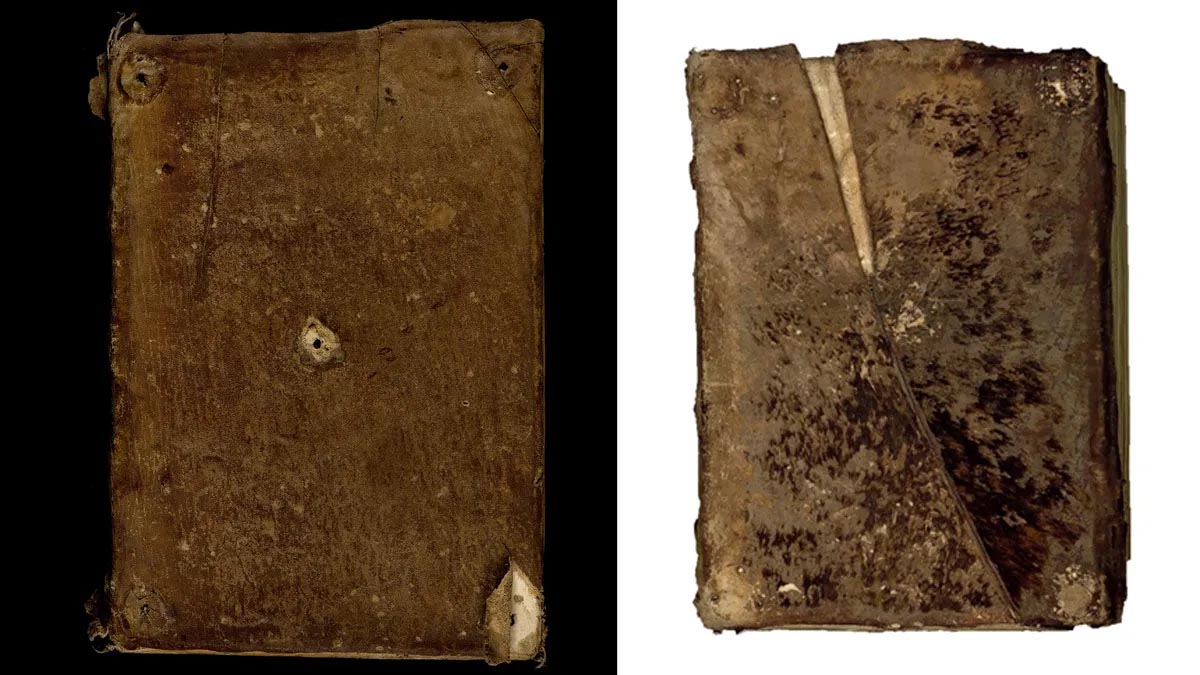
All of the sealskin books were made in abbeys located along known 13th-century European trading routes, the researchers noted in their study; these were also Norse trading routes. In particular, the Norse traded walrus ivory and furs from Greenlandto mainland Europe, and historical records suggest they used sealskins to pay tithes to the Catholic church in the 13th century.
No word on whether they did any experiments to see if you could balance a beach ball on the edge of the book.
Chime In
The Library of Congress’ National Recording Registry is a list of sound recordings that “are culturally, historically, or aesthetically significant, and inform or reflect life in the United States.” The latest additions to the Registry have been announced. Writes CBS News:
Elton John’s “Goodbye Yellow Brick Road,” Celine Dion’s “My Heart Will Go On,” Amy Winehouse’s “Back to Black,” albums by Miles Davis and Steve Miller Band, and Lin-Manuel Miranda’s revolutionary musical “Hamilton” are just some of the latest recordings to be added to the Library of Congress’ National Recording Registry, to be preserved for future generations.
Other inductees include Helen Reddy’s “I Am Woman,” the debut album from Chicago, singer-songwriter Tracy Chapman’s debut album, music from the game Minecraft (OK…), and Don Rickles’ comedy album, “Hello Dummy!” (why, you hockey puck!). The oldest entry this year is the Hawaiian Quintette's recording of “Aloha ’Oe,” which dates from 1913.
Probably the weirdest entry is Brian Eno’s “chime”—the sound heard when booting up Windows 95. Remember it?
Station-ary Printing
3D printing has been used for some interesting and amazing things, but here’s one that caught our eye: a 3D-printed train station. Says Futurism:
the West Japan Railway Company (JR West) just announced the completion of a 3D-printed train station, which it says is a world first. Plans to replace a crumbling wooden station in Wakayama Prefecture were first announced on March 11, 2025, and the printed building was more or less put together by March 26th in the span of just under three hours.

OK, not exactly Grand Central Station, but still…
The station was printed/built by Serendix, a specialist in 3D-printed homes. They delivered the station in four parts by rail (logically), which were then assembled into the final structure. Although the station is only 10 square meters, the construction time is “more than half the previous estimate of six hours.”
The construction method reportedly cut down on cost as well, according to The Japan Times, coming in at half the price of reinforced concrete. The company boasts that it should likewise be able to withstand the region's devastating earthquakes.
The station goes online in July, and train service allows people in the coastal city of Arida will to travel to the uninhabited island of Jinoshima, which is a popular summer vacation spot.
Grandpakemon
Does collecting baseball cards seem really old school to you? Are you too old for Pokémon? Well, if you live in one Japanese town, you can collect trading cards of grandpas. Say what? Via Boing Boing:
The “Ojisan Trading Card Game” in Kawara, Fukuoka Prefecture, has transformed 28 middle-aged and elderly men into collectible characters, complete with stats and special abilities. As reported in Tokyo Weekender, the game has doubled participation in town events as children eagerly seek out these real-life heroes.

The cards showcase actual community members with practical superpowers. Former fire brigade chief Mr. Honda, 74, appears as “Firewall” with a powerful Super Guard move. Mr. Takeshita, 81, earned his card as “Soba Master” for teaching noodle-making classes. Former prison officer Mr. Fujii, now a community volunteer, has become so popular that kids ask for his autograph.
So, just men, huh? Still, cool idea.
“Since the card game went viral, so many kids are starting to look up to these men as heroic figures,” Miyahara told Fuji News Network. The cards, handmade and sold at the community center for 100-500 yen per pack, regularly sell out as children save their allowance to collect their favorite neighborhood heroes.
So if you hear the phrase “Grandpa’s gone viral,” don’t immediately call 911.
Rabbit Tales
Looking to shake things up this Easter? Coloring eggs too expensive this year? Well, via Mental Floss, why not try some lost Easter traditions from yesteryear.
For example, instead of traditional Easter snacks like jelly beans, chocolate bunnies, and Peeps, why not try tansy, a sweet, pancake-like comestible made with herbs. “People believed the food helped cleanse the body from the after effects of consuming a great deal of fish during Lent.”
Or hunting rabbits and stags.
Today, when people think of Eater and long-eared, fluffy-tailed creatures, they imagine the Easter bunny bringing baskets of treats to kids. But in the past, the holiday was associated with hunting hares in England. The annual Leicester Hare Hunt was held on Easter Mondays until 1767. Stags weren’t safe, either—the Epping Forest Stag Hunt, held in the outskirts of London, was a yearly attempt to track down a stag in the forest that was eventually banned in 1847.
OK, we don’t recommend that one. What about “scrabbling” (and, no, not the board game):
This old custom involved throwing various things into a crowd so people could compete to see who could gather as many of objects as possible. The items thrown in for scrabbling were often various sweet and savory treats like pies and fruit, and would sometimes also include small amounts of money.
Sounds kind of barbaric. We’ll pass on that one, too. Um, OK, how about “chopping at a tree”?
This Easter tradition took place at the University of Oxford for hundreds of years before being abandoned in the 19th century. The custom was called “chopping at the tree” and, depending on the source, involved either a real tree or a “representation of a tree.” On Easter Sunday, members of University College would walk past a tree (or tree-like object) that had been placed in the college grounds after dinner and chop at it with a knife. The tree would have been decorated with flowers to mark the holiday.
You know what? We’ll stick with the egg hunts and marshmallow Peeps.
Dire Straights
One story that was all over the news this week was the supposed “de-extinction” of the dire wolf. The unfortunately named dire wolf (Aenocyon dirus) went extinct during the last ice age (the Pleistocene epoch, which began about 2.6 million years ago and ended 11,700 years ago). So, not recently. The creature was apparently made famous by the HBO series Game of Thrones.
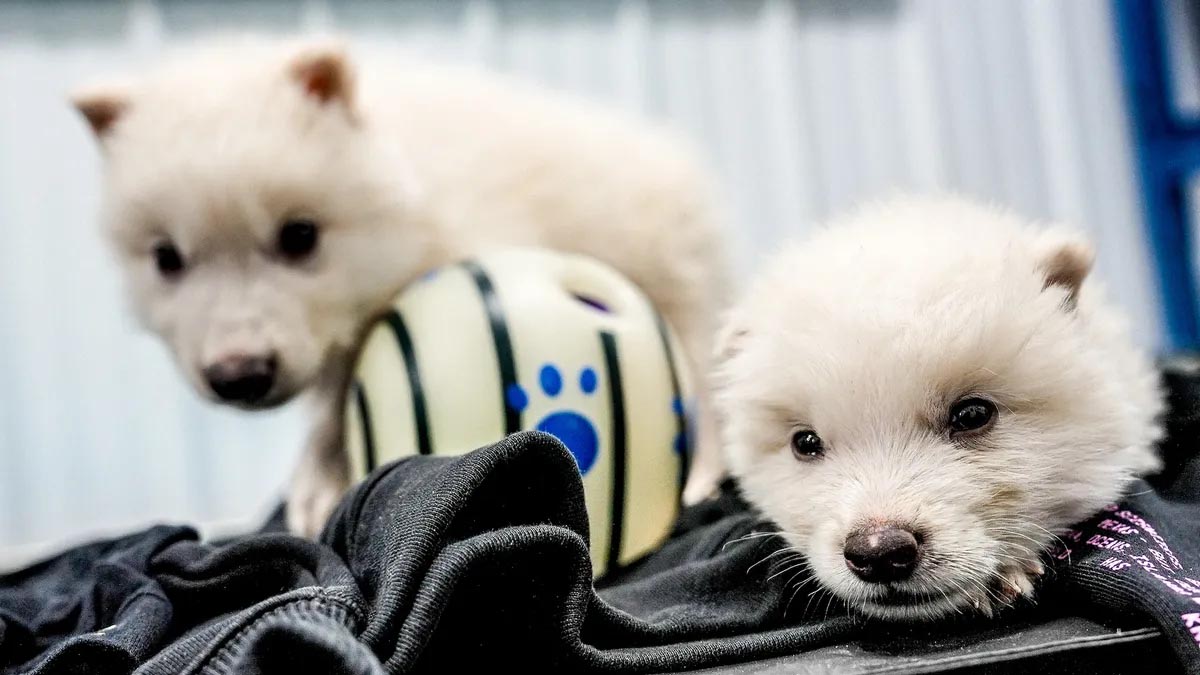
Biotechnology company Colossal Biosciences announced earlier this week that the company had used genetic engineering to bring back the dire wolf, sharing some images of some puppies that definitely look like wolves, hyping the critters as the “world’s first de-extinction.”
Colossal Biosciences
However, scientists say, “not so fast.” Says Live Science:
But many experts say the language used by Colossal to describe their creation is misleading. “What Colossal have produced is a gray wolf with dire wolf-like characteristics,” Nic Rawlence, an associate professor and co-director of the Otago Palaeogenetics Laboratory at the University of Otago, told the New Zealand Science Media Center (NZ SMC). “This is not a de-extincted dire wolf, rather it’s a ‘hybrid.’”
So what specifically did they do?
To make the pups, scientists extracted DNA from two prehistoric dire wolf fossils: a 13,000-year-old tooth discovered in Sheridan Pit, Ohio, and a 72,000-year-old inner ear bone from American Falls in Idaho. Using this DNA, the researchers pieced together a partial dire wolf genome, which they then compared with the genomes of the dire wolf’s closest living relatives, including wolves, jackals and foxes.
Based on their results, the scientists selected the gray wolf (Canis lupus) as an egg donor to “bring back” dire wolves — despite the two species not actually being that closely related, experts said.
And, as it turns out, the dire wolf is not actually a wolf, we guess in much the same way that former J. Geils Band singer Peter Wolf is also not actually a wolf.
Evolutionarily speaking, dire wolves split from wolves roughly 6 million years ago, forming an entirely separate group from modern-day gray wolves. “Dire wolves are in their own genus, so a very different species,” Philip Seddon, a professor of zoology at the University of Otago, told NZ SMC. “The African jackal might be more closely related to dire wolves.”
The term “dire jackal” certainly sounds less cute.
The goal is to eventually release the pups into the wild—but the question remains how and where, since, if they were true dire wolves, their natural habitat vanished tens of thousands of years ago when the ice age ended. This is the fundamental issue with so-called de-extinction: what’s the point of it, if an animal’s ecosystem no longer exists?
The Daily Grail makes a good point:
Here’s a crazy idea: What if we invested all that money into safeguarding all the animals we have today, instead of trying to prove some unresolved God complex with the ones that have long been extinct?
Bad Dog!
Oh, is it going to come to this? Via Laughing Squid, a video on how to protect yourself against a robot dog attack.
AI animator Hoog created an old-school style PSA that warns of the dangers of robotic quadruped dogs, their ability to carry weapons and other accoutrements, how they move autonomously as a pack, how to protect yourself from them, and how to disable these robotic dogs from attacking you and those you love.
Now, robotic dire wolves. There’s an idea…
Horsing Around
If you ignored the PSA on how to defend yourself against a robot dog attack, what other recourse do you have? Yes—the new Lone Ranger on his…robotic horse! Hi-yo, Silver! Away! Kawasaki Heavy Industries has been showing a concept for a ridable, four-legged robotic “horse.” Called Corleo (not to be confused with The Godfather’s Corleone family, although you would not want to find its head in your bed) it runs on a 150cc hydrogen engine. From Futurism:
According to the firm, the horse — which looks more like a gigantic wolf, in our opinion
But not a dire wolf?
— could traverse uneven terrain thanks to its four independently moving limbs. A wild, almost entirely CGI video shows off what such a creature might one day be capable of, from climbing mountains to leaping over icy crevasses.
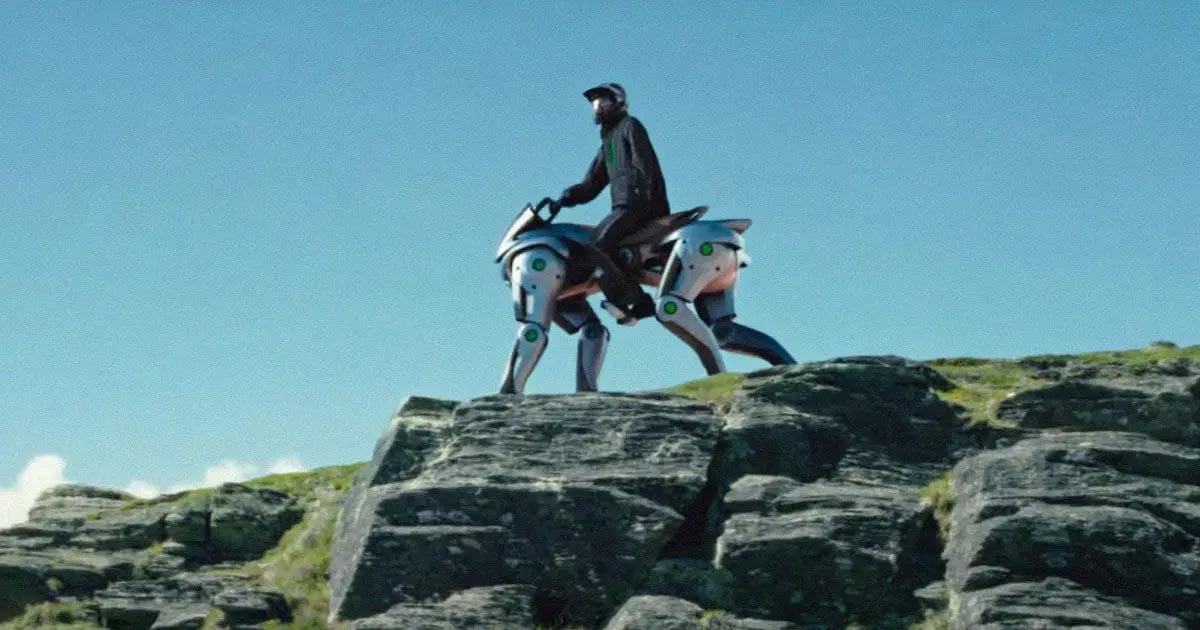
Not to mention the extent to which it could upend thoroughbred racing. Summer in Saratoga would never be the same. (“Corleo wins it by…well, lack of a nose.”)
The Graphene Circuit
Was it a good week for graphene news? It’s always a good week for graphene news! A new process that could replace copper with graphene in integrated circuits. From (who else?) Graphene-Info:
Inventor Anthony Paul Bellezza, owner of Bellezza Technologies, has pioneered a novel 2D graphene fusion process for semiconductor assembly, operating at low temperatures, which may hold great potential for CMOS chip manufacturing. This innovative process addresses the longstanding challenge of integrating graphene into circuits.
On his innovative graphene fusion process, Belleza said: "My method enables the utilization of 2D graphene as an interconnect material in semiconductor circuits, forming a low-resistance, metallurgical bond with the substrate. This advancement will lead to the production of faster and more efficient computers by replacing traditional copper circuits, which are approaching their physical limitations".
…Nor [M]any Drop to Drink…
Here’s a device that is great in theory, until you look into it a bit more closely. Via Core77, industrial design firm Bould has introduced a device called Spout, which harvests water from the atmosphere and filters it into potable water suitable for drinking or cooking. (A glorified dehumidifier, basically.)

The website claims that it makes water for less than $1.75 per gallon “a fraction of the cost of premium bottled water”—or you could just use tap water (which is usually perfectly fine) for even more of a fraction of the cost. You also have to subscribe to the filters, which is annoying.
Say goodbye to the hassle of filling up a Brita five times a day
Is that a hassle?
Interestingly, the company writes, “Water is one of our most precious resources, and yet many people around the world do not have access to a reliable supply of clean, drinkable water.” But the picture shows it next to what appears to be a fully functioning sink, so that’s not their primary customer base. And would those parts of the world that are challenged by access to water be able to afford this solution—and would it provide enough water?
Bread and Water
Want clean drinking water but don’t want to invest in a Spout? As it turns out, all you need is stale bread. Says Food & Wine:
In February, engineers from Saint Vincent College, the University of Pittsburgh, and the University of Pennsylvania revealed the findings of their research, which discovered that bread could be a valuable tool for desalinating — aka removing the salt from — water to make it drinkable.
Published in the peer-reviewed, open-access journal Royal Society Open Science, the study details how scientists used stale bread (specifically Pepperidge Farm whole-wheat bread) to more sustainably produce carbon electrodes. The high carbon content of bread allowed researchers to transform it into carbon electrodes, which are electrical conductors that can be used to desalinate water.
Ok, so we’re getting the sense is that this is more involved than running some seawater through a slice of bread.
The researchers tested two strategies for developing their carbon electrodes from stale bread. The first method involved using a 3D-printed mold to stamp the bread into the desired shape, then heating it in a furnace to a very high temperature — 800°C or 1472°F — for an hour, while under a flow of nitrogen gas, until it formed a solid carbon electrode.
Dang, we forgot to pay our nitrogen gas bill this month and they turned it off.
The second method started with combining bread and water in a blender, molding the resulting mixture into the requisite shape for the electrode, and then popping it in an 800°C, oxygen-free oven…
On a greased cookie sheet?
According to Tech Xplore, the researchers hope to continue refining their work and figure out how to mass-produce the product to create low-cost desalination systems to assist in delivering fresh water to people across the globe — an issue of growing concern considering that nearly one in three people in the world do not have access to clean drinking water, according to the United Nations International Children's Emergency Fund (UNICEF) and World Health Organization.
It's also a good way to reuse a major source of food waste.
According to a 2021 study at the University of Vaasa, the world produces some 100 million tons of bread a year, and an estimated 900,000 of those tons go to waste. That works out to about 24 million slices of bread thrown out per day.
Hmm…so this could literally be the best thing since sliced bread.
Snackcession
Here’s an economic indicator we never thought to follow: snacking. Via Food & Wine, spending on snacks could be a leading indicator of a potential economic downturn.
According to data from a February survey of 1,000 consumers by marketing research company NIQ, 42% of those consulted say they are spending less on snacks now in general. This is already showing up in the bottom line of companies like Frito-Lay, whose corporate owner, PepsiCo, has revealed that sales volume for Frito-Lay decreased by 3% last quarter in an earnings announcement.
As people start to watch their spending, one of the first things to go is snacks.
Data from market research and technology company Circana gives further insight into where people are forgoing their usual snack choices. Beyond supermarkets, convenience stores are one place where customers are opting out of purchasing snacks. Circana’s findings, as published by the Independent, reveal that convenience store sales volume dropped 4.3% over the last year, with chocolate candy sales specifically decreasing by 6%.
And a lot of it is what we might call “snackflation.”
Just how expensive are snacks these days? As a point of reference, TODAY reports that the average cost of a bag of chips is currently $6.46. That’s an increase of 31% compared to prices from 2021. If you’re purchasing a snack every time you get gas or go grocery shopping, that can add up.
However, while snacks are down, other things are not.
Per the Independent, sales of miniature alcohol bottles have actually increased. The media outlet also cites an interview with Lawson Whiting, the CEO of Jack Daniel’s, who tells the Wall Street Journal that sales of 50-mililiter bottles of whiskey and tequila are likely up because they’re far more affordable than a full bottle, even though they’re not a better price per volume.
And these days, chocolate just ain’t gonna cut it.
This Week in Printing, Publishing, and Media History
April 7
1770: English poet William Wordsworth born.
1805: German composer Ludwig van Beethoven premieres his Third Symphony at the Theater an der Wien in Vienna.
1927: The first long-distance public television broadcast (from Washington, D.C., to New York City, displaying the image of Commerce Secretary Herbert Hoover).
1949: The Rodgers and Hammerstein musical South Pacific opens on Broadway; it would run for 1,925 performances and win 10 Tony Awards.
1964: IBM announces the System/360.
1969: The Internet’s symbolic birth date: Publication of RFC 1.
April 8
1820: The Venus de Milo is discovered on the Aegean island of Milos, which archaeologists found disarming.
1904: Longacre Square in Midtown Manhattan is renamed Times Square after The New York Times.
1942: American director, producer, and special effects artist Douglas Trumbull born.
1947: Mood for a day: English guitarist, songwriter, and producer Steve Howe born.
1959: A team of computer manufacturers, users, and university people led by Grace Hopper meets to discuss the creation of a new programming language that would be called COBOL.
April 9
1553: French monk and scholar, author of Gargantua and Pantagruel, François Rabelais dies (b. 1494).
1821: French poet and critic Charles Baudelaire born.
1830: English photographer and cinematographer Eadweard Muybridge born.
1860: On his phonautograph machine, Édouard-Léon Scott de Martinville makes the oldest known recording of an audible human voice. In 2008, researchers at the Lawrence Berkeley National Laboratory in Berkeley, Calif., did successfully convert a “phonautogram”—“squiggles on paper,” essentially—recorded in 1860 to a digital audio file. It was a 10-second clip of a singer, possibly female, warbling “Au clair de la lune.” It is believed to be the earliest known sound recording, preceding Thomas Edison’s attempts by almost two decades. (Poor Charlotte Green, BBC Radio 4’s newsreader, who played the restored phonautogram on her broadcast, but was unable to get through the next story—alas, an obituary—without cracking up.)
1898: American singer, actor, and activist Paul Robeson born.
1928: American singer-songwriter, pianist, and mathematician Tom Lehrer born.
1959: NASA announces the selection of the United States’ first seven astronauts, whom the news media quickly dub the “Mercury Seven.”
1965: Astrodome opens; first indoor baseball game is played.
April 10
1710: The Statute of Anne, the first law regulating copyright, comes into force in Great Britain.
1847: Hungarian-American journalist, publisher, politician, and founder of Pulitzer, Inc. Joseph Pulitzer born.
1925: The Great Gatsby by F. Scott Fitzgerald is first published in New York City, by Charles Scribner’s Sons.
1934: American journalist and author David Halberstam born.
2019: Scientists from the Event Horizon Telescope project announce the first ever image of a black hole, located in the center of the M87 galaxy.
April 11
1976: The Apple I is created.
2007: American novelist, short story writer, and playwright Kurt Vonnegut dies (b. 1922). So it goes.
April 12
1932: American singer and ukulele player Tiny Tim (né Herbert Khaury) born.
1981: The first launch of a Space Shuttle (Columbia) takes place: The STS-1 mission.
1990: Jim Gary’s “Twentieth Century Dinosaurs” exhibition opens at the Smithsonian Institution National Museum of Natural History in Washington, D.C. He is the only sculptor ever invited to present a solo exhibition there.
1992: The Euro Disney Resort officially opens with its theme park Euro Disneyland; the resort and its park’s name are subsequently changed to Disneyland Paris.
April 13
1742: George Frideric Handel’s oratorio Messiah makes its world-premiere in Dublin, Ireland.
1743: American lawyer and politician, 3rd President of the United States Thomas Jefferson born.
1860: English-Belgian painter James Ensor born.
1870: The New York City Metropolitan Museum of Art is founded.
1899: American architect, game designer, and creator of Scrabble Alfred Mosher Butts born.
1901: French psychiatrist and academic Jacques Lacan born.
1923: Would you believe... American actor and director Don Adams born.
1906: Irish novelist, poet, and playwright, Nobel Prize laureate Samuel Beckett born.
1960: The United States launches Transit 1-B, the world’s first satellite navigation system.
1974: Western Union (in cooperation with NASA and Hughes Aircraft) launches the United States’ first commercial geosynchronous communications satellite, Westar 1.