Our Type of Book
Glenn Fleischman is a printing, typography, and comics historian. He trained as a typesetter, studied graphic design, and spent the bulk of his career as a technology journalist, contributing to the New York Times, Wired, The Economist, etc. Since 2017, he has been heavily involved in creating books and other projects around printing history.
His most recent project is a history book called Six Centuries of Type & Printing:
starting with early documented efforts and surviving artifacts from China and Korea, and introducing Gutenberg and his innovations. It then takes you through each generation of increasing sophistication in metal and relief printing until the abrupt 20th century shift into flat offset printing, which was made possible through photographic and digital improvements, and phototypesetting and digital composition.
It is available as a beautiful hardcover (for Kickstarter backers) or—if you must—an ebook.
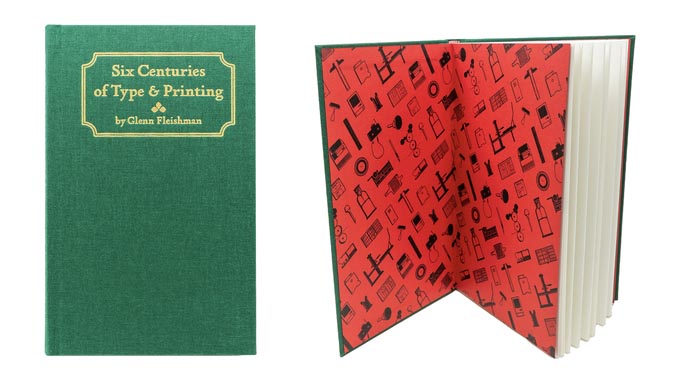
I’ve paired the love of type and printing in my approach to the design, production, and typesetting of this book. It’s set in Monotype Bembo, a classic typeface used extensively in the hot-metal era and still popular today. The hardcover volume is bound in green cloth with a debossed, foil-stamped title and spine. The interior paper is a creamy textured stock with black text and illustrations in a second color. The endpapers are printed in black on a sharp, bright red.
There are also various bundles available. It looks very cool!
The Living Endpapers
One element of the physical book that gets lost when a title is converted to an ebook is endpapers. Endpapers are of course the printed sheets bound into the inside front and back covers of a book. Often just decorative, they sometimes included maps (for history books) or other functional graphics. They are also very popular in children’s books. People often take them for granted, but via Print magazine, a new exhibition at The Eric Carle Museum of Picture Book Art in Amherst, Mass., showcases the beauty of endpapers.
Open + Shut: Celebrating the Art of Endpapers features original art from more than 50 books, from classics such as Blueberries for Sal and The World of Pooh, to three decades of contemporary books by Sophie Blackall, Yas Imamura, Eliza Kinkz, Grace Lin, Jessic Love, Jerry Pinkney and Paloma Valdivia.
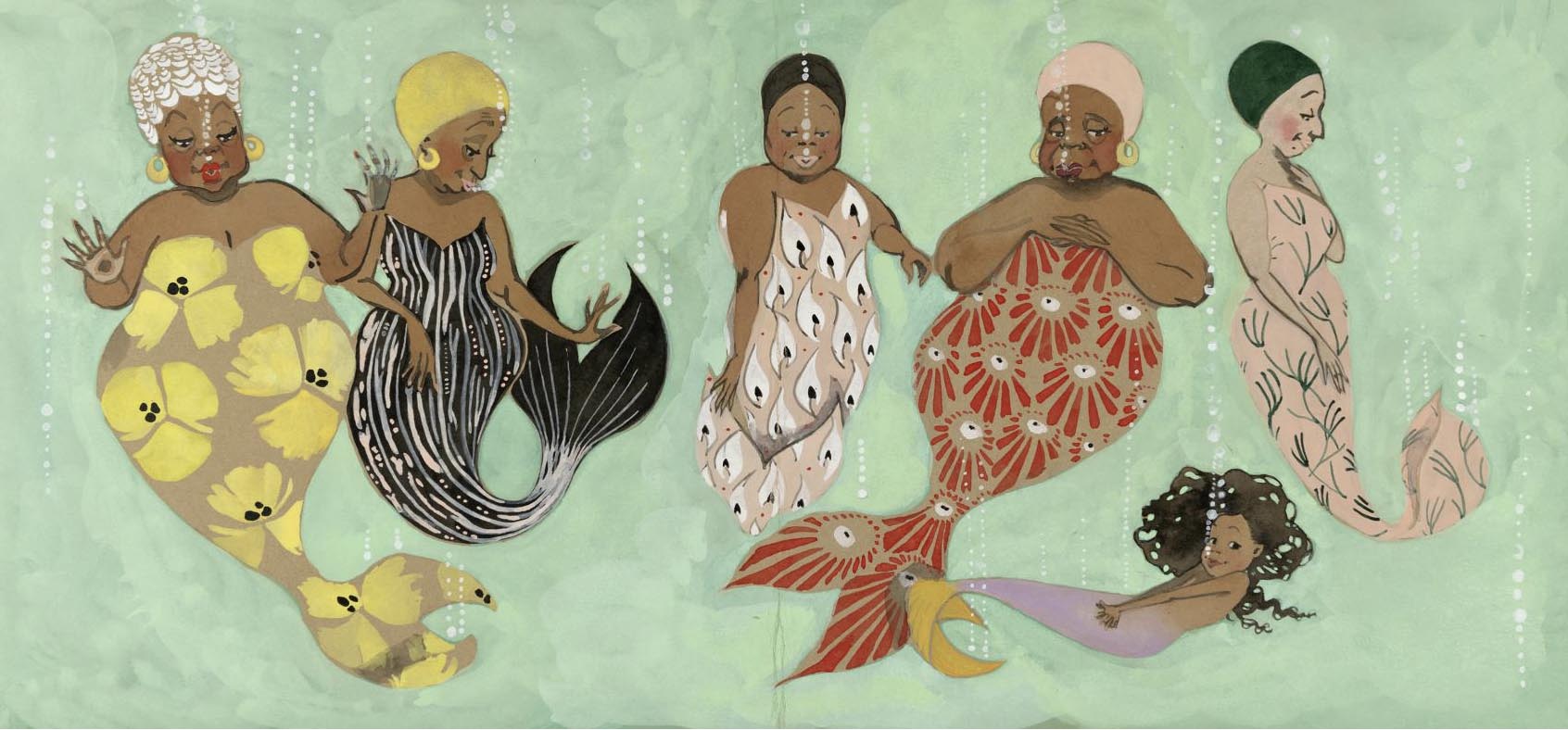

Jessica Love, Illustration for Julia?n is a Mermaid (Candlewick). Collection of the artist. © 2018 Jessica Love.
…“I think of endpapers as the picture book equivalent of a movie or TV show’s title and credits sequence, or a tempting appetizer at the start of a meal … plus a sweet dessert at the end,” explains guest curator Bruce Handy. “In the digital age, they give us yet another reason to cherish the pleasures of physical bookmaking—and reading.”
The exhibition also includes a talk by curator Handy, as well as two children’s book workshops. Open + Shut: Celebrating the Art of Endpapers runs from April 19–November 9, 2025. If you’re in the Amherst area, check it out!
Car-Toons
Do you wrap vehicles? Or do you have a vehicle you’d like to wrap? Well, via Laughing Squid, you’ll want to check out California artist Joshua Vides, who creates monochrome car wraps à la Pop Art comics, or similar to those that Roy Lichtenstein created.

Low Art
Here’s a new approach to display graphics. Douglas Hoekzema (aka HOXXOH) is a Miami artist who, via Laughing Squid, paints murals using gardening equipment. For one, he put a subwoofer on a track, attached a hose, and used the beat to paint distinctive patterns on the wall. He calls this method “painting with sound.”

Table that Motion
Whenever we are in a furniture-buying environment and come across an item labeled as an “occasional table,” we can’t help but ask: what is it when it’s not a table? (We usually get ushered out pretty quickly.) But, via Core77, now we know: it’s a desk.
One of the challenges of working from home—especially during the pandemic when not everyone had a proper home office—is where to actually do the work. For many people without a dedicated space, the dining table serves as an ersatz desk, or at least until mealtime. But is a dining table functional as a desk? Or is a desk functional as a dining table? Well, Quebec-based modular furniture company Transformer Table thinks it has solved the “table dichotomy” with product it calls The Savouring, which sounds like some alien religious ritual in an episode of Star Trek.
The Savouring is simply a desk that turns into a dining table. One unit provides a desk that's roughly 19" deep by 5' wide, providing enough real estate for two people to work side-by-side, in a pinch. With two of these units back-to-back, you've got an appreciable 38" by 62.5" eating surface with the work surfaces hidden away.
(We all remember the Beatles song, “You’ve Got to Hide Your Desk Away.”)

You can also couple two The Savourings together.

The work configuration can mount two 27" monitors per side, and there's an integrated power strip featuring a USB-C port, two USB-A ports and four electrical outlets.
However:
The Savouring’s work surface by necessity is lower than the dining surface, 25" in height for the former, 31.5" for the latter. Your standard dining table is 28" to 30" tall, and most dining chairs are designed accordingly. By splitting the difference with its two heights, the Savouring might yield a worksurface a tad too low and a dining surface a tad too high. A few inches off from the recommended heights might not sound like a lot, but an ergonomicist might beg to differ.
A steal at—dah!—$1,386 for one unit. Although if you buy two, they’ll take $100 off of each, bringing the price for a pair to $2,572.
Data in Vogue
Our WhatTheyThink data wranglers follow a number of statistics sources, economists, and publications. But have they ever thought to look for economic trends in Vogue magazine? Via Econbrowser, economic uncertainty has spawned a hair fashion trend called “recession blonde.”
Recession blonde (or recession brunette) refers to the darker, more brown-tinted hue that many are letting grow in with their normally bright, golden strands. TikTok users explain that while it may look like “old-money blonde,” letting their natural roots grow actually points to how the economy is affecting their spending habits; many are opting out of their touch-up appointments to save money.
Apparently, being blonde is expensive. Says celebrity colorist Jenna Perry:
“A double process, hyper blonde, is one of the most labor-intensive on your colorist to provide the biggest blonde impact. Highlights generally feel more natural, although the final may look effortless. A skilled application is akin to that of a trained painter and [cost] ranges depending on your colorist as well.”
Econbrowser’s Menzie Chinn tried to find data to back up the thesis of “recession blonde.”
I tried to find data on hair salon expenditures, but the closest I could get at fairly high frequency is the BEA’s “personal care and clothing services” category. I plot the log ratio of the real measure of personal care services to total real consumption (keeping in mind these are chained quantities).
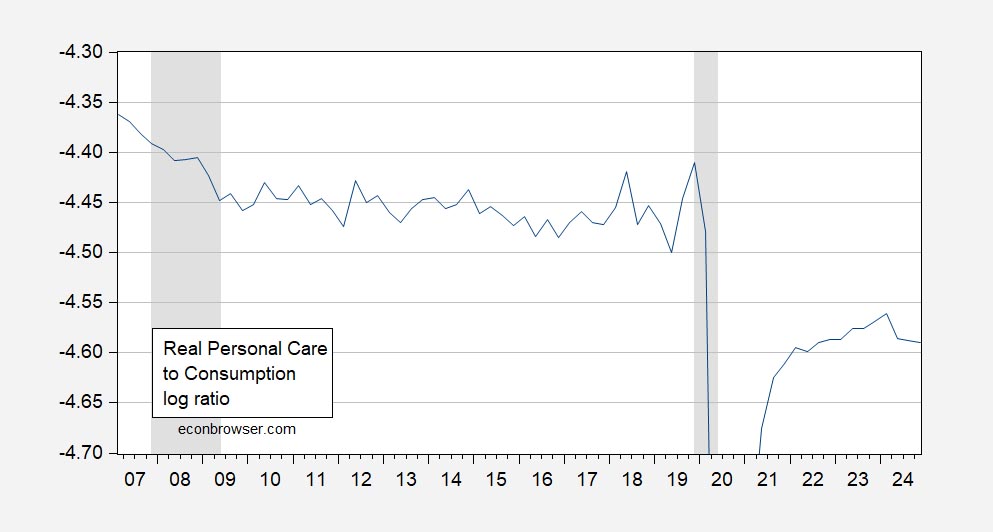
We’re getting perilously close to Dr. Joe’s old April Fool’s chart correlating the value of printing shipments with no-hitters pitched in baseball.
But clicking through to the Vogue article (we have never written those words before…), gauging economic trends based on fashion trends is not a crazy idea. They cite the Hemline Index, created by economist George Taylor in 1926 positing that the length of women’s hemlines is closely related to economy conditions (can you guess that these economists were all men?).
Shorter hemlines indicate a thriving economy (think the Roaring ’20s and the flapper dress or the ’60s and the birth of the miniskirt) while longer hemlines show an economy that is not (floor-length dresses and pants dominated fashion during The Great Depression).
And remember “recession hair” back in 2009?
Back at Econbrowser, there have been attempts to get more reliable data, such as a paper by Michele Andreolli, Natalie S. Rickard, and Paolo Surico called “Non-Essential Business Cycles”:
Using newly constructed time series of consumption, prices and earnings in essential and non-essential sectors, we document three main empirical regularities on post-WWII U.S. data: (i) spending on non-essentials is more sensitive to the business-cycle than spending on essentials; (ii) earnings in non-essential sectors are more cyclical than in essential sectors; (iii) low-earners are more likely to work in non-essential industries. We develop and estimate a structural model with non-homothetic preferences over two expenditure goods, hand-to-mouth consumers and heterogeneity in labour productivity that is consistent with these findings. We use the model to revisit the transmission of monetary policy and find that the interaction of cyclical product demand composition and cyclical labour demand composition greatly amplifies business-cycle fluctuations.
Got all that? Try this picture instead of those thousand (it seems) words:
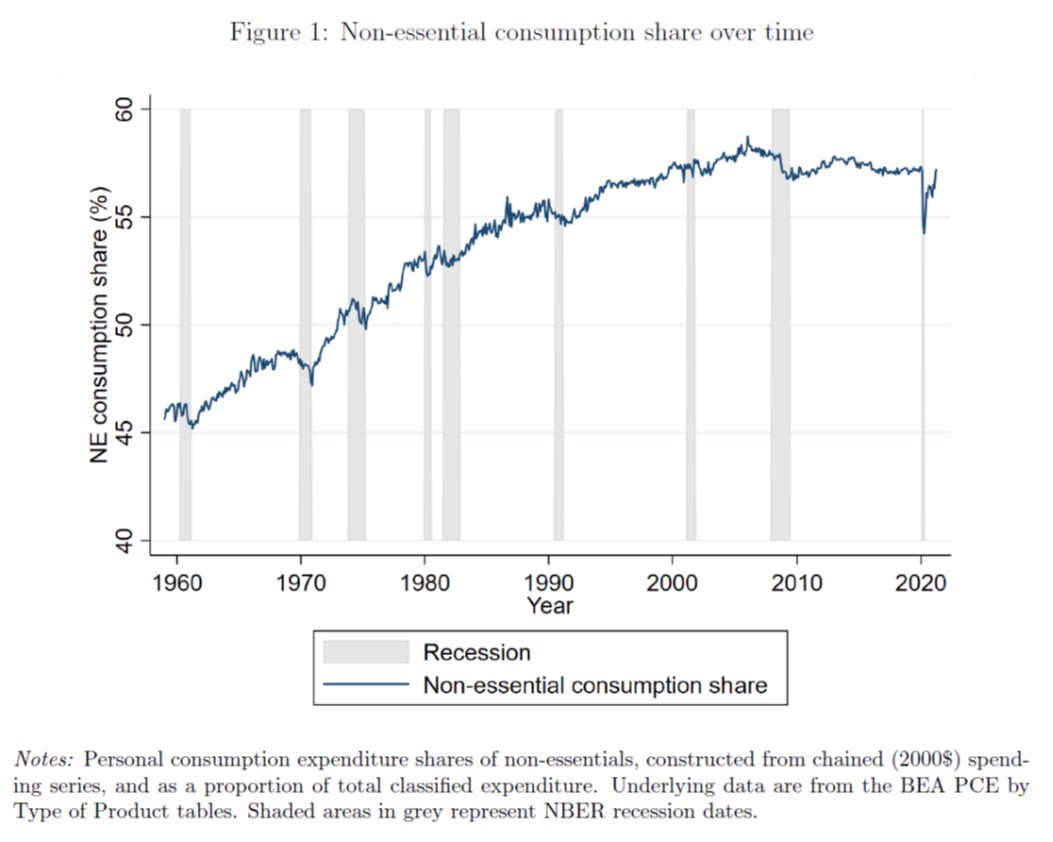
Source: Andreolli et al (2024).
Hmmm… At the end of the day, concludes Chinn:
So, one thing to look at is Q1 consumption composition, as well as the level. A continued downward movement in “personal care and clothing services” might well signal an imminent downturn.
Games People (Used to) Play
Do you like word games? But are you weary of Wordle? Have you had enough OREO in your crosswords? Can’t even get started on The Guardian Cryptic Crossword? Well, via Mental Floss, try some vintage word games…if you dare. For example, there is Doublets:
The brainchild of author Lewis Carroll (Alice’s Adventures in Wonderland), this game tasks players with taking one word and transforming it into an entirely different one by changing just one letter at a time—all while making sure the transitional steps are actual words, too. The bookended words are usually related. One could, for example, try to turn fire into hose by opting for tire, tore, pore, pose, and then hose.
This idea does occasionally turn up in crosswords, as well. How about Minister’s Cat?
This group game tasks players with declaring that “the minister’s cat is a ____ cat,” with the blank being an adjective beginning with a, then b, then c. Each round begins with a new letter. If a player misses, repeats a word, or otherwise makes a mistake, they’re eliminated. Some versions increase the difficulty by having players repeat the previous answers.
Fictionary sounds like fun:
Victorians amused themselves with this game in which one player produces a dictionary and finds a very obscure word that’s read aloud to other players. Those players then jot down a made-up definition. The first player then reads all definitions out loud, including the real one, and invites the others to guess which is legitimate. Participants get points when their fake definition is guessed or when someone guesses correctly.
Or how about Crambo, which dates back to the 1660s?
The first player announces they have a word that rhymes with sea. The other player can then ask, “Is it a vegetable?” The first player then says, “No, it’s not a pea.” The answer must allude to a rhyme that the first player then utters.
Well, they can’t all be gems…
Put the Load Right On Me
Here’s a question you may never have thought to ask before: what’s the weight of the Internet? We’re not sure why anyone would need to know, unless they are planning to ship it somewhere. Anyway, Wired mulls this question, and it’s actually less than you would think.
The first sub-question to ask is, are we talking about all the wires and cables and servers? And the answer is no.
We mean the internet itself. The information. The data. The cybernetics. And because storing and moving stuff through cyberspace requires energy—which, per Einstein, has mass—it should, in theory, be possible to calculate the internet’s weight.
One initial and popular attempt was made in 2006 by Harvard physicist Russell Seitz, who concluded that:
If you consider the mass of the energy powering the servers, the internet comes out to roughly 50 grams—or about the weight of a couple strawberries.
We envision a modern remake of The Caine Mutiny. Anyway, a lot has been added to the Internet since 2006—pictures, videos, social media, etc. So, if you used Seitz’s method, the Internet would now weigh as much as a potato (and just as susceptible to blight).
There’s also the fact that, around the time of Seitz’s calculation, Discover magazine proposed a different method. Information on the internet is written in bits, so what if you looked at the weight of the electrons needed to encode those bits? Using all internet traffic—then estimated to be 40 petabytes—Discover put the internet’s weight at a tiny fraction (5 millionths) of a gram. So, more like a squeeze of strawberry juice.
Another method estimated that it weighed 53 quadrillionths of a gram. Wired didn’t like that—they felt that since the Internet feels heavy it should be heavy. Hmm…Try using this logic the next time you get weighed during a physical—“I feel lighter therefore I should be lighter.” We’re sure that’ll work.
scientists have floated the idea of storing data within the building blocks of nature: DNA. So what if we were to weigh the internet in those terms? Current estimates say that 1 gram of DNA can encode 215 petabytes—or 215 x 1015 bytes—of information. If the internet is 175 x 10247 bytes, that’s 960,947 grams’ worth of DNA. That’s the same as 10.6 American males. Or one third of a Cybertruck. Or 64,000 strawberries.
Even better: we have a USB thumb drive that can hold 4GB. If you put the entire Internet on a set on 4GB thumb drives, how much would it weigh then? You do the math.
Stop on a Mime
No one likes rush hour traffic, but Bogotà, Columbia Colombia, once took a unique approach to enforcing traffic laws: traffic mimes. We kid you not. Via Atlas Obscura:
White face paint and charcoal-lined eyes accentuate an expression of utter horror aimed at the motorist who just ran a red light. Pale gloves flash at a honking heathen, and gregariously exaggerated steps imitate the pedestrian who just can’t wait their turn. After three vehicles nearly collide in an intersection, a fleet of performers stretch colorful fabric across the hoods.
Mocking bad drivers and pedestrians…interesting idea. We wonder how long that would last in the US before road rage kicked in.
But it’s not all chastising. A series of cartwheels as perfect as pinwheels follow the family that uses the crosswalk. Applause greets the cyclist who waits their turn.
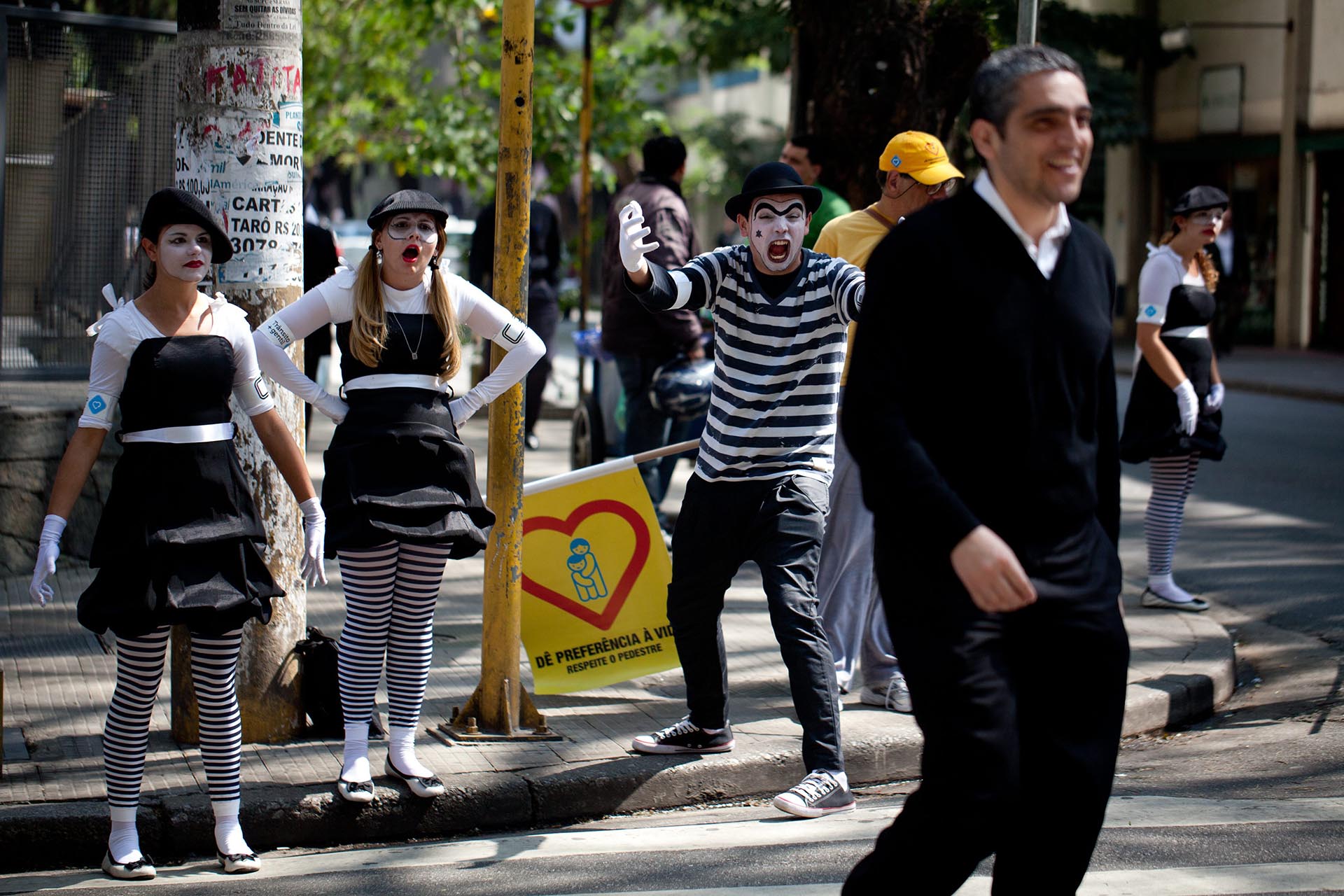
The scene is the result of a slogan called “arm yourself with love,” which mayoral candidate Antanas Mockus started advocating for in 1995. As a former professor of mathematics and psychology, Mockus hoped to transform the fragmented city into a “6.5-million-person classroom.”
Mock us? Hmm…
The new mayor began his term by tackling the 1,500 annual traffic-related deaths in the city. He seemed to abide by an old theater saying: If the show isn’t going well, send in the clowns. Ever the political performer, Mockus did just that.
So Mockus fired all the cops and hired 20 mimes.
Armed with nothing but signs that read correcto and incorrecto, the silent troupe theatrically mocked lawbreakers and applauded polite motorists. A system purely based on public approval was on trial in Mockus’s so-called classroom. And it worked.
…“Rather than strength or physical violence to get people to cross the street in the right place, he used behavioral change—and this was powerful,” says Paulius Yamin, a behavioral scientist and Mockus’s former research assistant. “There are not always going to be police on every corner, but there are always citizens, and people care about what others think about them.”
At its peak, the mime program (another set of words we have never written before) had 420 performers. The program ended by the end of the 1990s, but apparently Colombians still recall the mimes fondly.
The mimes became a symbol of Mockus’s broader public policy package called cultura ciudadana, or “citizen culture,” which centered on advancing policy goals through strategic cultural interventions. Ordinary citizens with no real authority assumed superhero status under the guise of stripes. Behind silent mocking and theatrics lies the politics of play. The scheme used art and expression to ask the spectator, a passive citizen, to challenge how they lived and behaved in the city. When individuals were willing to engage with the mimes and play along, they were forced to rethink everyday interactions between one another and their larger community. In doing so, ordinary citizens assumed an active part in the theater of civic culture.
Tale of the Tape
Anyone who has ever wasted a small eternity trying to find the end of a roll of sticky tape will appreciate this mechanical sculpture. Via Boing Boing, Eternal Frustration was created by inventor and artist Stoccafisso design.

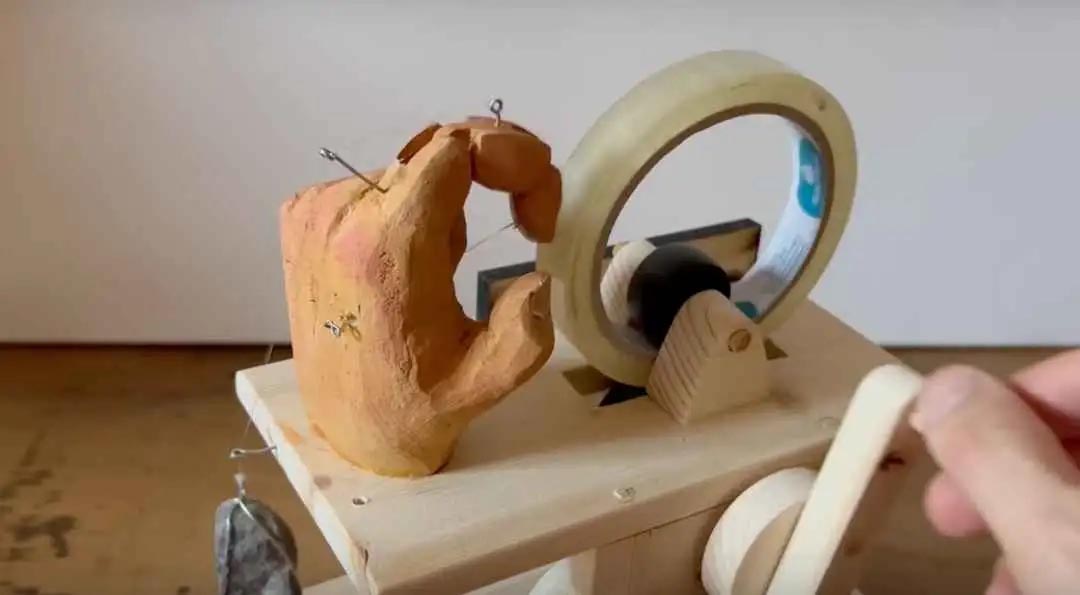
[It] sums up the annoyance one feels when trying endlessly to peel back a roll of clear tape. This incredible sculpture featuring a wooden hand picks and picks at a rotating roll of tape with no success. The tape never stretches from its roll.
Endless Pastabilities
The BBC has an interesting deep dive on “What pasta reveals about the universe.” OK, it’s just about lunch time, so we’ll bite. What does pasta reveal about the universe?
Going back at least a century, spaghetti has been the subject of rigorous studies.
Ah, “studies.” Is that what they’re calling it? OK.
For example: how thin can spaghetti get? The typical spaghetto – the word for an individual strand of spaghetti – is between one and two mm thick (0.04-0.08in). But other long noodles vary widely in diameter, from udon at 4mm (0.16in) to angel hair at 0.8mm (0.03in). The thinnest handmade strands are called su filindeu, coming in at 0.4mm (0.02in), so slender that only a few women in Nuoro, Italy know how to make them.
Can science make a spaghetto even thinner? Researchers at University College London tried:
They used a technique called “electro-spinning”. First, they dissolved flour into a special, electrically charged solution in a syringe. Then they held the syringe over a special, negatively-charged plate. “This pulls the solution through the dispenser needle down towards the collector plate in a very stringy noodle-type shape,” says Beatrice Britton, lead author of the study.
They needed a microscope to detect strands as thin as 0.1mm (0.004in). Why are they doing this?
Britton and her colleagues hope their research can be a step towards biodegradable alternatives to plastic “nanofibers”, which are now used to filter liquids and treat wounds.
Ah, OK. Fair play then.
There is also a conundrum posed by Brown University physicist George F. Carrier in 1949 called “the spaghetti problem,” which was essentially “Why can’t I slurp up a strand of spaghetti without getting sauce on my face?” Because you should never eat like that. What, was he raised by wolves?
His equations showed how the exposed strand swings about more wildly as it gets shorter and shorter, guaranteeing an eventual slap of the noodle against the slurper’s lip – and the fateful sauce eruption Carrier so deplored. Sadly, his mathematical formulas offered no way around the face-slap. It’s as deeply etched in the laws of the universe as the Big Bang.
Well, learn how to eat properly. It’s like the old joke: “Doctor, it hurts when I do this.” “Then don’t do that.”
At any rate, if you have more burning questions about the physics of spaghetti—whether it be snapping dry spaghetti into pieces, the proper way to add dry spaghetti to boiling water, “spaghetti transmutation,” or how spaghetti science is helping scientists understand the mechanics of Alzheimer’s Disease—be sure to click through. At the end of the day, though:
For now, no theoretical physicist has attempted the more complicated problem of two dogs slurping from either end of the same spaghetti strand.
Egg Hunt
Food & Wine asks, “Too Busy to Hide Easter Eggs?” OK, first of all, if you’re too busy to hide Easter eggs, then maybe having kids is really not your thing. But, yeah, fine, sometimes big trade shows are held right after Easter, making travel a little hectic. So what’s the solution? Brach’s, purveyors of fine jelly beans and other Easter comestibles, is launching its Brach’s Egg Hunt Hiders, an official service that hides the eggs for you.
The service will be available in Brach’s top ten markets: New England, DC–Baltimore, Boston, New York, South Carolina, Chicago, Detroit, Philadelphia, Los Angeles, and Phoenix–Tucson. In these markets, residents can visit BrachsEggHunt.com starting April 3 at 7 p.m. Eastern for a chance to win a visit from Brach’s Egg Hunt Hiders.
Ah, so it’s a chance kind of thing, not an actual service available to anyone.
The promotion, which will select 300 winners, is in partnership with Card My Yard, a business specializing in celebratory lawn signs. If an entrant is selected, The Egg Hunt Hiders will visit their home on Saturday, April 19, to hide pre-filled eggs around the front and/or backyard.
During the signup process, entrants will select how many people will be in their egg hunt so the hiders know how many eggs to supply. Each egg will contain Brach’s jelly beans, branded stickers, and erasers, and the giveaway will include a themed yard sign (a nod to Card My Yard).
This is probably less expensive than using actual eggs.
Easter is an important holiday for candy companies.
Well, you know, it’s also important for some others as well…
This Week in Printing, Publishing, and Media History
March 24
1693: John Harrison, English carpenter and clock-maker, invented the Marine chronometer. (Harrison was the subject of Dava Sobel’s excellent book Longitude.)
1721: Johann Sebastian Bach dedicated six concertos to Margrave Christian Ludwig of Brandenburg-Schwedt, now commonly called the Brandenburg Concertos, BWV 1046–1051.
1834: English textile designer, poet, and author William Morris born.
1874: Hungarian-Jewish American magician and actor Harry Houdini (né Ehrich Weiss) escaped from the womb.
1882: American poet and educator Henry Wadsworth Longfellow dies (b. 1807).
1905: French novelist, poet, and playwright Jules Verne dies (b. 1828).
1909: Irish playwright and poet John Millington Synge dies (b. 1871).
1907: The first issue of the Georgian Bolshevik newspaper Dro is published.
1949: English singer-songwriter, bass player, and producer Nick Lowe born. And so it goes.
1958: Elvis Presley is drafted in the U.S. Army.
March 25
1811: Percy Bysshe Shelley is expelled from the University of Oxford for publishing the pamphlet The Necessity of Atheism.
1881: Hungarian pianist and composer Béla Bartók born.
1925: American short story writer and novelist Flannery O’Connor born.
1931: American journalist and activist Ida B. Wells dies (b. 1862).
1939: American screenwriter and producer D. C. Fontana born.
1957: United States Customs seizes copies of Allen Ginsberg’s poem “Howl” on obscenity grounds.
1995: WikiWikiWeb, the world's first wiki, and part of the Portland Pattern Repository, is made public by Ward Cunningham.
March 26
1484: William Caxton prints his translation of Aesop’s Fables.
1812: A political cartoon in the Boston Gazette coins the term “gerrymander” to describe oddly shaped electoral districts designed to help incumbents win reelection.
1827: German pianist and composer Ludwig van Beethoven dies (b. 1770).
1830: The Book of Mormon is published in Palmyra, N.Y.
1859: English poet and scholar A. E. Housman born.
1874: American poet and playwright Robert Frost born.
1892: American poet, essayist, and journalist Walt Whitman dies (b. 1819).
1911: American playwright, and poet Tennessee Williams born.
1931: American actor Leonard Nimoy born.
1959: American crime novelist and screenwriter Raymond Chandler dies (b. 1888).
1969: American novelist John Kennedy Toole dies (b. 1937).
1973: English playwright, actor, and composer Noël Coward dies (b. 1899).
1980: French linguist and critic Roland Barthes dies (b. 1915).
1996: American engineer and businessman, co-founder of Hewlett-Packard David Packard dies (b. 1912).
March 27
1845: German physicist, academic, and Nobel Prize laureate Wilhelm Röntgen born.
1869: American publisher and politician, and 65th Mayor of New York City James Harper dies (b. 1795).
1931: English author and playwright Arnold Bennett dies (b. 1867).
2006: Ukrainian-Polish author Stanis?aw Lem dies (b. 1921).
2012: American poet essayist and feminist Adrienne Rich dies (b. 1929).
March 28
1836: German-American brewer and founder of the Pabst Brewing Company Frederick Pabst born. (Did they sponsor the hipster Olympics?)
1842: First concert of the Vienna Philharmonic Orchestra, conducted by Otto Nicolai.
1868: Russian novelist, short story writer, and playwright Maxim Gorky born.
1994: How absurd: Romanian-French playwright and critic Eugène Ionesco dies (b. 1909).
March 29
1871: Royal Albert Hall is opened by Queen Victoria.
1886: John Pemberton brews the first batch of Coca-Cola in a backyard in Atlanta.
1943: English actor and comedian Eric Idle born, looking on the bright side of life.
1999: The Dow Jones Industrial Average closes above the 10,000 mark (10,006.78) for the first time, during the height of the dot-com bubble.
March 30
1853: Dutch-French painter and illustrator Vincent van Gogh born.
1880: Irish dramatist, playwright, and memoirist Seán O'Casey born.
1986: American poet and etymologist John Ciardi dies (b. 1916).
2004: English-American journalist and author Alistair Cooke dies (b. 1908).