Photo Finish
Some of the most talented artists on the planet spend their time photographing the planet. They are nature photographers and this week the winners of the World Nature Photographers Awards were announced. This year’s World Nature Photographer of the Year is Marusa Puhek for her image “Run.”

© Marusa Puhek
This photo was part of my 366 project, when I captured one image every day and carried my camera everywhere. It was a snowy day and I only had a wide-angle lens with me when I spotted two deer running through the snowy vineyard. I took a few shots, frustrated that I didn’t have a telephoto lens with me. Only later, while editing, did I realise how lucky I was; the scene wasn’t overly zoomed in, allowing the snowy surroundings to remain an essential part of the composition.
It's worth clicking through and checking out the rest of the winning images and artists—there are Gold, Silver, and Bronze awards in dozens of categories, such as Mammals, Insects, Birds, etc.
You can also buy prints of winning images as wall art. Their online shop. A steal at $33 for a 12 x 16-in. print.
Big Blue Marble
And sometimes nature photographers aren’t even on the planet. One of the most famous photographs of the 20th century is “Earthrise,” taken by astronaut Bill Anders, who was on the crew of Apollo 8, the first spacecraft to orbit the moon. Anders shot the image on December 24, 1968, on a Hasselblad camera using Kodak Ektachrome film. It has been described as the most important environmental photograph ever, and for a generation of Americans captivated by the space program in the late 1960s, caused our planet to be seen in a completely new light (as it were).
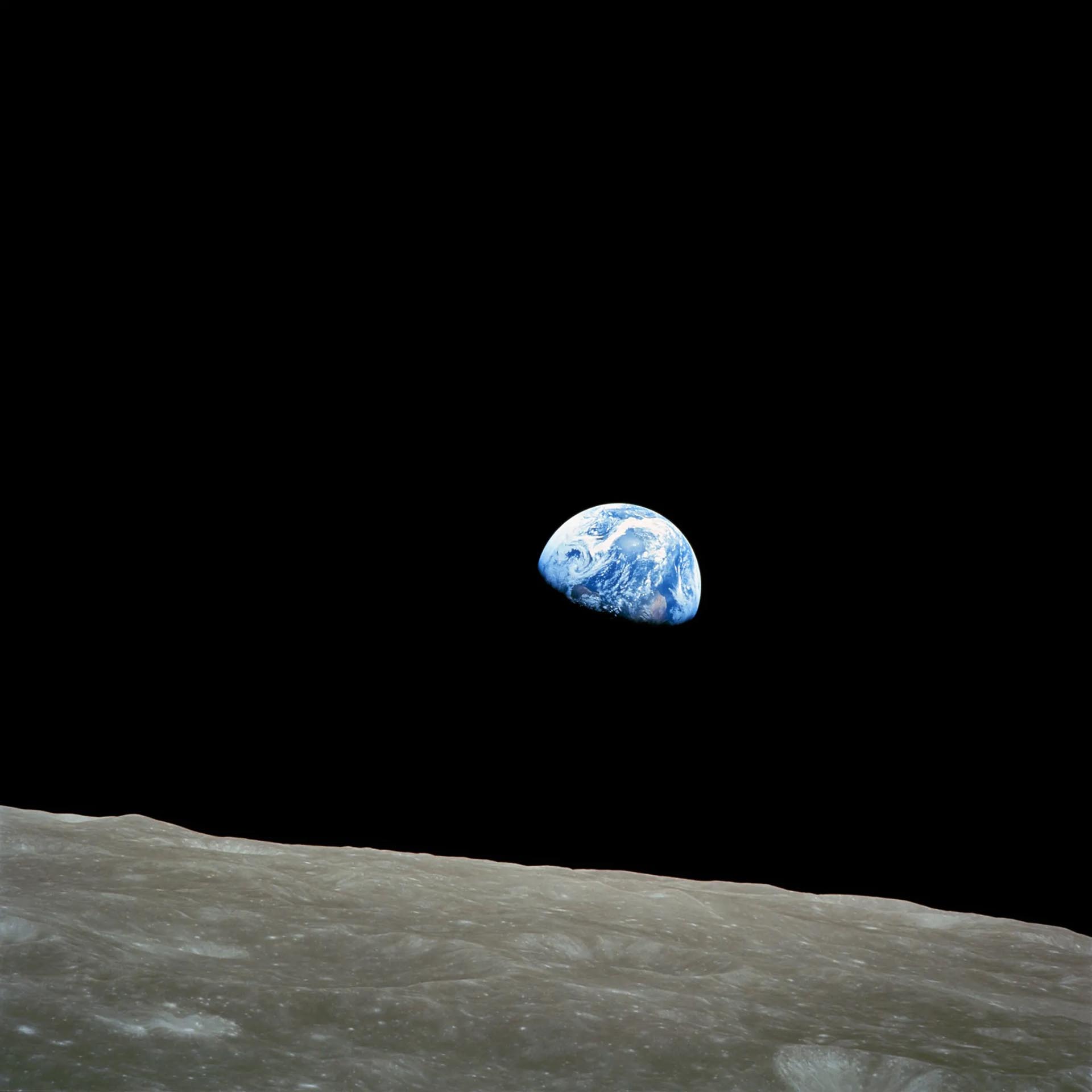
Via Print magazine, a new book documents the photograph and its impact.
A new middle-grade book, Earthrise: The Story of the Photograph That Changed the Way We See Our Planet by Leonard S. Marcus, introduces a generation—who did not experience the incredible high of watching American astronauts blast off and splash down—to the story of a global brand and the impact it had on low to high culture. Anders’ photo is the “beauty” shot that speaks to the hopes and dreams of the world and the next frontier’s infinite possibilities. Marcus’ book encapsulates the intense emotional power this one image had and continues to have.
Print’s Steven Heller spoke with Marcus about the book and his own growing up during the Space Race.
I was a fifth grader and a history geek when John Glenn flew his first orbital mission. My mother, knowing how excited I was about it, let me stay home from school that day to watch the blastoff live on TV. NASA was a big part of my own childhood—and of my childhood reading. (For a while, I also drank Tang—the astronaut’s instant orange juice substitute—every morning for breakfast.) Much later, by the time I began researching children’s book history and was writing my biography of [Goodnight Moon author] Margaret Wise Brown, I understood what a powerful symbol the moon was in art and literature.
Pick it up here.
Time’s Fool
It’s amazing how pliable the works of William Shakespeare are—the sheer variety of adaptations of his plays and other works demonstrates how universal his writing was. Although there are many takes on his plays, the sonnets sometimes get short shrift. But the discovery of a hitherto unknown version of Sonnet 116 gives Shakespeare scholars a look at how he was received in days of yore.
Sonnet 116 goes thusly:
Let me not to the marriage of true minds
Admit impediments; love is not love
Which alters when it alteration finds,
Or bends with the remover to remove.
O no, it is an ever-fixèd mark
That looks on tempests and is never shaken;
It is the star to every wand'ring bark
Whose worth's unknown, although his height be taken.
Love's not time's fool, though rosy lips and cheeks
Within his bending sickle's compass come.
Love alters not with his brief hours and weeks,
But bears it out even to the edge of doom:
If this be error and upon me proved,
I never writ, nor no man ever loved.
But Gizmodo (of all places) reports on a new manuscript of the sonnet that has been found by English professor Leah Veronese, who stumbled across it while conducting research at Oxford University’s Bodleian Library.
The sonnet in question is a handwritten copy of a musical adaptation of Shakespeare’s Sonnet 116, and it’s now only the second handwritten copy of Sonnet 116 known to scholars. Veronese recognized it within a manuscript of miscellaneous texts compiled by Elias Ashmole (1617–1692), the founder of Oxford’s Ashmolean Museum of Art and Archaeology and a loyal Royalist during England’s Civil Wars. As detailed in a study published February 3rd in The Review of English Studies, the sonnet’s adaptation and unique context shed light on a fundamental slice of 17th-century English history.
Of particular note is that the opening is completely different:
Self blinding error seize all those minds
Who with false appellations call that love
Which alters when it alterations finds
It’s a version of the sonnet that had been set to music by 17th-century English songwriter Henry Lawes, and also features a different ending as well as extra lines—which, the study theorizes, were intended to make the song longer. Perhaps think of it as an “extended dance remix” of Shakespeare. But, Veronese also contends, the added lines may be political.
From 1642 to 1651, England was wracked by three civil wars between King Charles I and Parliament. Parliament ultimately won, sentenced Charles I to death in 1649, and a Republican regime ruled for 11 years before Charles I’s son was reinstated as King. Those turbulent decades saw a devastating loss of life, as well as some bizarre legislation outlawing things such as Christmas and performing songs in public.
The revised sonnet/song was found a manuscript of miscellaneous texts compiled by Elias Ashmole (1617–1692), who was the founder of Oxford’s Ashmolean Museum of Art and Archaeology and a loyal Royalist during England’s Civil Wars.
The chaos of this period is reflected in Ashmole’s collection, which, along with the song version of Sonnet 116, includes Royalist poetry and banned Christmas carols. By itself, the adapted Sonnet 116 might seem vague, but in its historical context, Veronese interprets it as a call for religious and political loyalty.
“In the context of Ashmole’s collection, Lawes’ setting of Sonnet 116 reads as a political love-song in praise of Royalist political constancy during political turmoil,” Veronese writes in the study.
Dress like a the New Yorker
As we highlighted in this space recently, The New Yorker magazine is celebrating its 100th year of publication. In addition to magazine cover exhibitions the venerable magazine is pattering with J. Crew on a new “collaborative capsule”—that is, clothing. It’s not the first time the two NYC brands worked together—they had previously launched a line of limited-edition New Yorker comic T-shirts—and this time they are expanding into a full range of outerwear for men, women, and children, Says Hypebeast:
In the new capsule, J. Crew looked to bring the publication’s wit and sophistication to life across a delivery of dual-minded apparel and accessories. Dominated by an earthy, neutral color palette, rugby shirts are stamped with subtle logos and oversized oxford shirts land in both plain and striped iterations.

Wool crewneck sweaters arrive alongside cashmere knits, while graphic tees and hoodies come stamped with The New Yorker’s logo across the middle as well as other phrases like “Future Critic” and “Talk of the Town.” In true New York City fashion, accessories include a canvas tote bag and canvas baseball cap.
All items are available at J.Crew’s webstore.
Off a Cliff
Some of us (not us, we hasten to add) relied on CliffsNotes to get through high school English class. (Actually Monarch Notes were better.) In 1989, Spy magazine released a parody of CliffsNotes for a trio of “hip urban novels” from the 80s.
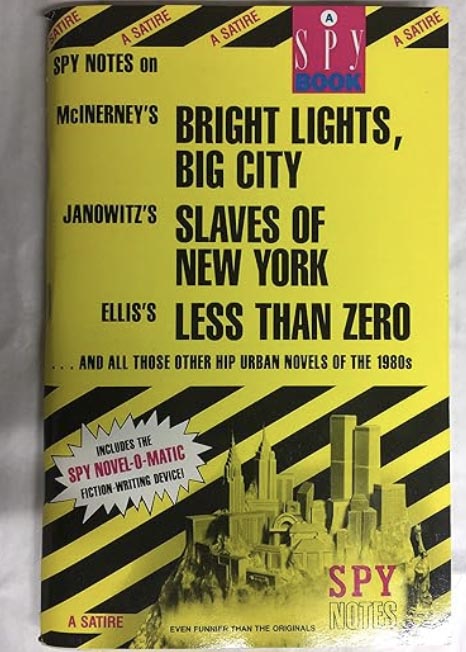
The joke being that they’re not exactly difficult to read and understand. (The parody is still available, by the way.)
Now, what sounds like another Spy parody, there is an app that will generate “CliffNotes” for nonfiction books. Via Boing Boing:
Headway is a book summary app that distills the key ideas from the world's best nonfiction reads into quick, 15-minute pieces. Whether you listen or read, you get the big ideas without the commitment of reading hundreds of pages.
(Weirdly, BoingBoing’s headline is “This app is like CliffsNotes but for books,” even though CliffsNotes is for books.)
There’s not a lot of information on what books it summarizes, aside from “thousands of reads that could help you crush your career, sharpen your mind, or just sound really smart at dinner parties,” although the official app site goes into far more detail.
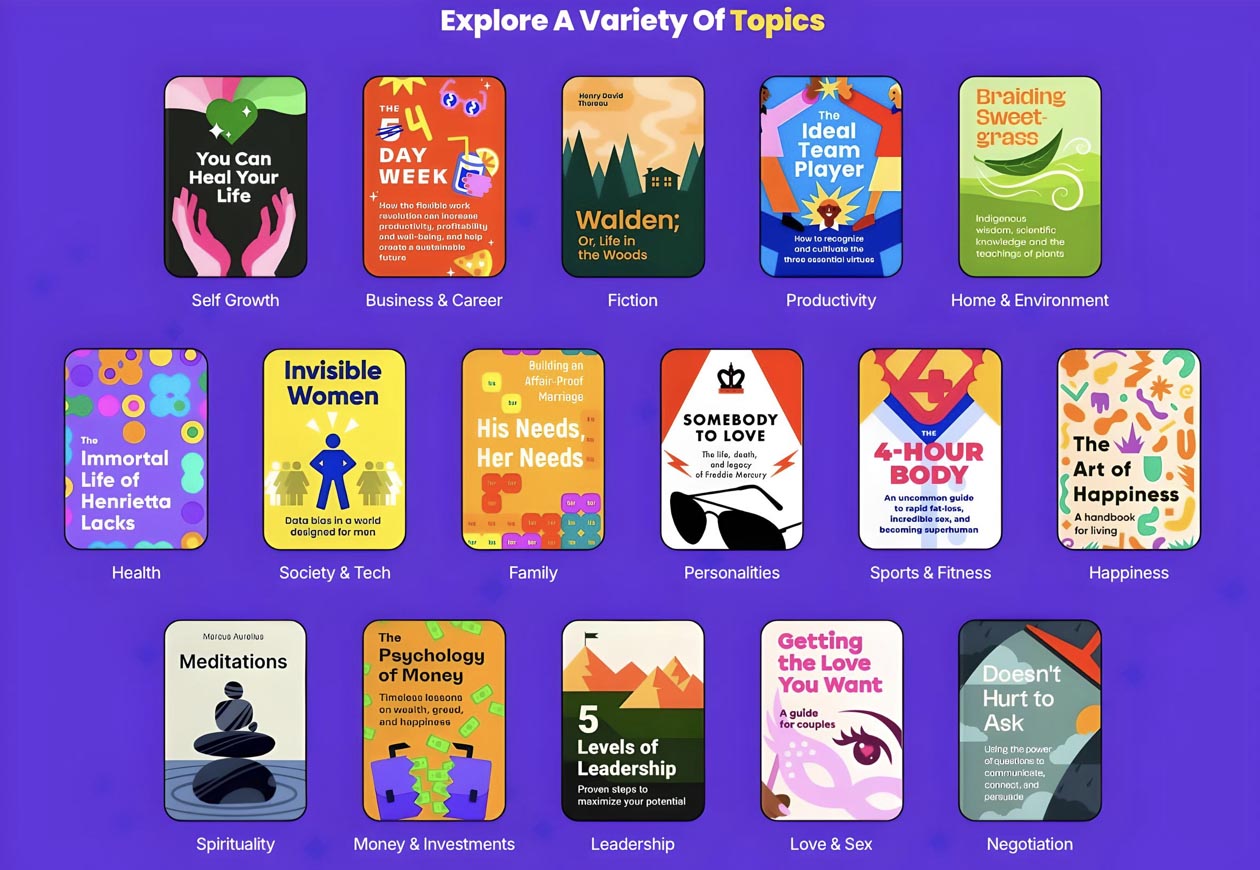
It’s rather like DuoLingo in a way whereby you set a particular goal and it will find the relevant book summaries. And you have to subscribe to it, which is annoying. We’ll stick with proper CliffsNotes—or, you know, read a book.
AI-Yi-Yi, Part the Ongoing: Bookmarked
If 15-minute summaries of books isn’t for you, why not try an AI bookmark? A what? Says Gizmodo:
Mark is a bookmark you place into a book when you are finished reading to mark your spot. Once you close the book, the gadget does the hefty lifting. It sends a summary of the pages you just read to your smartphone and then concocts a generalized summary based on information already associated with that title. The idea is that when you come back to it later, your brain will catch up with the breadcrumbs left behind.
Says the company:
Mark is an ecosystem designed to make reading engaging, seamless, and impactful.
With Mark, you read your physical book as usual. When you are done, simply slip Mark into your book, and it instantly syncs to your devices with:
Intelligent Summaries. Instantly generates insights from what you just read, customized to highlight key themes, quotes, and stats.
A Connected Reading Community. Discuss ideas and stay motivated, just like Strava—but for books.
Personalized Data & Tracking. Monitor reading pace, progress, and trends. Get Mark Wrapped—a yearly recap of everything you've learned.
This sounds like hell:
“Just like Strava keeps you motivated in fitness, Mark keeps you inspired in reading,” says the Mark Twitter/X account. This refers to the social media element of the bookmark, which lets your friends know you’ve made a dent in your reading once you’ve shut the book.
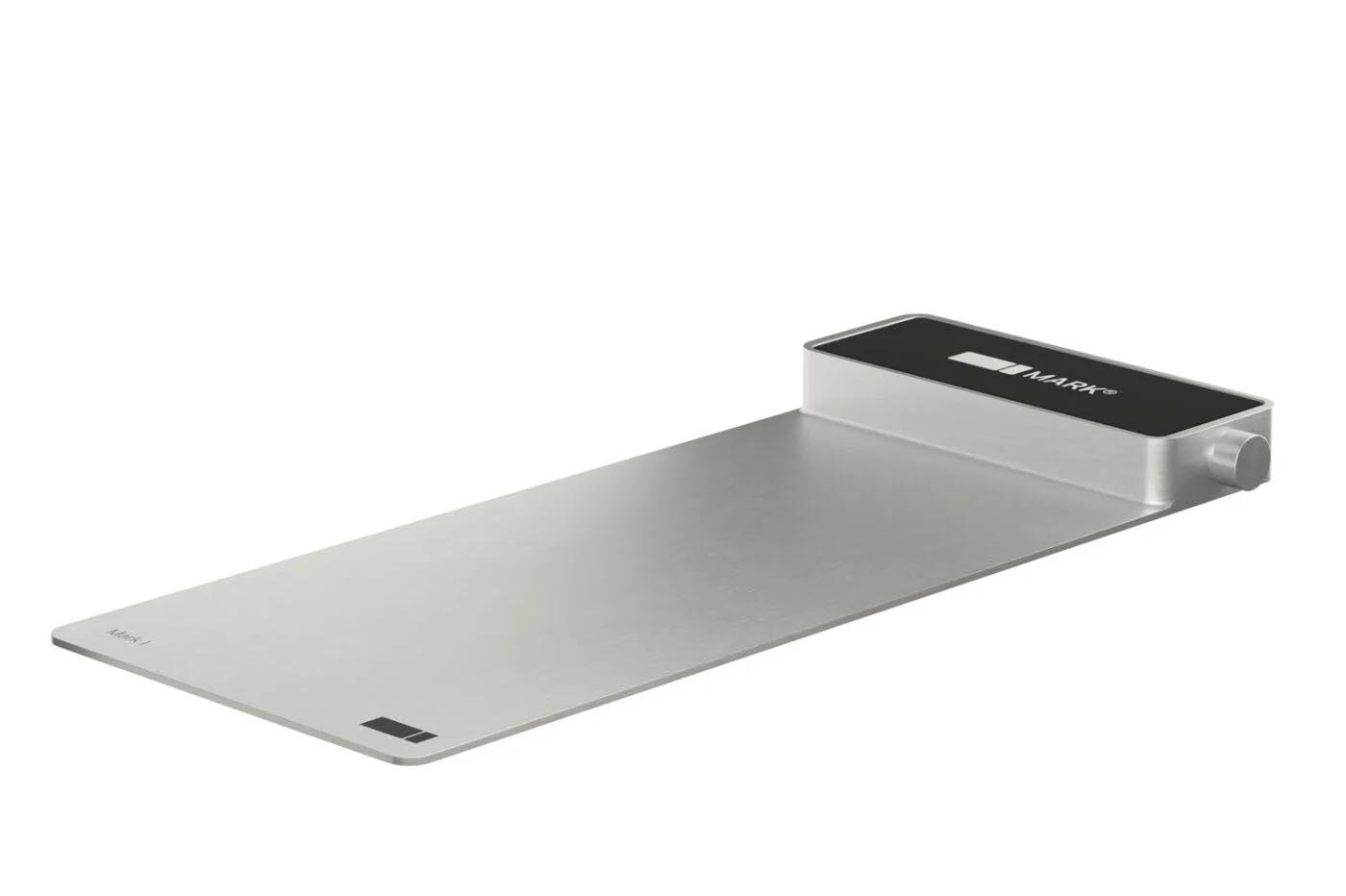
Bear in mind that it doesn’t really exist yet, but you can join a waitlist (when it appears it will cost $130). Or just read a book without the aggravation of something electronic.
Eskype Clause
Today, we take Zoom, Teams, Meet, etc., for granted (or get irritated by yet another video meeting) so it’s hard to recall just how revolutionary Skype was back in the day—that day being the early 2000s. Indeed, for some of us, the word “Skype” itself was synonymous with videocalling, and was a good and inexpensive way to call folks overseas without racking up hefty phone bills. And for some of us, a SkypeIn/Out number was a useful inexpensive alternative to a landline, especially for those of us who have lousy cellphone reception in our homes. It also had a call recorder for those of us who conduct phone interviews. Such was Skype’s popularity that Microsoft paid $8.5 billion for it in 2011.
But, alas, all things must pass.
Skype users (both of us) recently saw this message: “Starting in May, Skype will no longer be available. Continue your calls and chats in Teams.”
But, yeah, Skype had not kept up with the times. Boing Boing comes to bury Skype, not praise it:
Remember the pandemic, when everyone was desperate to video chat? That was your moment to shine! Instead, you sat in the corner while Zoom became a verb and Teams took over the corporate world. Even your notification sound started to feel less like a friendly chirp and more like the death rattle of outdated technology.
So it's time to join Clippy, Windows Vista, and Internet Explorer on that great digital ice floe in the cloud.
Don’t Let’s Start
Back in 1986, when we first heard the band They Might Be Giants—and bought their debut album—we would never in a million years have guessed that they would still be together, releasing records, and touring nearly 40 years later. Nor that they would inspire a set of postcards and prints. But, via Laughing Squid:
Chet Phillips, a talented artist and illustrator in Austin, created “Preposterous Astonishments”, a series of postcard sets and prints of fictional roadside attractions and parks that were inspired by They Might Be Giants songs.
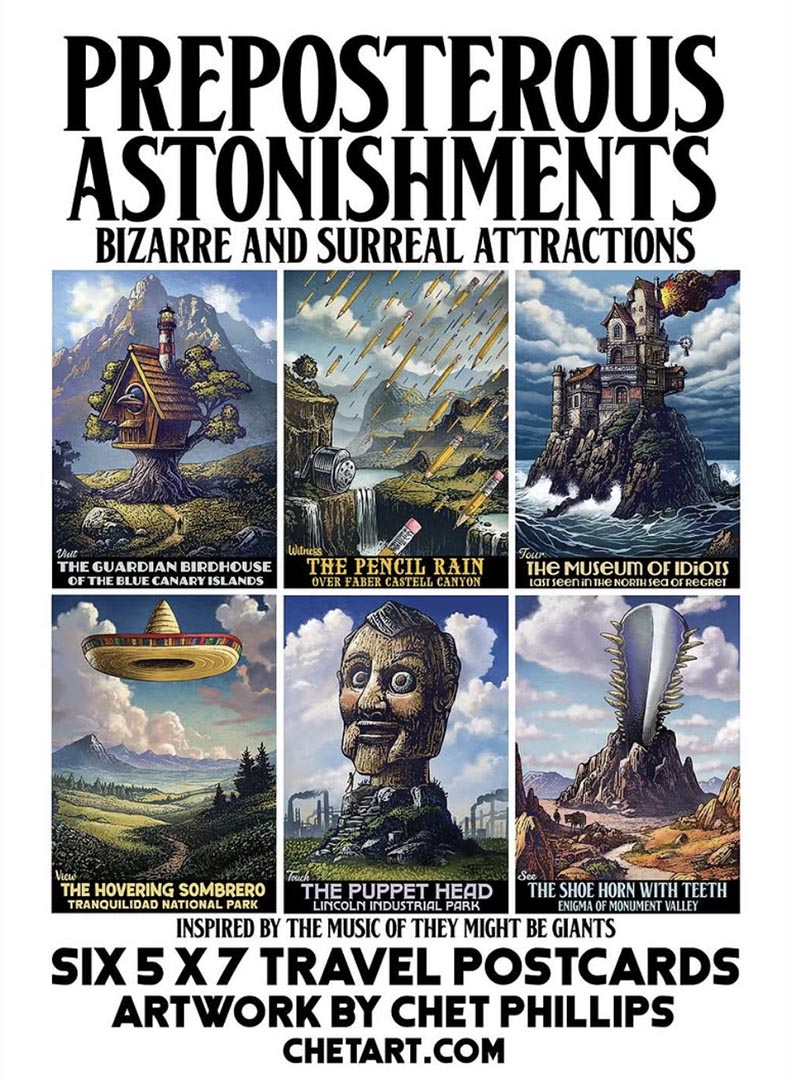
These and much more are available at Chet Phillips’ online store.
Graphene On My Mind
Was it a good week for graphene news? It’s always a good week for graphene news! Graphene-based brain implants. From (who else?) Graphene-Info:
A team led by researchers at the University of California San Diego Jacobs School of Engineering has been awarded a $5 million grant from the National Institutes of Health (NIH) to develop next-generation brain implants that can record brain activity with unprecedented resolution and speed across different brain regions. The technology aims to advance neuroscience by providing clearer insights into brain function and overcome key limitations of existing brain-monitoring devices.
And the implants use electrodes made from graphene.
This thin, transparent and flexible implant, called Neuro-clear, houses a dense array of graphene electrodes, offering a powerful alternative to current neural interface technologies. Conventional surface arrays are minimally invasive but struggle to detect signals from deeper brain structures. On the other hand, electrode arrays with penetrating needles provide deeper access but often lead to inflammation and scarring, which can degrade signal quality over time. The Neuro-clear technology developed at UC San Diego combines the strengths of both approaches, allowing it to achieve high-resolution, long-term neural recording with minimal invasiveness.
Wow—high-res brain scanning with minimal invasiveness Think about it!
Mighty Mouse
You may have seen the news this week that scientists have genetically engineered “woolly mice,” or mice that have thick fur similar to what woolly mammoths sported during the last ice age.
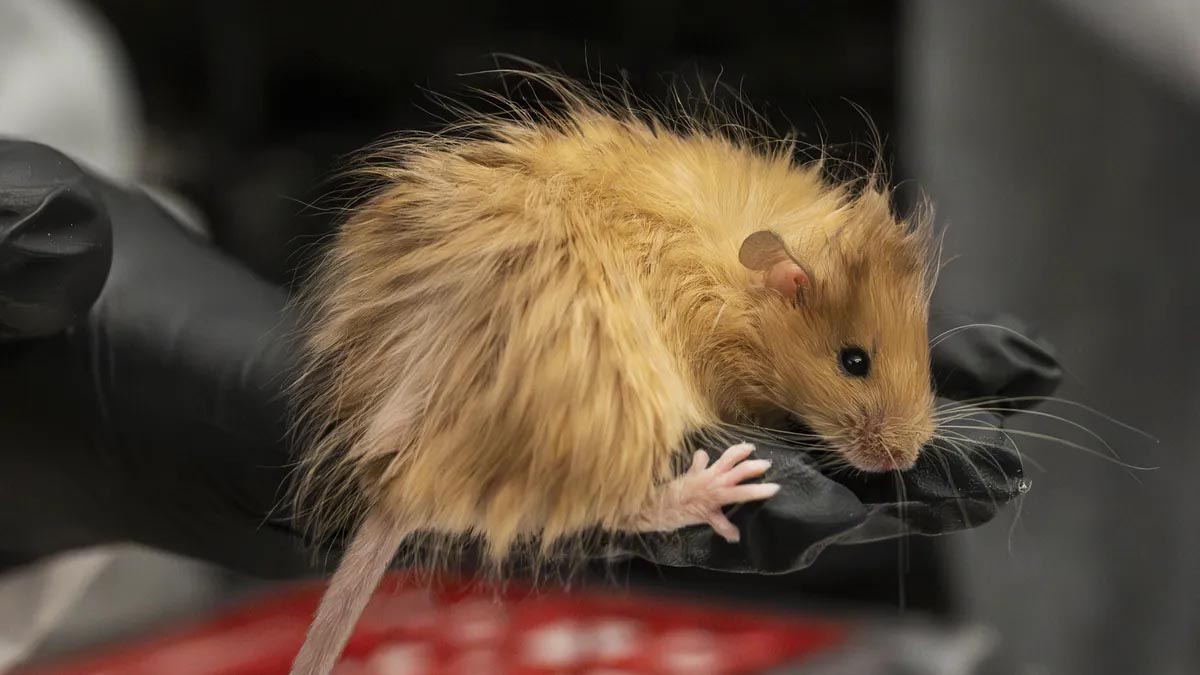
It’s cute and all, but we still wouldn’t want it in the kitchen. The mice were developed by scientists at Colossal Biosciences as part of their efforts to bring the woolly mammoth back to life, which they call “de-extinction.” Said LiveScience:
Colossal scientists plan to eventually “resurrect” woolly mammoths (Mammuthus primigenius) by first editing cells from the mammoths’ closest living relatives, Asian elephants (Elephas maximus), to create elephant-mammoth hybrid embryos with shaggy hair and other woolly mammoth traits. But before the researchers can start working with elephants, they must test the relevant gene edits and engineering tools in mice, which are easier to keep and quicker to breed.
But LiveScience asks, is this something we should be doing? Arguments against de-extinction involve the fact that the ecosystem in which they lived has changed so dramatically that it’s questionable that they would be able to survive on their own. And what kind of impact they would have on the ecosystem that does now exist? Introducing species into new environments has always been fraught with trouble. And if they’re only going to be de-extincted to be put in a zoo—or used as a food source—just seems kind of mean. Ultimately, it seems like there is little point to it. But the mice are cute.
Radio Silence
On January 18, 1903, Italian inventor Guglielmo Marconi made the first public two-way wireless communication between Europe and America, setting the stage of the advent of radio, television, radar, and many other communications technologies. Marconi’s transmitting site was located in South Wellfleet, Mass., now part of the Cape Cod National Seashore. There, he had erected a large antenna array on four 210-foot wooden towers. Kerosene engines produced the 25,000 volts of electricity needed to send signals to a similar station in Poldhu, Cornwall, United Kingdom. Says Atlas Obscura:
This coastal station was instrumental in several key sea rescues, including the pivotal response to the RMS Titanic’s sinking in April 1912, where station operators rapidly communicated the ship’s fate to the RMS Carpathia.
The station was closed in 1917 due to the outbreak of World War I, beach erosion, and the fact that better technologies existed. All the equipment was removed in 1920.
Not much is left there now but there is a commemorative plaque and a little display.
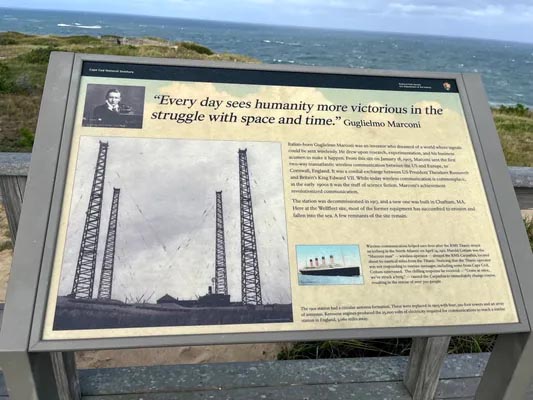
If you’re visiting Cape Cod, be sure to drop by.
Peep Show
Do you like Icees? Marshmallow Peeps? If so, good news! As Easter gets near, the two brands are coming together to create a Peeps-flavored Icee. From (who else?) Food & Wine:
According to the two brands, the ice-cold treat really does have the "unmistakable Marshmallow sweetness of Peeps" and can be found at participating convenience stores, as well as "mass merchandisers, trampoline parks, movie theaters, and theme parks," including select Target, Regal, and Main Event locations.

But wait! There’s more!
This isn't the only thing Peeps has going on this spring. In early February it also announced it's rolling out Peeps milk in partnership with Promised Land Dairy, which the two said is "a delicious, limited-time offering that delivers Easter delight straight from the cow."
That’s not as appetizing as they think.
It will be an interesting Easter this year; what with the price of eggs, the Easter Bunny will end up on Skid Row.
This Week in Printing, Publishing, and Media History
March 3
1847: Scottish-American engineer and academic and inventor of the telephone Alexander Graham Bell born.
1873: The U.S. Congress enacts the Comstock Law, making it illegal to send any “obscene, lewd, or lascivious” books through the mail.
1875: Georges Bizet’s opera Carmen receives its première at the Opéra-Comique in Paris.
1875: The first ever organized indoor game of ice hockey is played in Montreal, Quebec, Canada.
1882: Italian swindler, con artist, and “businessman” Charles Ponzi born. He was a practitioner of what eventually became known as the “Ponzi scheme.”
1885: The American Telephone & Telegraph Company is incorporated in New York.
1904: Kaiser Wilhelm II of Germany becomes the first person to make a sound recording of a political document, using Thomas Edison's phonograph cylinder.
1920: Canadian-American actor and purported inventor of transparent aluminum James Doohan born.
1923: TIME magazine is published for the first time.
1931: The United States adopts “The Star-Spangled Banner” as its national anthem.
1949: American historian, journalist, and author Ron Chernow born.
1951: Jackie Brenston, with Ike Turner and his band, records “Rocket 88,” often cited as “the first rock and roll record,” at Sam Phillips’s recording studios in Memphis, Tenn.
1953 English singer-songwriter and guitarist Robyn Hitchcock born.
March 4
1852: Ukrainian-Russian short story writer, novelist, and playwright Nikolai Gogol dies (b. 1809).
1882: Britain’s first electric trams run in east London.
1913: The United States Department of Labor is formed.
1957: The S&P 500 stock market index is introduced, replacing the S&P 90.
1974: People magazine is published for the first time in the United States as People Weekly.
March 5
1512: Flemish mathematician, cartographer, and philosopher Gerardus Mercator born.
1616: Nicolaus Copernicus’s book On the Revolutions of the Heavenly Spheres is added to the Index of Forbidden Books 73 years after it was first published.
1953: American screenwriter and producer Herman J. Mankiewicz dies (b. 1897).
March 6
1475: Italian painter and sculptor Michelangelo born.
1665: The first joint Secretary of the Royal Society, Henry Oldenburg, publishes the first issue of Philosophical Transactions of the Royal Society, the world's longest-running scientific journal.
1885: American journalist and author Ring Lardner born.
1888: American novelist and poet Louisa May Alcott dies (b. 1832).
1899: Bayer registers “Aspirin” as a trademark. What a headache that must have been.
1927: Colombian journalist, author, and Nobel Prize laureate Gabriel García Márquez born (not in the time of cholera).
1943: Norman Rockwell published Freedom from Want in The Saturday Evening Post with a matching essay by Carlos Bulosan as part of the Four Freedoms series.
1946: English singer-songwriter and guitarist David Gilmour born.
1966: English comedian, actor, and screenwriter Alan Davies born.
1975: For the first time the Zapruder film of the assassination of John F. Kennedy is shown in motion to a national TV audience by Robert J. Groden and Dick Gregory.
March 7
1274: Italian priest and philosopher Saint Thomas Aquinas dies (b. 1225).
1765: French inventor of photography Nicéphore Niépce born.
1792: English mathematician, astronomer, experimental photographer, and inventor of the blueprint John Herschel born.
1872: Dutch-American painter Piet Mondrian born.
1876: Alexander Graham Bell is granted a patent for an invention he calls the “telephone.”
1917: American engineer and programmer Frances Elizabeth “Betty” Holberton born. She was one of the six original programmers of ENIAC, the first general-purpose electronic digital computer, and was the inventor of breakpoints in computer debugging.
1999: American director, producer, and screenwriter Stanley Kubrick dies (b. 1928).
March 8
1010: Persian poet Ferdowsi completes his epic poem Shahnameh.
1618: Johannes Kepler discovers the third law of planetary motion.
1775: An anonymous writer, thought by some to be Thomas Paine, publishes “African Slavery in America,” the first article in the American colonies calling for the emancipation of slaves and the abolition of slavery.
1817: The New York Stock Exchange is founded.
1865: American type designer Frederic Goudy born.
1931: American author and critic Neil Postman born. (His 1985 book Amusing Ourselves to Death was eerily prescient.)
1979: Philips demonstrates the compact disc publicly for the first time.
March 9
1454: Italian cartographer and explorer Amerigo Vespucci born.
1776: The Wealth of Nations by Scottish economist and philosopher Adam Smith is published.
1815: Francis Ronalds describes the first battery-operated clock in the Philosophical Magazine.
1842: Giuseppe Verdi’s third opera, Nabucco, receives its première performance in Milan; its success establishes Verdi as one of Italy's foremost opera composers.
1918: American crime novelist Mickey Spillane. (It was Hammer time!)
1954: CBS television broadcasts the See It Now episode, “A Report on Senator Joseph McCarthy,” produced by Fred Friendly.
1959: The Barbie doll makes its debut at the American International Toy Fair in New York.
1963: American journalist and author David Pogue born.