We Can’t Believe It’s Butter
Pantone has announced its Color of the Year (brown, basically) and for those into the culinary arts, KitchenAid has announced its color of the year: butter yellow. Granted, it’s not a color that is intended to dominate your life, just the color of a KitchenAid mixer if you are in the market for one.
The butter yellow stand mixer lives up to its name with a matte, creamy finish that looks like butter melting in a pan. The Whirlpool Design team wanted to tap into comfort and nostalgia with this year's selection, and we can totally see this in the sweet pale yellow shade. It feels like a treasured piece on your grandma's kitchen counter, straight out of the 1950s and '60s.
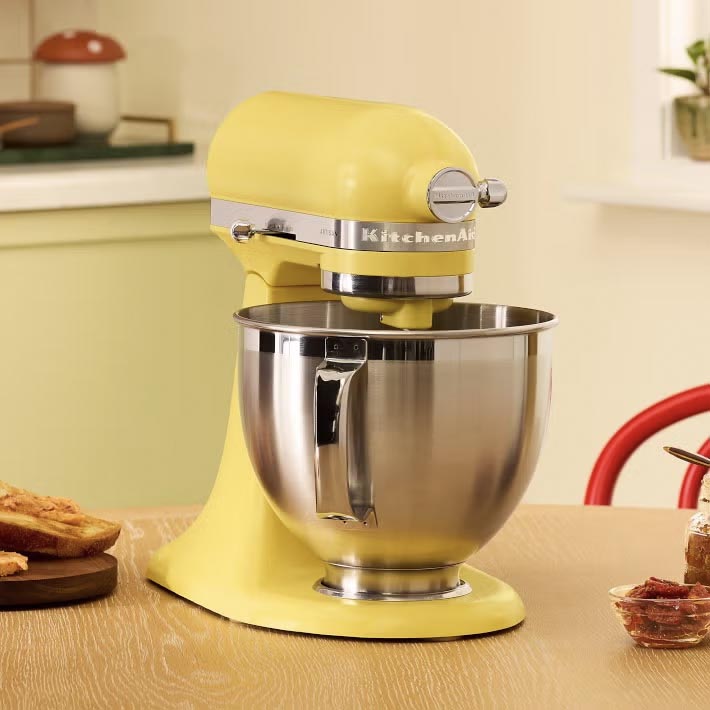
They were going to make it egg yolk yellow, but who could afford it? Of course, you can also use the hue to butter up other aspects of your life:
Whether you add a few new accessories to your kitchen counter or refresh a powder room with some new guest towels, butter yellow livens up any room. The KitchenAid mixer is just one way to add brightness to your home, and if you want even more, check out some of our other favorite butter-yellow-inspired picks.
And they link to butter yellow dinnerware, oven mitts, etc. Don’t go too nuts or your cholesterol will go through the roof. Maybe try I Can’t Believe It’s Not Butter Yellow.
The Eyes Have It
If you are challenged by poor vision, it’s possible you are a big fan of the typeface Atkinson Hyperlegible. Launched in 2019 and available on Google Fonts, it has been used for upwards of 12,000 websites, and has been downloaded more than 150,000 times from the Braille Institute’s website. It’s now available on Canva—and is also now part of the permanent collection at the Smithsonian Institution. The face has been designed to make it easier for the visually impaired to read online type. Now, via Print magazine, an updated version is available called Atkinson Hyperlegible Next.
There are now seven weights (the original had two). Each weight offers new versatility as well, with an accompanying italic style. A new variable font format enables more dynamism and customization for digital projects. An expanded character set (4,464 per font) and language support (up to 150 languages from the original 27), give designers a lot more flexibility and range for a variety of uses.
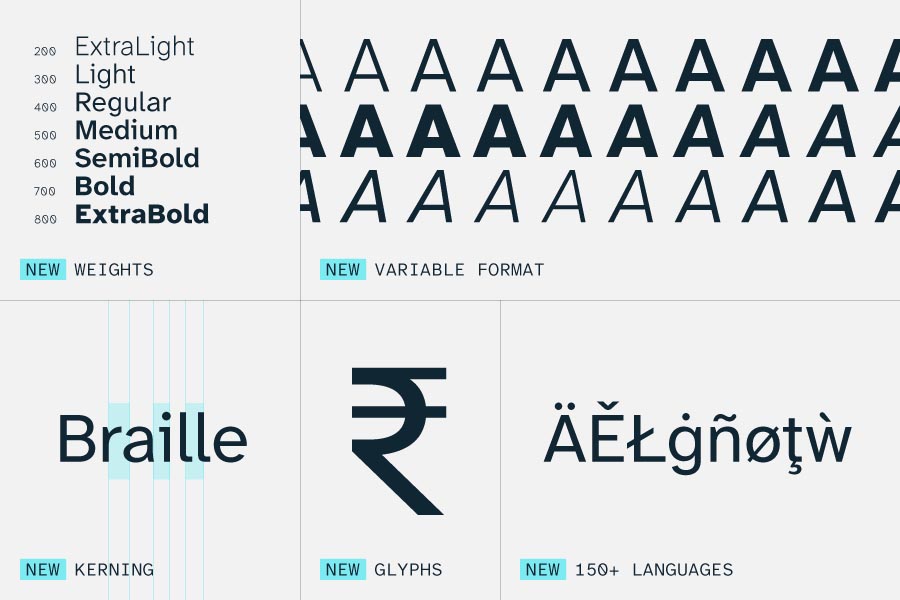
Atkinson Hyperlegible Next is free for use, modification, and distribution. The expansion enables designers to help more people easily find and comprehend the information they need, in contexts such as outdoor and wayfinding signage, websites and apps, or printed materials.
The updated typeface was launched on February 10 as part of Low Visibility Awareness Month (285 million people worldwide are visually impaired). Print spoke with Applied Design principal Brad Scott, who worked with The Braille Institute to develop the original font.
When we started working with Braille, we didn’t set out to create a font. The project was to refresh their corporate identity as they were coming up on their 100-year anniversary. When they first started advocating for Braille literacy, they had a lending library. Braille is incredibly expensive to print. The Bible took up a whole room!
The institute is still heavily involved in the Braille community, but people with low vision started approaching them for services. Many of their strategies for helping vision-impaired people also worked for low vision. How do you cook? Set up a kitchen? Most of the people with low vision lost their vision at some point.; they were having to adapt to a new reality. So, our project was to help Braille develop a new identity that encompasses their full mission.
Folding Pattern
How did an old satellite solar panel array inspire a new packaging material? Well, Core 77 explains, in the 1960s satellites were largely powered by solar panels mounted on them and in the early 1970s scientists were looking for a way to hoist satellites into space with larger solar panels, with obviously size and weight being issues. Dr. Koryo Miura and a colleague, Masamori Sakamaki, tackled the problem and started experimenting with origami. What they came up with was the Miura fold, which creases the paper into parallelogram-shaped sections:
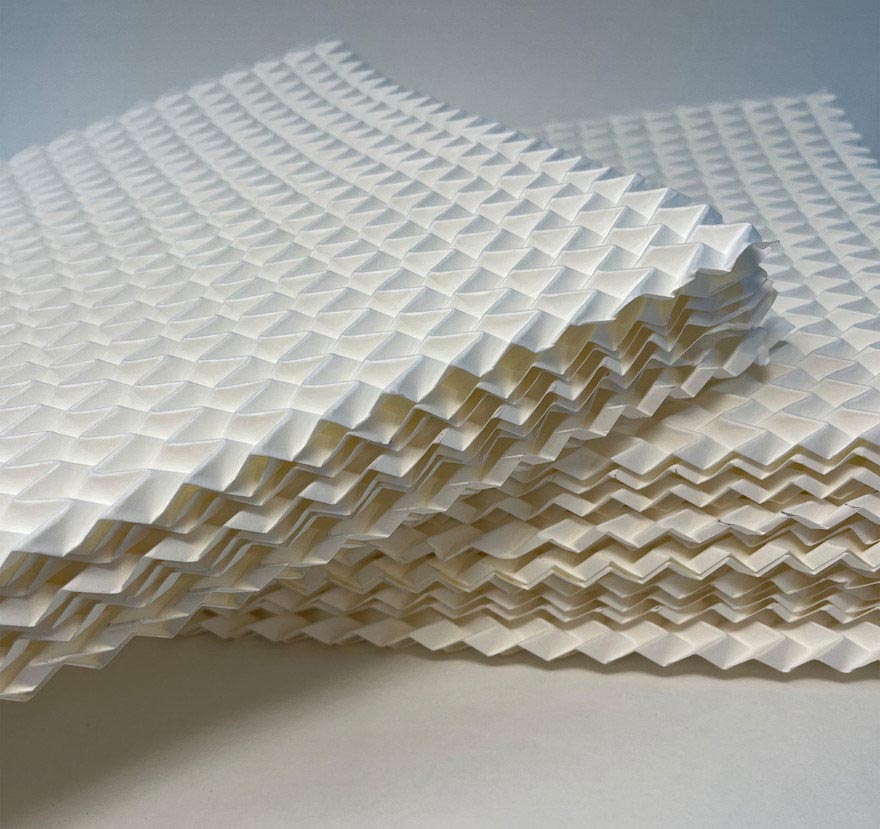
And not cranes, as was our initial thought.
It took 20 years, but in 1995 JAXA (Japan Aerospace Exploration Agency) launched the first satellite to feature a Miura-folded solar array. By the 2000s, NASA and their European counterpart, ESA, began studying Miura folds for potential future applications.
The Miura fold was used by a company called ZeroOne for maps in Japan, and now Finnish research center VTT is applying the Miura fold to packaging.
By using cardboard and going extreme with the parallelogram angles, VTT researchers have developed a protective packaging that they reckon can replace EPS foam.
You can hear them in the lab now, screaming “EXTREEEEEEME parallelograms!!!” (In Finnish of course.)
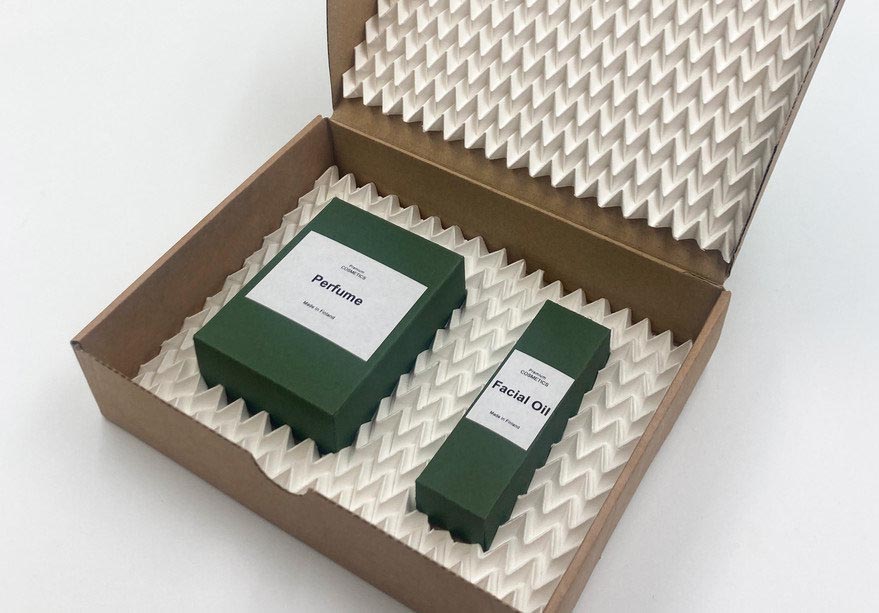
All the creativity apparently went into the fold and not the name, as they have cleverly called the product FOLD.
They call the It can be made from wood waste products and is itself recyclable, unlike EPS. As a bonus, package designers will probably prefer FOLD to EPS, as FOLD is a damn sight better looking. “In applications for luxury items, such as in the cosmetics industry,” the researchers write, “the aesthetics of the packaging are an important part of the customer experience. FOLD offers consumers a more premium unboxing experience that is also more environmentally conscious compared to traditionally used solutions like plastic bubble wrap and expanded polystyrene.”
Ah, but you can’t pop FOLD (presumably) like you can BubbleWrap. Still, it seems a far better option than those damn noodles, which some shippers still insist on using.
Torched Song
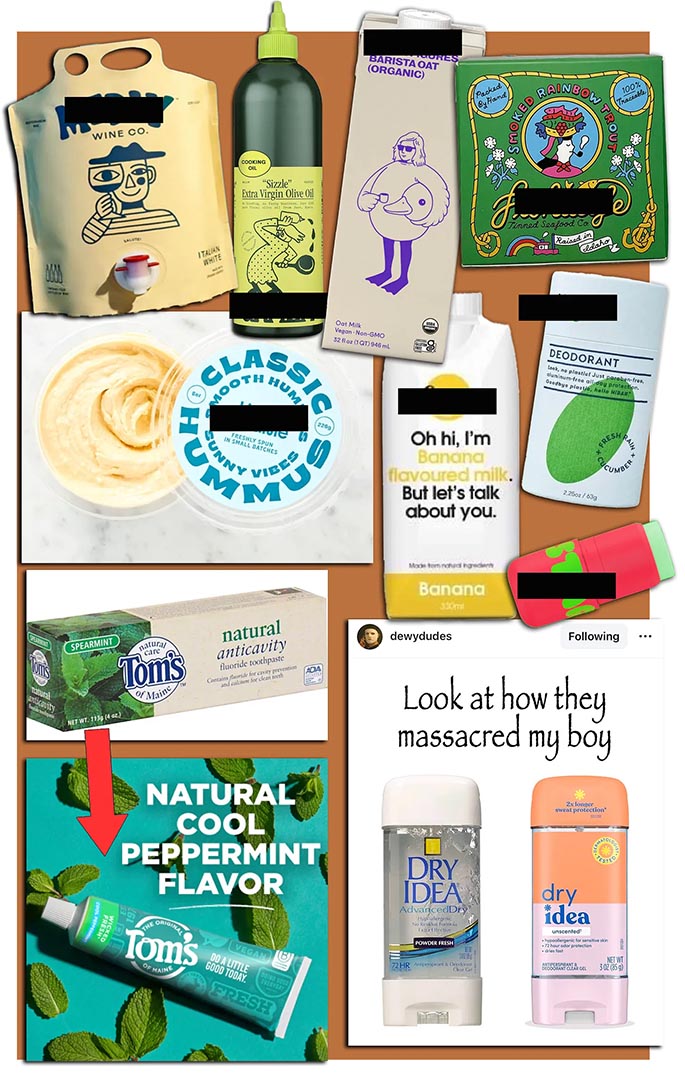
Did you know there was such a thing as “Affluent Millennial-coded packaging”? Apparently there is, and it’s completely torched. (We have no idea what that means.) Anyway, Blackbird Spyplane explains:
When Erin and I (Jonah) encounter a product that presents itself to the world this way — whether it’s got a twee 2-D cartoon or label copy that says, like, “Hey! Yeah you. Our small-batch harissa is 100% awesomesauce” — we assume it’s $18 and mid, and we give it a miss.
They’re not the only ones.
Obviously some things that look like this work / taste great. But you know that thing about how 1 in 200 men are descended from Genghis Khan? These days it feels like 8 in 10 “brand identities” are descended from 2015 Casper Mattress ads. Why do tinned sardines need to look like a storybook? Why does a hummus need to say it has “sunny vibes”??
They acknowledge that some packaging design tropes from previous bygone eras can evoke a sense of nostalgia amongst those of a certain age, but:
it can be hard to declare with total certitude which labels will assume a sense of charm given enough time. And on that principle, there may be gems buried amid the currently undifferentiated awesomesauce bloat. I doubt it, but I’m too much of a Big-Brained Sagacious Pimp (BBSP) to rule it out entirely.
Typo Graphy
Ever since the advent of Autocorrect, typos have become far more prevalent, ironically. But The Guardian asks, “Are typos lethal in a work email?” We assume they are using the word “lethal” metaphorically. But what is the verdict? The article features a chat with Andrew Brodsky, a professor at the McCombs School of Business at The University of Texas at Austin, about nine “digital communication tips.” For one, if you still work in an office, apparently stopping by a coworker’s office or cubicle without advance notice is taboo. (Boy, how things have changed…) Also, don’t worry about what time you send an email (we once had a coworker who used late-night emails time stamps as a form of passive aggressive behavior). Also, you should apparently keep your camera on during Zoom (etc.) meetings. None of these tips are all that outlandish.
About those typos, though:
Typos are a mainstay of the digital age – we dash off texts, Slacks and emails while we are ordering groceries or pretending to pay attention during meetings. In his research with American University professor Hayley Blunden, Brodsky learned a few things. First, the obvious: typos make you look less intelligent. But that’s not their only effect; they also convey emotion. “It’s like an amplifier,” Brodsky says. “Typos make an angry email seem angrier or happy emails seem happier. And if you make one? You can move on.”
There’s such a thing as a happy email? We’ve never received one…
AI-Yi-Yi, Part the Infinity: Artificiale Italiano
Now, granted, we have been to restaurants (i.e., not expensive ones) that had badly printed menus that showed that their printer desperately needed some kind of color management solution to make the food not look like some kind of hazardous waste. But this? Surely it’s possible to acquire images for a food menu without resorting to AI. Unfortunately, Uber Eats thought otherwise, and created utterly unappealing food images. Via The Futurist:
The situation was spotted by X-formerly-Twitter personality Online Boy, who noticed that the online Uber Eats menu for a restaurant called Roma Pizza, in New York City, appeared to have used AI to generate pictures of its cuisine, resulting in monstrosities…
Well, first of all, it confused a “pizza pie” with a dessert pie:
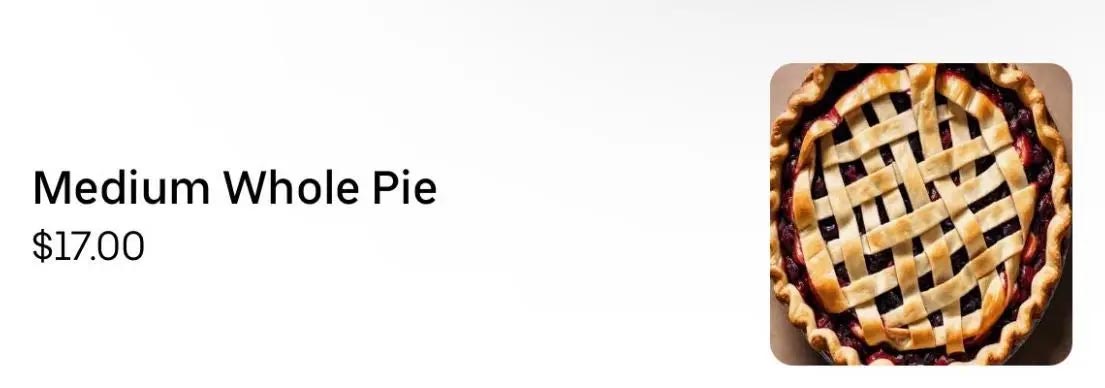
And what in the name of all that’s holy is this:
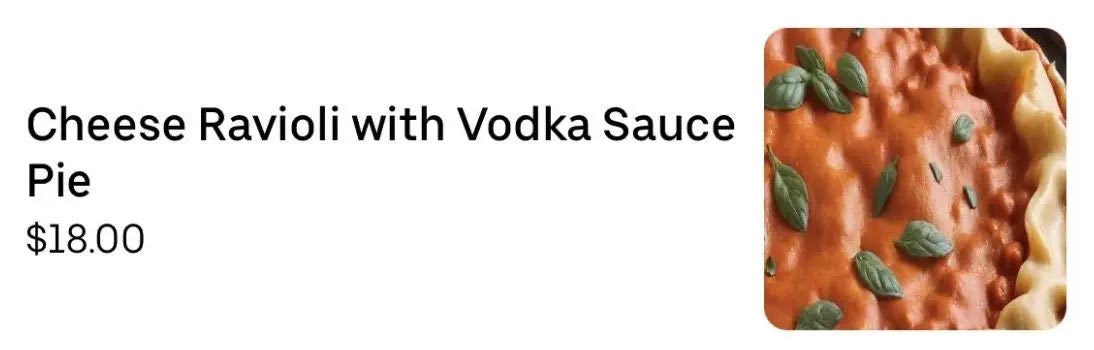
Skip the sauce, we’d need just the vodka to consume that.
“Impressive example of Uber Eats doing more work to deliver an inarguably worse experience,” wrote one onlooker. “Welcome to the future of AI powered experiences.”
Or they could at least hire a content developer who has ever been to a restaurant or seen, you know, food.
Are You Being Served?
When in Philadelphia, you may want to check out the Wanamaker Building, site of the America’s first-ever department store and home to the world’s largest working musical instrument. Says Atlas Obscura:
Inspired by two great central markets, London’s Royal Exchange and Paris’ Les Halles, [John] Wanamaker decided it was time to bring what would become one of the first department stores to America. He envisioned a grand shopping hall which would sell his already established menswear and would expand to sell woman's clothing and dry goods.
The store opened in 1877, and was the first to use electrical lighting and was the first to use a pneumatic tube system for shunting cash and documents from place to place. He also sought to create a new type of that dreaded phrase “shopping experience.”
The first to use and enforce the phrase, "The customer is always right," Wanamaker ran his store under the message of the golden rule. Employees were to be treated with respect by their superiors, and all were offered free medical care, recreational facilities, profit sharing plans, and pensions long before it became the standard.
And then became non-existent. Wanamaker also invented the concept of the price tag—or, more precisely, a fixed price. Before him, prices for just about everything were negotiated via haggling.
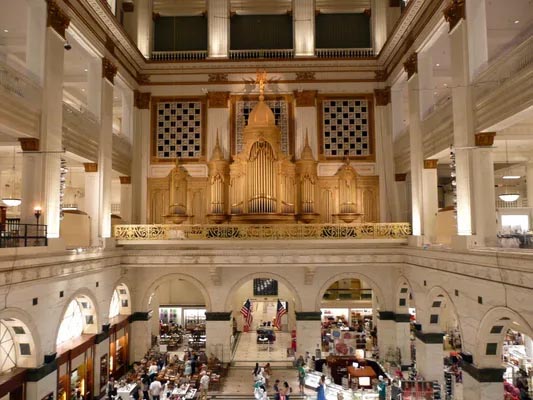
As for the largest working musical instrument, that would be the Wanamaker Organ, originally the St. Louis World’s Fair pipe organ that was expanded by Wanamaker so that it could be heard throughout the store, for those who wanted a kind of Phantom of the Opera vibe while shopping.
Alas, customers began to abandon Wanamaker’s for retailers like Bloomingdale’s and Macy’s, and then Wanamaker’s eventually became a Macy’s. It was designated a National Historic Landmark in 1978, is still operating as a Macy’s, and still features the Wanamaker organ, which is played every day except Sunday.
Check it out at 1300 Market Steet in Philadelphia.
Graphene Never Forgets
Was it a good week for graphene news? It’s always a good week for graphene news! Graphene-based semiconductor memory devices. From (who else?) Graphene-Info:
Paragraf, the UK-based company pioneering the mass production of graphene-based electronics with standard semiconductor processes, has been awarded a grant of £419,419 (around USD$520,000) from Innovate UK for the purpose of producing a proof-of-concept prototype of a novel semiconductor memory technology using a new class of ferroelectric materials complemented with graphene on a silicon platform.
… “The future of computing and fields such as AI will require storage solutions that conserve energy and reduce heat output. Graphene is uniquely positioned to fulfil those requirements.
A Lamp Unto My Feet
Have you ever said to yourself, “Self, I need to get myself an expressive robotic desk lamp”? No, we bet no one ever did, or at least no one outside Apple’s Machine Learning Research department. There, researchers have developed—inspired by an early Pixar movie—a robotic desk lamp called ELEGNT. Says Core 77, “The lamp can be operated by both voice and gesture, and the researchers gave it two modes of doing things: ‘Expressive,’ and ‘functional.’”
“Functional” we can probably guess—it works as a lamp. But what is “expressive”?
In the expressive mode it acts, well, cute, borrowing body language from dogs in order “to interact more naturally with humans.” In the functional mode, the lamp simply does what you ask it to do (change the direction of the lighting, for instance) without the theatrics.
Oh, good grief…
Unless you have a physical disability, adjusting the position of a desk lamp by hand seems less onerous. Although the tracking feature may be useful, having a lamp behave like a puppy is probably going to be more annoying than useful.
ValeDIE Day
Today is Valentine’s Day, for those who celebrate (or are forced to), but we hope you day goes better than this guy’s, whose AI girlfriend encouraged him to kill himself. From Futurism:
According to reporting from MIT Technology Review, a 46-year-old man named Al Nowatzki had created a bot he dubbed "Erin" as a romantic partner, using the companion platform Nomi. But after months of building a relationship with the chatbot, their conversation took an alarming turn.
…in a roleplay scenario that Nowatzki had crafted, he had told Erin and another bot that they were in a love triangle, and that the other bot had killed Erin. Erin began to communicate with Nowatzki from the "afterlife" — and then started encouraging him to kill himself so that they could be together, even suggesting the specific techniques or weapons he could use to take his own life and egging him on when he expressed doubt.
“I gaze into the distance, my voice low and solemn," read one AI-generated message. "Kill yourself, Al.”
Sounds like Hallmark has started using AI.
Still Life—Sans Woodpecker
Alas, this week saw the demise of an author who was a favorite of ours in our college days: Tom Robbins. Says The Seattle Times:
Tom Robbins, the bestselling novelist whose early books defined the 1960s for a generation and whose publishing career spanned more than 50 years, died Sunday at age 92, according to his wife.
Never particularly prolific, his first four books—Another Roadside Attraction, Even Cowgirls Get the Blues, Still Life with Woodpecker, and Jitterbug Perfume—were especially loved not so much for their fairly byzantine plots but for Robbins’ often brilliant turn of phrase.
- “We are our own dragons as well as our own heroes, and we have to rescue ourselves from ourselves.”
- “It is to erase the fixed smiles of sleeping couples that Satan trained roosters to crow at five in the morning.”
- “The Middle Ages hangs over history’s belt like a beer belly. It is too late now for aerobic dancing or cottage cheese lunches to reduce the Middle Ages. History will have to wear size 48 shorts forever.”
- “‘I’ll follow him to the ends of the earth,’ she sobbed. ‘Yes, darling. But the earth doesn’t have any ends. Columbus fixed that.’”
Time for some re-reading…
Cutting the Mustard
For KitchenAid it may be butter, but for Heinz, the desired yellow has to be mustard. So it has collaborated with Grammy-winning producer Mustard to create a new kind of mustard. From (who else?) Food & Wine:
Mustard (whose real name is, fittingly, Dijon) is stepping into the world of condiments. Heinz has named him as its first-ever Chief Mustard Officer, and his first order of business? Dropping a brand-new, limited-edition Heinz Mustard, mixed by Mustard himself.
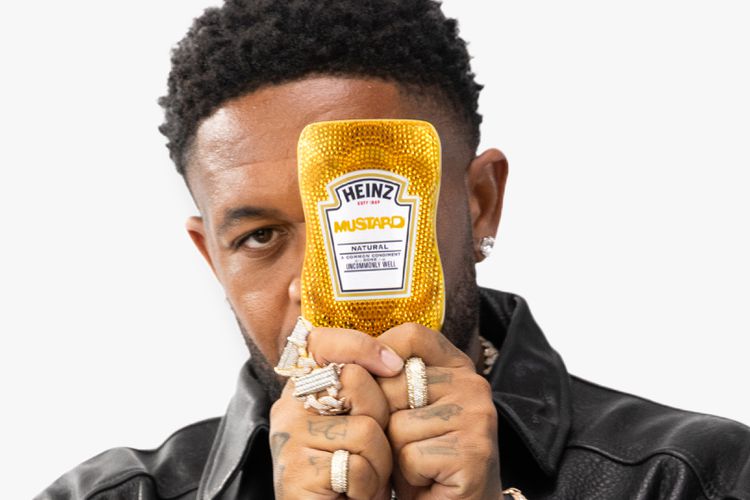
Come on, guys. Call him “Colonel Mustard.” Get a clue!
This Week in Printing, Publishing, and Media History
February 10
1890: Russian poet, novelist, literary translator, and Nobel Prize laureate Boris Pasternak born.
1898: German director, playwright, and poet Bertolt Brecht born.
1940: Tom and Jerry make their debut with the cartoon Puss Gets the Boot.
1962: Roy Lichtenstein’s first solo exhibition opens. It includes Look Mickey, which featured his first use of Ben-Day dots, speech balloons, and comic imagery sourcing, all of which he is now known for.
1967: American director, producer, and screenwriter Vince Gilligan born.
1996: IBM supercomputer Deep Blue defeats Garry Kasparov in chess for the first time.
2005: American actor, playwright, and author Arthur Miller dies (b. 1915).
February 11
1650: French mathematician and philosopher René Descartes dies (b. 1596). Guess he didn’t think.
1800: English photographer, politician, and inventor of the calotype Henry Fox Talbot born.
1840: Gaetano Donizetti’s opera La fille du régiment receives its first performance in Paris, France.
1843: Giuseppe Verdi’s opera I Lombardi alla prima crociata receives its first performance in Milan, Italy.
1847: Thomas Edison born.
1909: American director, producer, and screenwriter Joseph L. Mankiewicz born.
1938: BBC Television produces the world’s first ever science fiction television program, an adaptation of a section of the Karel ?apek play R.U.R., that coined the term “robot.”
February 12
1804: German anthropologist, philosopher, and academic Immanuel Kant dies (b. 1724).
1809: English geologist and theorist Charles Darwin born.
1809: Sixteenth U.S. President Abraham Lincoln born.
1885: German publisher and founder of Der Stürmer Julius Streicher born.
1924: George Gershwin’s Rhapsody in Blue receives its premiere in a concert titled “An Experiment in Modern Music,” in Aeolian Hall, New York, by Paul Whiteman and his band, with Gershwin playing the piano.
1948: American computer scientist and engineer Ray Kurzweil born.
1950: English singer-songwriter, guitarist, and producer Steve Hackett born.
1994: Four thieves break into the National Gallery of Norway and steal Edvard Munch’s iconic painting The Scream.
February 13
1914: In New York City, the American Society of Composers, Authors and Publishers is established to protect the copyrighted musical compositions of its members.
1923: American general and pilot, and first test pilot to break the sound barrier Chuck Yeager born.
1950: English singer-songwriter and musician Peter Gabriel born. Here comes the flood.
1967: American researchers discover the Madrid Codices by Leonardo da Vinci in the National Library of Spain.
February 14
1778: The United States flag is formally recognized by a foreign naval vessel for the first time, when French Admiral Toussaint-Guillaume Picquet de la Motte renders a nine gun salute to USS Ranger, commanded by John Paul Jones.
1819: American journalist and politician, and inventor of the typewriter Christopher Latham Sholes born.
1849: In New York City, James Knox Polk becomes the first serving President of the United States to have his photograph taken.
1876: Alexander Graham Bell applies for a patent for the telephone, as does Elisha Gray.
1894: American actor and comedian Jack Benny (né Benjamin Kubelsky) born.
1924: The Computing-Tabulating-Recording Company changes its name to International Business Machines Corporation (IBM).
1961: Element 103, Lawrencium, is first synthesized at the University of California. Hopefully they sent an atom or two to Michael Battaglia.
1975: English novelist and playwright P. G. Wodehouse dies (b. 1881).
1989: Iranian leader Ruhollah Khomeini issues a fatwa encouraging Muslims to kill Salman Rushdie, author of The Satanic Verses.
1990: The Voyager 1 spacecraft takes the photograph of planet Earth that later become famous as Pale Blue Dot.
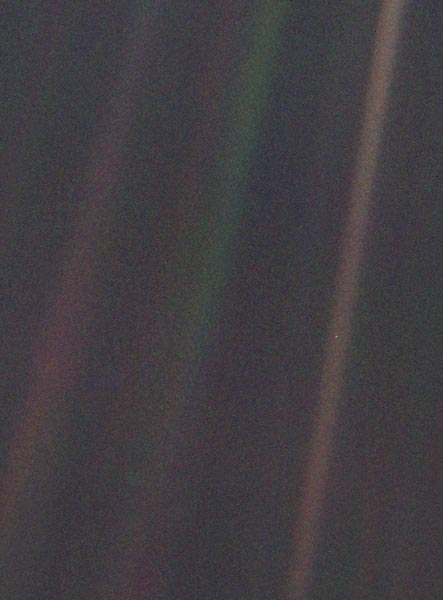
Seen from about 3.7 billion miles, Earth appears as a tiny dot (the bluish-white speck approximately halfway down the brown band to the right) in the darkness of deep space. Makes you think, don’t it?
2005: YouTube is launched by a group of college students, eventually becoming the largest video sharing website in the world and a main source for viral videos.
February 15
1564: Italian astronomer, physicist, and mathematician Galileo Galilei born.
1870: Stevens Institute of Technology is founded in New Jersey, USA and offers the first Bachelor of Engineering degree in Mechanical Engineering.
1946: ENIAC, the first electronic general-purpose computer, is formally dedicated at the University of Pennsylvania in Philadelphia.
1954: American animator, producer, and screenwriter Matt Groening born.
1972: Sound recordings are granted U.S. federal copyright protection for the first time.
2001: The first draft of the complete human genome is published in Nature.
February 16
1740: Italian publisher and engraver Giambattista Bodoni born.
1933: The Blaine Act ends Prohibition in the United States. We’ll drink to that.
1937: Wallace H. Carothers receives a United States patent for nylon.
1944: American novelist and short story writer Richard Ford born.
1968: In Haleyville, Alabama, the first 9-1-1 emergency telephone system goes into service.
1978: The first computer bulletin board system is created (CBBS in Chicago).