World's largest berry company teams up with leading traceability solutions provider to explore how GS1 standards and 2D barcode serialization are transforming supply chain transparency — from field to consumer.
Mount Laurel, NJ — Antares Vision Group (AVG), a global leader in supply chain traceability and transparency solutions, and Driscoll's, the world's leading fresh berry company, will deliver a joint presentation at GS1 Connect 2026 in Las Vegas. Titled "Berry Smart Traceability: Item-Level Traceability with 2D Barcodes," the session will provide supply chain, operations, and technology leaders with a detailed, real-world account of deploying serialization at unprecedented fresh produce scale — as well as the steps necessary to optimize such a far-reaching endeavor. The presentation, which occurs on June 10 from 3-3:30pm, in the Mont-Royal Room on Level 4, also will outline how GS1 Digital Link is emerging as the next foundation for Driscoll’s connected consumer vision.
The session will be led by Dana Biancardi, Senior Program Manager at Driscoll's, and Herb Wong, Chief Customer Officer at Antares Vision Group. Each brings a distinct perspective, with Ms. Biancardi focusing on the effort’s business outcomes and operational reality while Mr. Wong details the project’s technical architecture and implementation.
First and foremost, the joint effort was defined by its sheer size and scope: Driscoll's ships more than one billion pounds of berries annually to more than 400 customer locations across the U.S. and Mexico, sourcing from more than 4,000 independent growers. With over two million consumer survey responses received each year, the company had no shortage of feedback — but no way to connect that feedback to the specific farm, field, or berry variety that produced it.
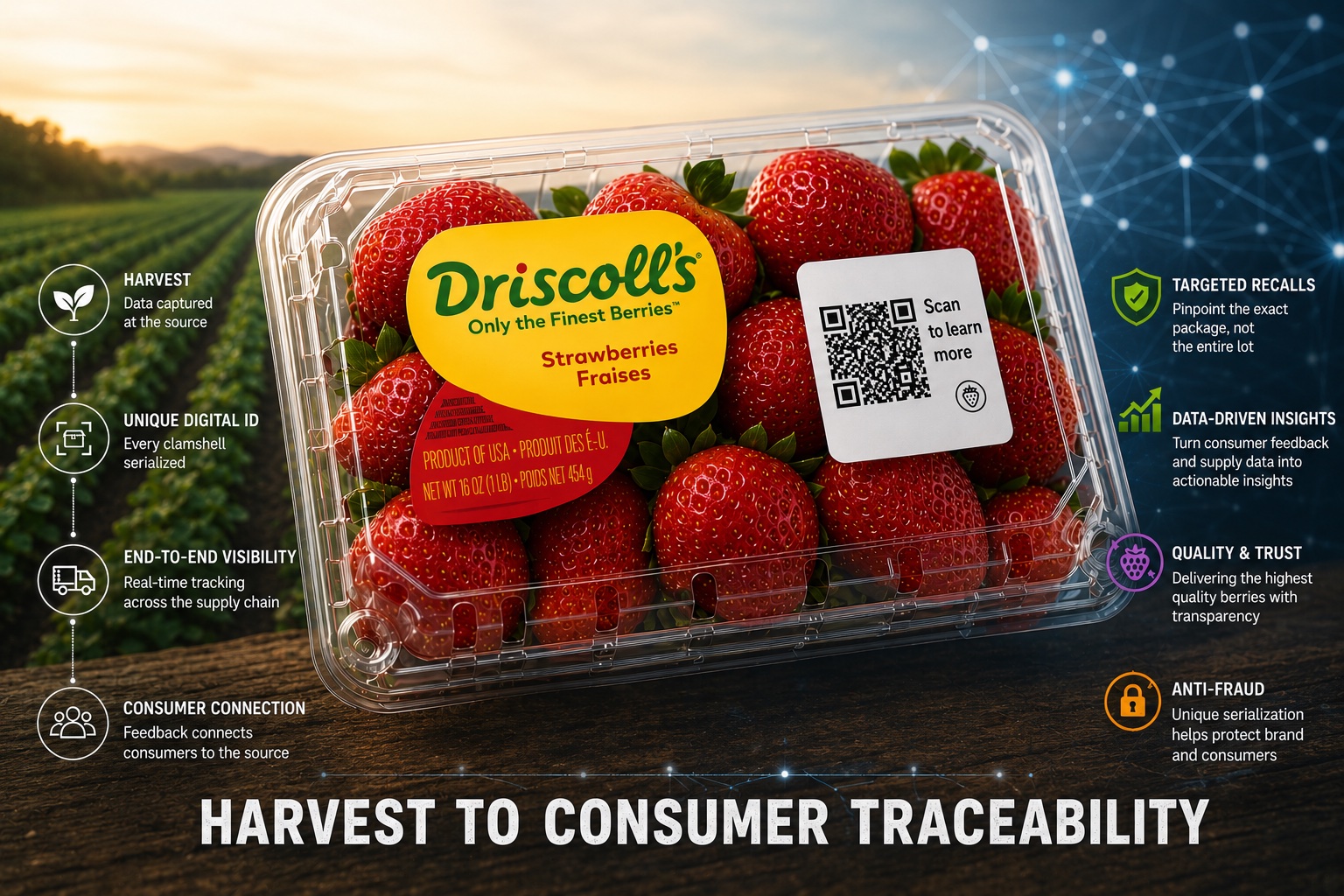
The solution was item-level serialization: giving every individual clamshell a unique identity, grounded in GS1 standards, that links each package back through the full supply chain encompassing its variety, grower, harvest event, and growing conditions. Consumers scanning the on-pack QR code to submit quality feedback are now not only providing valuable information, but also completing Driscoll’s shelf-to-field feedback loop.
Achieving Scale Without Sacrificing Precision
The implementation required solving for three constraints simultaneously: 99% scanning accuracy across millions of items in active field conditions, sub-second throughput without interrupting the pace of harvest, and compatibility with any consumer smartphone, without a proprietary app.
To date, more than 250 million clamshells have been serialized, with the system sustaining over 50 million serial numbers processed per month. A phased rollout of more than 11,000 Zebra handheld and stationary scanners spans 4,000+ farms across the United States and Mexico, with an expected volume of 2.7 billion serial numbers annually by 2028.
"We've designed a system that reliably manages billions of products in the first and last miles of the supply chain," said Herb Wong. "It performs these tasks day in and day out, with sub-second scanning times and exacting accuracy."
A central theme of the joint GS1 Connect presentation is the role of GS1 standards as the architecture that makes scale possible and interoperability achievable. The use of Global Trade Item Numbers (GTINs) and GS1's serialization framework provided a shared data language that avoids custom integration for each trading partner in Driscoll’s ecosystem.
For Driscoll’s, the shift from disconnected quality data to item-level traceability produced measurable operational outcomes. For one, growers and category managers can now act on consumer feedback tied to specific berry varieties and growing locations, enabling targeted improvement rather than broad inference. Adverse issues also are detected more expediently – for example, within days rather than weeks – preventing the proliferation of potentially substandard product through the supply chain. Variety optimization is another benefit, with high-performing varieties more easily identified, prioritized and scaled.
The program’s next phase is already underway: Driscoll's is currently running a live GS1 Digital Link pilot with three major retail partners, converting proprietary QR codes into universally readable data carriers. This shift connects two worlds that have historically been separate: the consumer experience and the supply chain system. A single scan can now serve both, enabling consumers to engage with the product while simultaneously allowing structured data to flow to retailers and partners. Where the first phase delivered internal visibility, GS1 Digital Link creates a shared interaction layer between consumer, product, and supply chain.