Every print business wants to get more out of the equipment it already owns. Yet many don’t have a clear picture of how their presses are actually performing day to day. Knowing your true utilization rate and billable production is one of the simplest ways to uncover hidden capacity. Most print operations know how fast their presses can run, but fewer have a clear picture of how efficiently that time is being used.
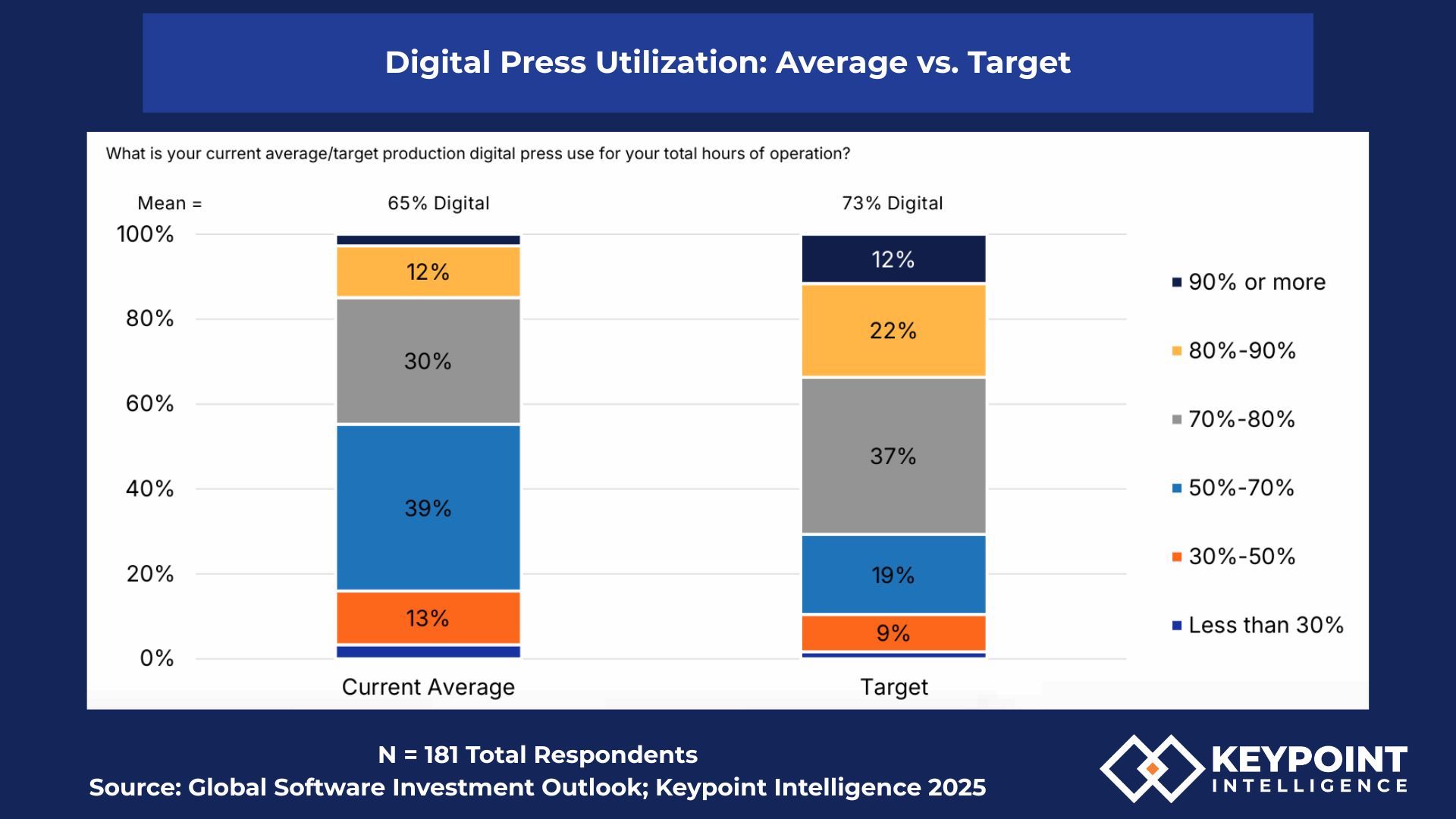
Recent research from Keypoint Intelligence found that digital presses are running at roughly 65% utilization on average, while most shops would like to be closer to 73%. That eight-point gap represents valuable hours that could be turned into billable work. Question is, What’s holding printers back from reaching that target?
See What’s Really Happening on the Floor
The first step is visibility. Too often, production data lives in different places: a spreadsheet here, a scheduling board there, a few manual notes on a clipboard. Without a clear view of the entire operation, it’s easy to miss trends like a press that sits idle during shift changes or recurring slowdowns in prepress.
“The most effective automation strategies start with insight,” says Mark Boyt, Principal Analyst at Keypoint Intelligence. “Real data turns automation from a buzzword into a business advantage, connecting every stage of production so the workflow operates as one system.”
Shops that use connected dashboards or analytics tools gain a clearer understanding of how time is spent. They can see when utilization dips, track which job types cause delays, and identify the real impact of approvals or rework. Once those insights are visible and an accurate picture of profitability is determined, small adjustments can add up to meaningful gains in productivity.
Track the Friction Points
Every workflow has bottlenecks, but they’re not always obvious. A shop might assume its presses are the problem when, in fact, the holdup often happens upstream. Files wait for client sign-off. Job tickets arrive incomplete. Finishing can’t keep up with throughput. These slow spots interrupt the rhythm of production and make it harder to plan capacity.
Mapping the journey of a typical job, from intake to delivery, helps reveal where time is lost. With that information, teams can decide what kind of investment will make the biggest impact. Sometimes it’s new automation software. Sometimes it’s better coordination between departments. And yes, for some, it may point to the need for additional equipment or new capabilities.
Turn Understanding into Smarter Investment
Knowing exactly where utilization drops allows leaders to invest strategically rather than reactively. When the data shows consistent backlogs at a certain stage, it’s easier to justify technology upgrades or training programs. When the numbers prove that presses are running near their limit, that evidence supports the case for new hardware. The insight turns investment from guesswork to strategy.
OEMs benefit from this approach as well. When customers understand their performance data, they can have clearer, more strategic conversations about what will truly improve productivity.
Build a Culture of Ongoing Improvement
Improving utilization isn’t a single project; it’s a mindset. The most successful print providers treat their operations as evolving systems that are constantly tuned for efficiency. They review the numbers regularly, listen to the production teams, and look for patterns that reveal the next opportunity.
“Once print providers can clearly see where time and capacity are being lost,” says Mark Boyt, Principal Analyst at Keypoint Intelligence, “they can make informed decisions about where to automate, where to invest, and where to grow.
As the industry moves into 2026, one thing is clear: the companies that truly understand their press utilization will have a powerful advantage. They’ll know where to focus, where to invest, and how to turn every press hour into a stronger bottom line.
Keypoint Intelligence provides timely and informative insights on current and future market trends and consults with stakeholders to navigate opportunities and challenges of the print industry. For more information go to our Production Workflow Advisory Service here.