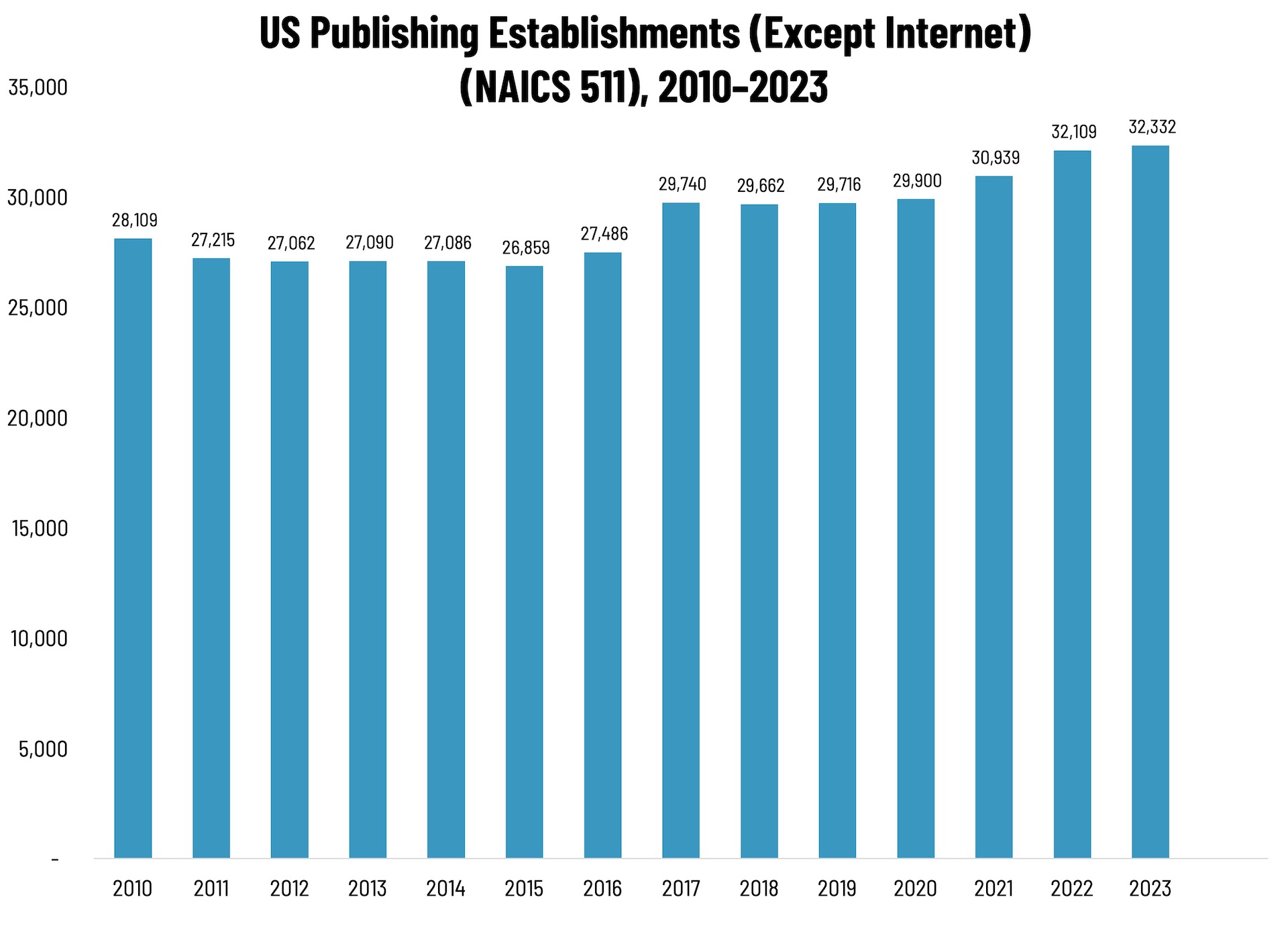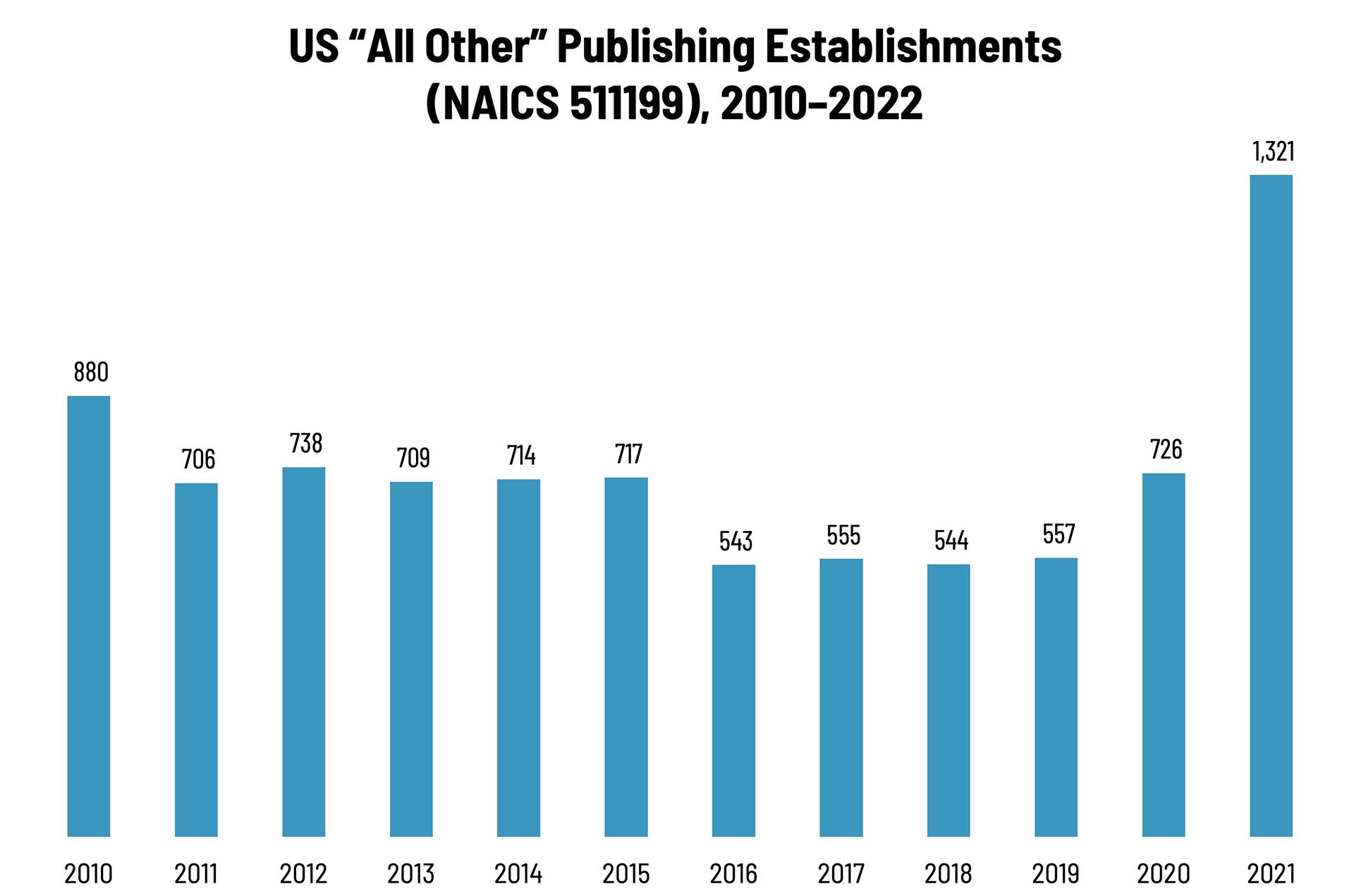
Our Friday data slice’n’dice look at the latest edition of County Business Patterns has been detailing the publishing industries and this one needs some explanation. As 2022 began, there were 1,321 establishments in NAICS 511199 (All Other Publishing). This represents a net increase of 82% in one year. Say what?!
The Census Bureau defines this category as:
This U.S. industry comprises establishments generally known as publishers (except newspaper, magazine, book, directory, database, music, and greeting card publishers). These establishments may publish works in print or electronic form.
This is a catchall category that includes publishers who specialize in all sorts of things not covered in the other NAICS categories. And a lot of these kinds of things are perfect for digital or other kinds of short-run printing equipment. Think printed postcards, art prints, calendars, maps and atlases, etc. And while a lot of these print applications have been largely replaced by digital alternatives (printed and mailed postcards have been superseded by posting pictures of trips and events on social media sites, for example), but art prints are still produced digitally on inkjet equipment like Epson SureColor units (Epson has a whole SureColor line dedicated to this market) and there is still a very large market for these prints. Wall and “page-a-day” calendars are still fairly strong, despite electronic calendar apps. The last time we looked at this category, we had said, “printed maps have almost entirely been replaced by GPS/GoogleMaps (except for historical or collectors maps).” And yet, as we pointed out in Around the Web last year, via Axios: “AAA produced 123% more maps in 2022 than 2021, the Wall Street Journal reports. “Digital maps, while powerful, aren’t perfect navigational tools: Phone batteries die, cell signals fail. And though a smartphone can easily direct you to the quickest route, taking it often means you’ll miss the best scenery. A paper map...can provide a bigger picture. And it’s not just for navigation. People are buying maps as gifts or to hang on their walls as art. Artists on Etsy will hand-draw custom maps of neighborhoods with beautifully illustrated landmarks.” So think various “boutique” publishing operations. So this NAICS category lends itself to lots of small businesses.
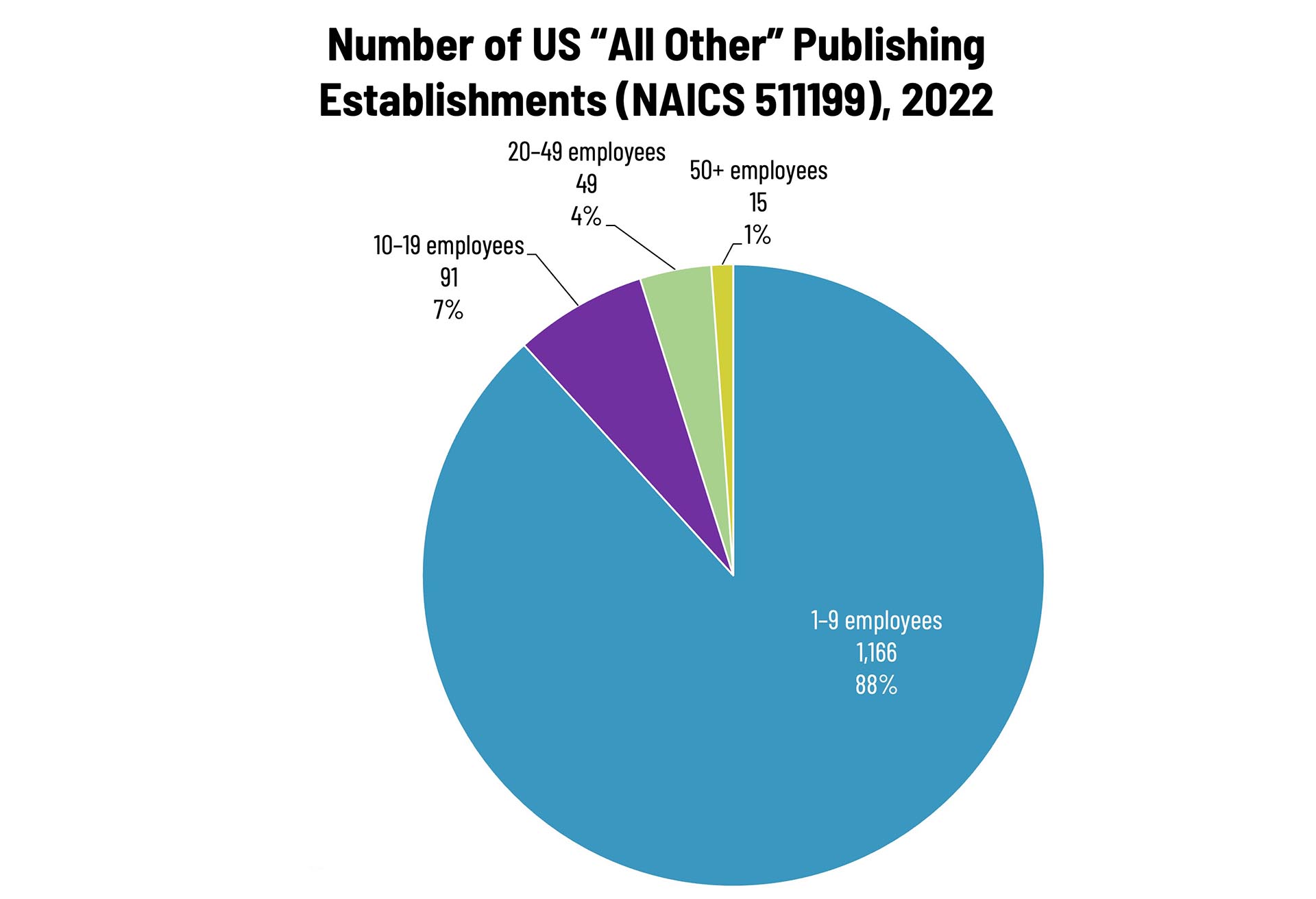
Regardless of what they produce, publishing establishments in this category are concentrated at the lower end of the employee-count spectrum. Small publishers (1 to 9 employees) account for 88% of all establishments, with the other three size classifications ranging from 2–7%.
These counts are based on data from the Census Bureau’s County Business Patterns. Every other week, we update these data series with the latest figures. These counts are broken down by printing business classification (based on NAICS, the North American Industrial Classification System). Next time, we’ll look at:
- 51913 Internet Publishing and Broadcasting and Web Search Portals
To clarify what is included in the 2022 CBP, establishment counts represent the number of locations with paid employees at any time during the year. If an establishment existed at any point during the year, it would be included in the CBP count of the number of establishments for 2022 CBP.
These data, and the overarching year-to-year trends, like other demographic data, can be used not only for business planning and forecasting, but also sales and marketing resource allocation.
This Macro Moment…
Yesterday, the BEA revised Q1 GDP growth down:
Real gross domestic product (GDP) decreased at an annual rate of 0.5 percent in the first quarter of 2025 (January, February, and March), according to the third estimate released by the U.S. Bureau of Economic Analysis. In the fourth quarter of 2024, real GDP increased 2.4 percent.
The decrease in real GDP in the first quarter primarily reflected an increase in imports, which are a subtraction in the calculation of GDP, and a decrease in government spending. These movements were partly offset by increases in investment and consumer spending.
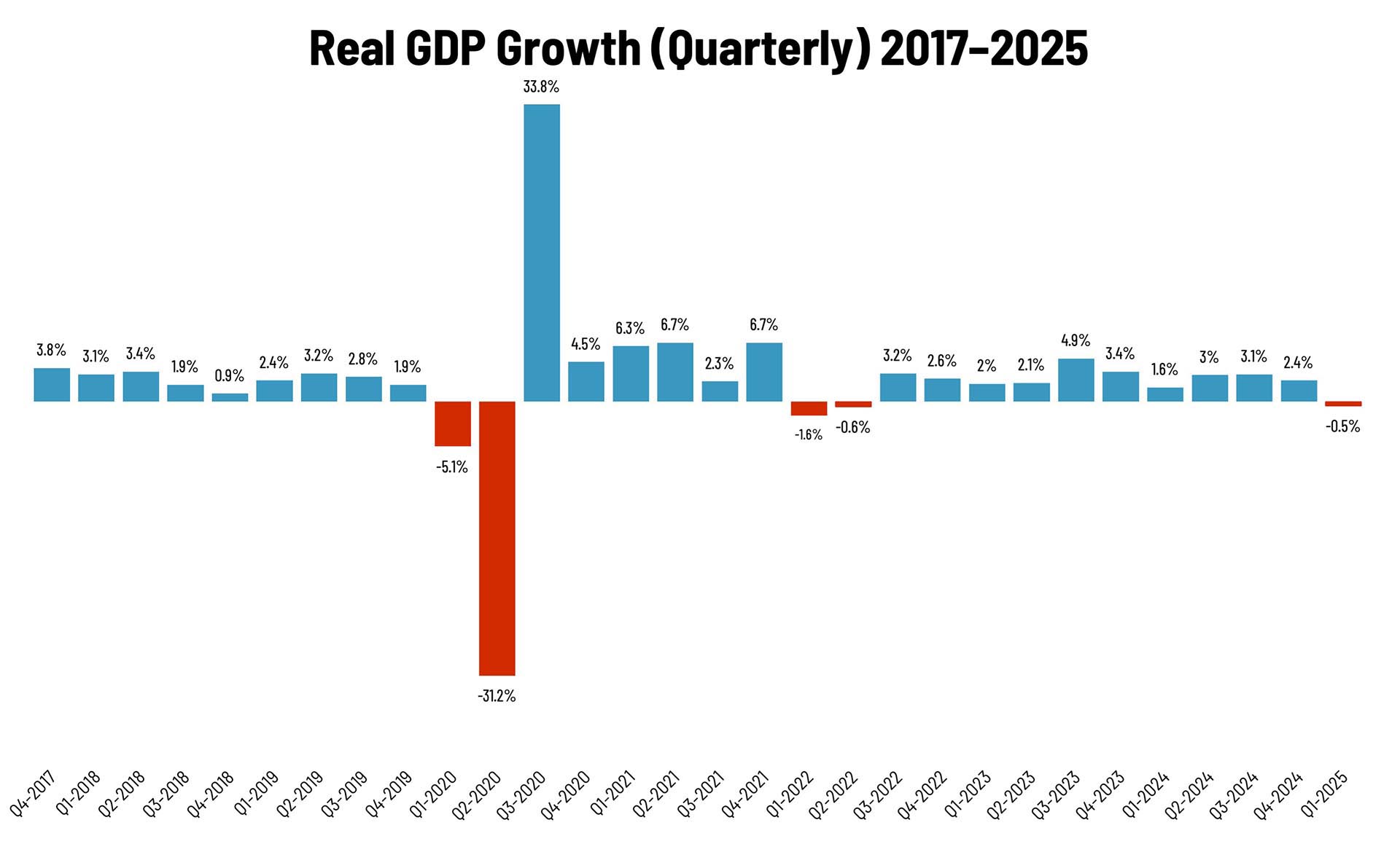
Source: Bureau of Economic Analysis
Real GDP was revised down 0.3 percentage point from the second estimate, primarily reflecting downward revisions to consumer spending and exports that were partly offset by a downward revision to imports.