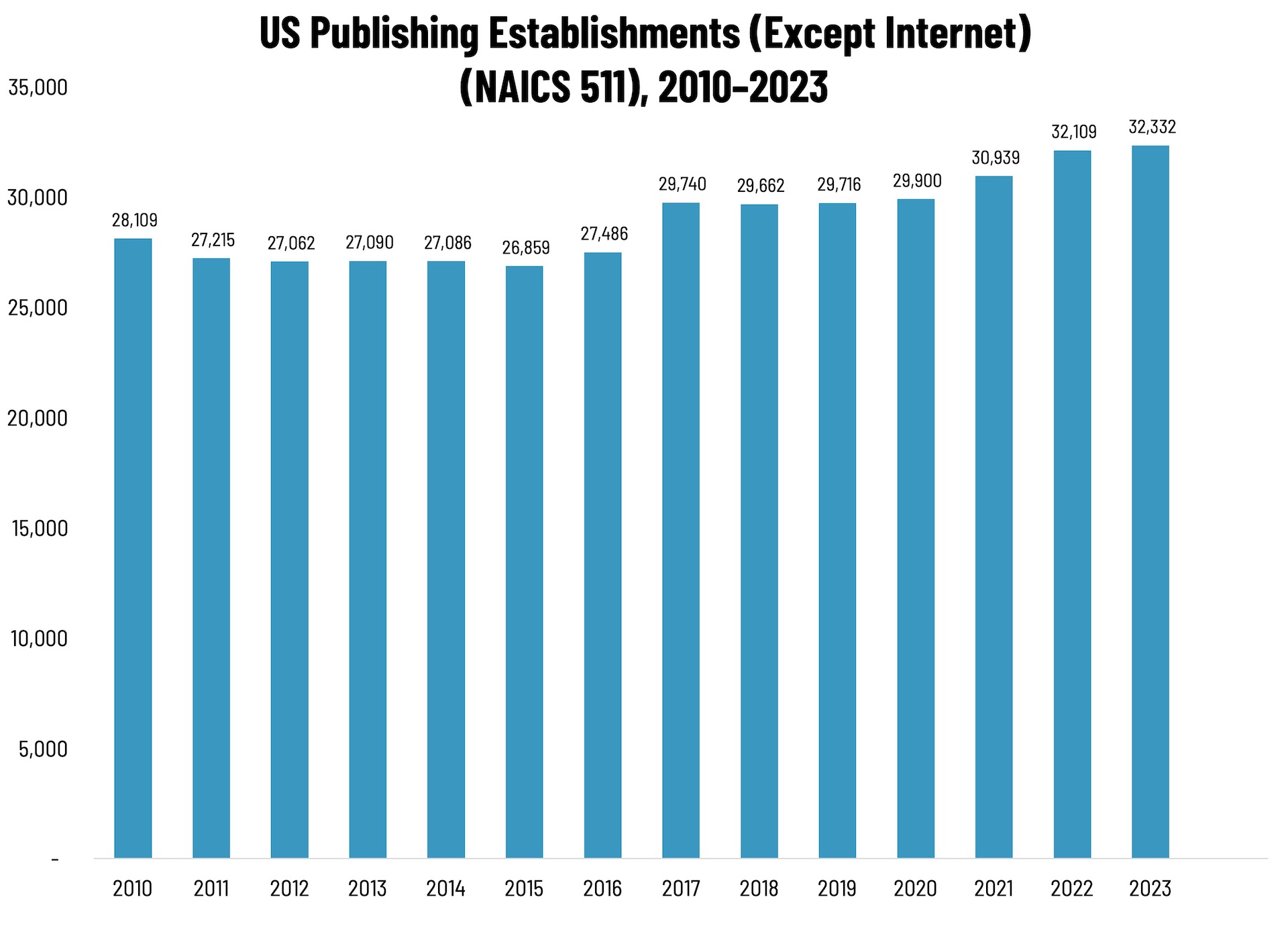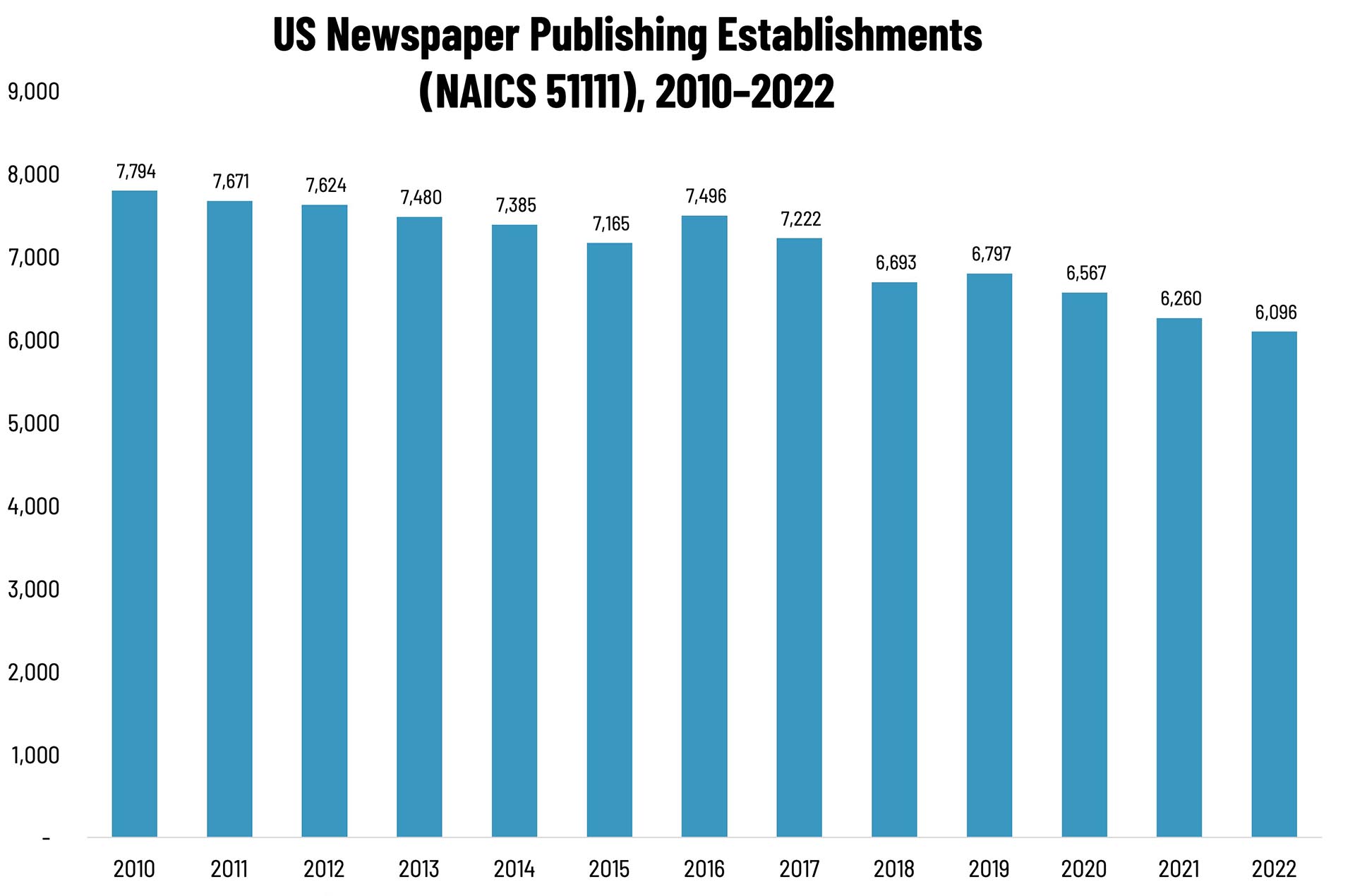
Our Friday data slice’n’dice look at the latest edition of County Business Patterns turns to the publishing industries. As 2022 began, there were 6,096 establishments in NAICS 51111 (Newspaper Publishers). This represents a decrease of 22% since 2010—and a decrease of 7% since the start of the pandemic.
The U.S. Census Bureau officially designates NAICS 51111 as:
This industry comprises establishments known as newspaper publishers. Establishments in this industry carry out operations necessary for producing and distributing newspapers, including gathering news; writing news columns, feature stories, and editorials; and selling and preparing advertisements. These establishments may publish newspapers in print or electronic form.
It’s tempting to blame the Internet (or the pandemic) on the decline of newspaper circulation, but that really only hastened a trend that started with the advent of television (and the nightly news) and then kicked into high with the advent of 24-hour cable news. At the same time, there has been tremendous consolidation among newspaper publishers, with one company owning many local papers, and even centralizing editorial and production facilities. The hardest hit have been small, local papers, which has serious consequences for local journalism.
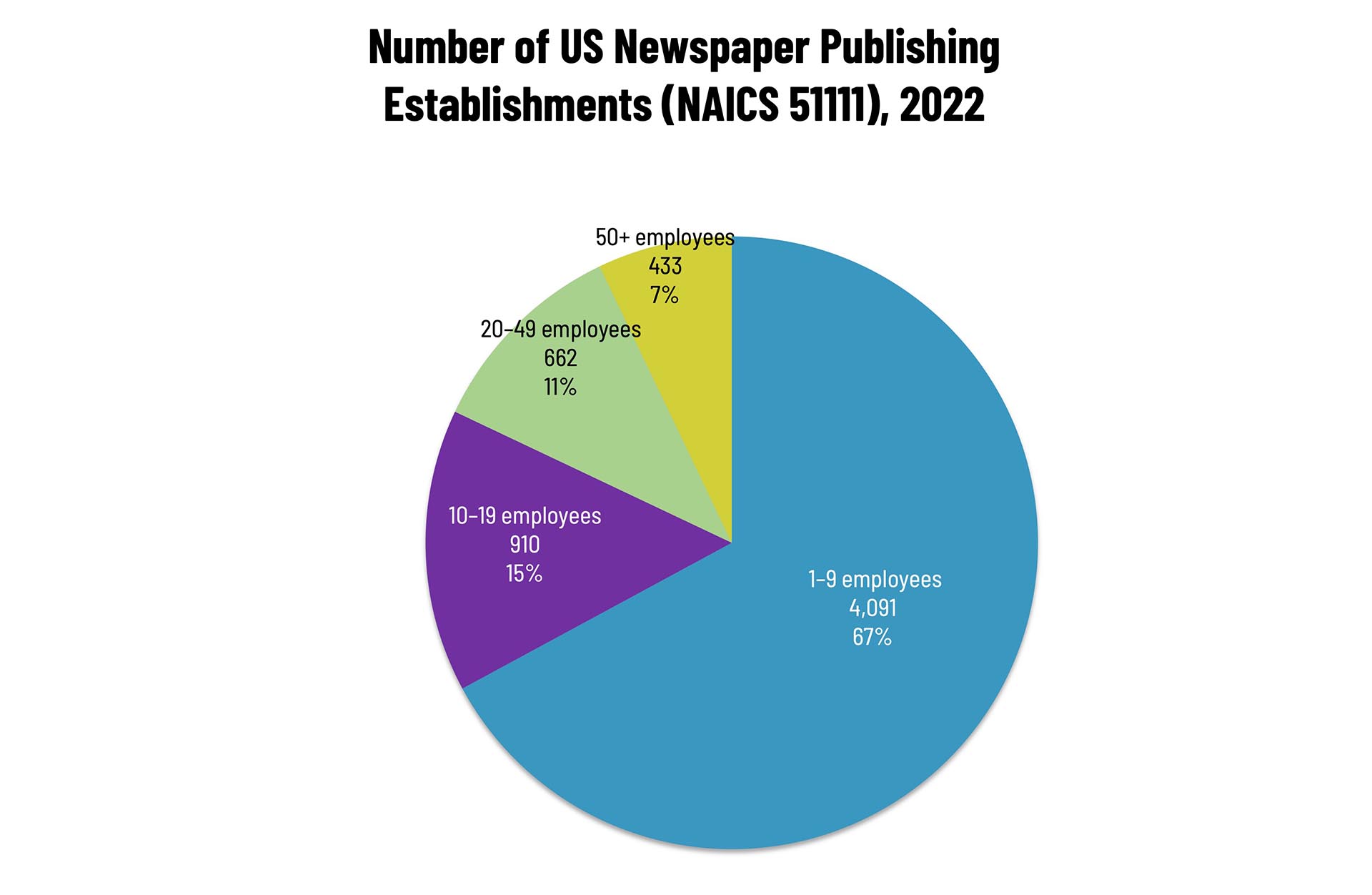
As we saw in the printing categories, publishing establishments are concentrated at the lower end of the employee-count spectrum. Small publishers (1 to 9 employees) comprise the bulk of the establishments, accounting for 67% of all establishments, with large publishers accounting for 7% and mid-size newspaper publishers accounting for 26%.
These counts are based on data from the Census Bureau’s County Business Patterns. Throughout this year, we will be updating these data series with the latest CBP figures. County Business Patterns includes other data, such as number of employees, payroll, etc. These counts are broken down by commercial printing business classification (based on NAICS, the North American Industrial Classification System). Up next:
- 51112 Periodical Publishers
- 51113 Book Publishers
- 51114 Directory and Mailing List Publishers
- 51119 Other Publishers
- 511191 Greeting Card Publishers
- 511199 All Other Publishers
These data, and the overarching year-to-year trends, like other demographic data, can be used not only for business planning and forecasting, but also sales and marketing resource allocation.
This Macro Moment…
One data point we check in with occasionally is the American Institute of Architects (AIA) Architecture Billings Index (ABI), which is a leading indicator for new commercial real estate investment and thus potential new signage projects. According to the AIA, in February 2025, demand for design services was soft indicating that interest in new projects was on the decline:
The AIA/Deltek Architecture Billings Index (ABI) score was 45.5 for the month, indicating that a majority of firms are still experiencing declining firm billings. Billings were flat early in the fourth quarter of 2024 but have softened significantly since then. February also marked the first month since the height of the pandemic in 2020 that inquiries into new projects at firms have declined. Inquiries can be as formal as an RFP or RFQ from a potential client, or as informal as a discussion about a potential project, and rarely decline, even during periods of economic softness. The decline this month likely reflects the ongoing uncertainty about the economy at this time. In addition, the value of new signed design contracts decreased at firms for the twelfth consecutive month in February, as clients also remain hesitant to commit to new projects at this time.
The billings index was below 50 for all of last year except for October (anything below 50 is poor) and has stayed below 50 for the first two months of 2025 thus far. While inflation was down, fear of tariffs remains a concern.
The Consumer Price Index (CPI) grew by 0.2% in February, indicating that inflation declined modestly, most notably due to decreases in energy and food prices. However, there is concern that the impact of the recently announced tariffs may cause the price of goods to rise again in the coming months. With this uncertainty, the Federal Reserve looks unlikely to lower interest rates at its meeting this month but is still expected to lower them later in the year.
The rule of thumb is that this index leads actual commercial real estate investment by about 9–12 months, so commercial real estate development might also be a bit soft as we head through 2025. Sign businesses should keep an eye on construction activity in their area to get a jump on involvement in these projects.