Drawing on seven years’ worth of Print Business Outlook surveys, our “Tales from the Database” series looks at historical data to see if we can glean any particular hardware, software, or business trends. This issue, we turn our attention to printing technologies.
These surveys form the basis of our annual Printing Outlook reports, the most recent of which (2024) is currently in development and should be available in January 2024. In every survey, we ask a broad cross-section of print businesses about business conditions, business challenges, new business opportunities, and planned investments. In our Printing Outlook reports, we tend to focus (obviously) on the most recent survey data, occasionally looking back a survey or two to see how these items have changed in the short-term. Plumbing the depths of our survey database can give us a better sense of how these trends have changed since the mid-2010s.
New Business Opportunities
Over the past decade, we have tweaked our survey question(s) specific to printing technologies as they have evolved, so it’s not always possible to get a clear trendline.
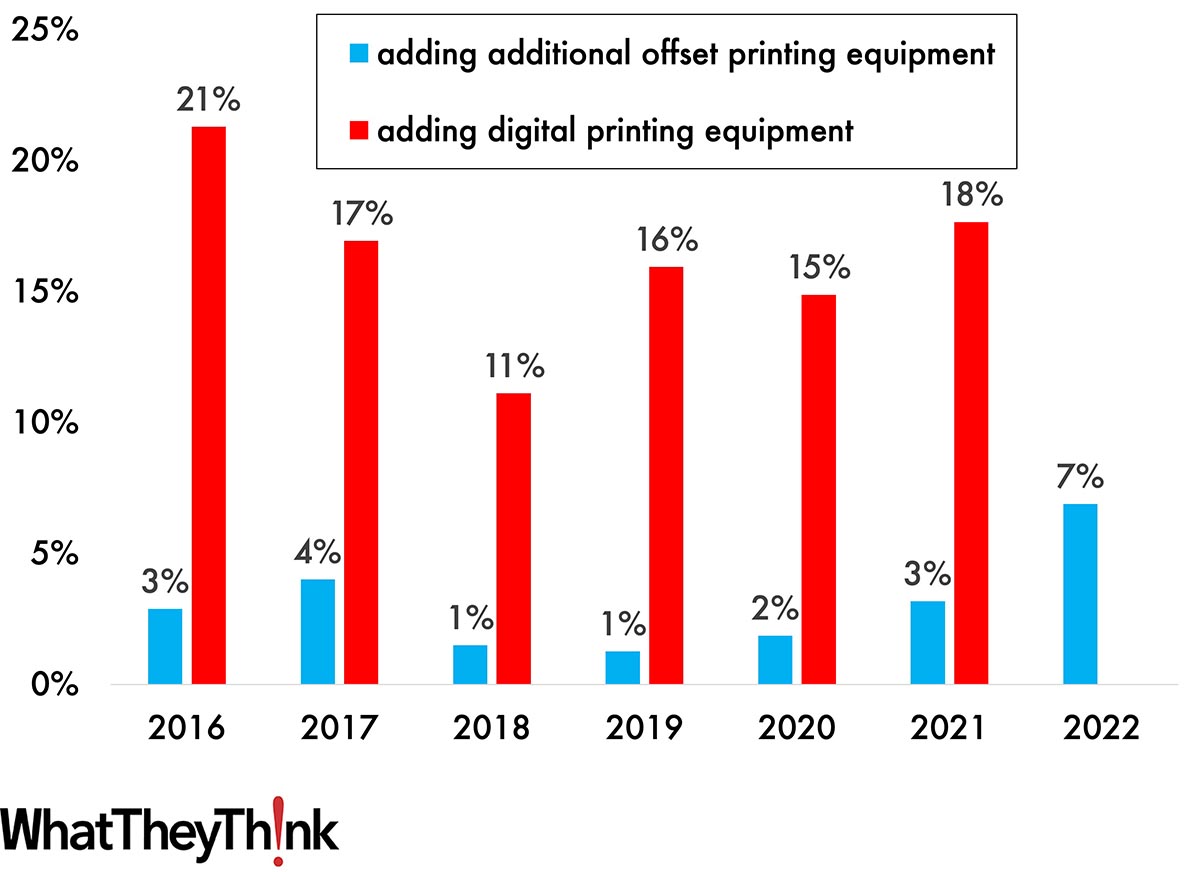
First, let’s look at some basic opportunities (see Figure 1).
Figure 1: “Adding additional offset equipment” and “adding digital printing equipment” as new business opportunities.
Source: WhatTheyThink Printing Outlook Surveys, 2016–2022.
“Adding additional offset equipment” has always been an under-5% business opportunity, although, interestingly, it spiked at 7% in Fall 2022 (primarily among 20+-employee shops). This could just be a statistical anomaly, it could reflect businesses adding capacity to handle more offset work that rebounded post-pandemic, or it could be part of the effort to diversify into new applications. We’ll pay attention to this when our Fall 2023 survey data comes in. (But also see investment data below.)
Still, offset is easily overshadowed by “adding digital printing equipment” as a business opportunity, which has generally been a 15%+ opportunity. However—and you can see where this is going—“digital printing equipment” is not just one thing, so in 2022, we split out the two primary categories of digital printing equipment:
- “adding high-speed production inkjet printing equipment (like HP PageWide, Canon Océ ColorStream/ImageStream)”: 16%
- “adding toner-based digital printing equipment (like HP Indigo, Xerox iGen)”: 12%
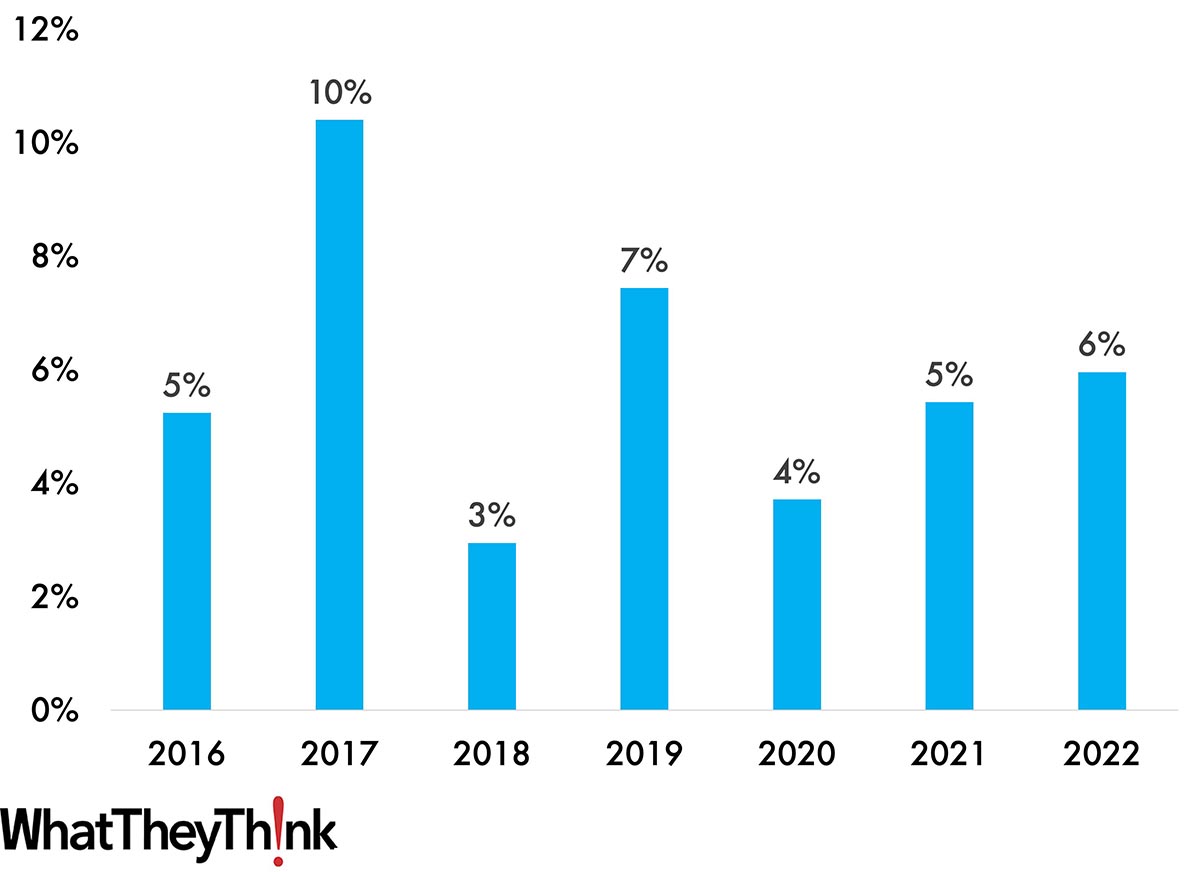
We don’t like to ask sad questions, but sometimes we must: to what extent do print businesses see “disposing of offset equipment to concentrate on digital printing” as an opportunity? As Figure 2 shows, this opportunity only peaked at 10% in 2017 (although we suspect it would have been a lot higher in the previous decade). So it looks like whatever offset-to-digital transformation is taking place has already taken place.
Figure 2: “Disposing of offset equipment to concentrate on digital printing” as a new business opportunity.
Source: WhatTheyThink Printing Outlook Surveys, 2016–2022.
And for those playing along at home, in Fall 2022 we added “replacing toner-based digital equipment with production inkjet” as a business opportunity, and it came in at 13%. This is another data point that we suspect was higher a few years ago, but we’ll have to see where this comes in when we get our Fall 2023 data.
Planned Investments
Those are perceived new business opportunities. What are print businesses actually buying? As Figure 3 shows, toner is still holding its own, with 2021 and 2022 seeing all-time-high investment plans in a toner-based press. But, these last two years have also seen all-time-high investment plans for production inkjet—which hit 13% last fall. And the sheetfed offset opportunity we saw a while ago was no fluke: even that hit a high of 7% in 2022. (Ah, but pity poor web offset: in this same period it never rose above 1%.)
By the way, we say “toner,” but “electrophotography” would be more accurate, as the HP Indigo doesn’t use “toner” per se, but is grouped in this equipment class.
Figure 3: Planned investment in various press technologies.
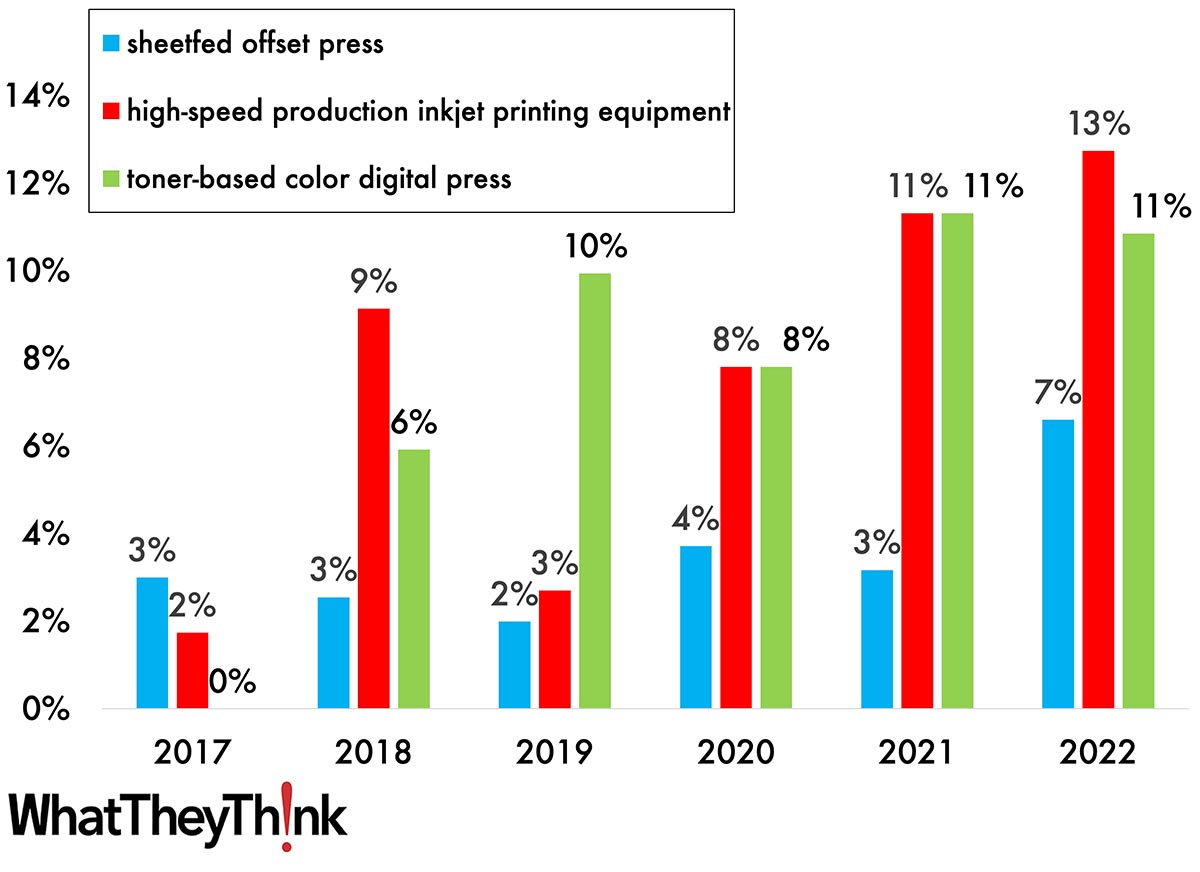
Source: WhatTheyThink Printing Outlook Surveys, 2017–2022.
In our Fall 2023 survey that is currently in the field, we asked more granular questions about specific configuration of digital press, so it will be interesting to see how those shake out.
At the End of the Day
So far, we’re not all that prepared to say that new printing technologies are necessarily replacement technologies—although we know anecdotally that for some print businesses they are. But in general, they seem more complementary, as a diverse fleet enables print businesses to take on different kinds of jobs, something that is becoming increasingly necessary.