
Frank Romano
Frank Romano has spent over 60 years in the printing and publishing industries. Many know him best as the editor of the International Paper Pocket Pal or from the hundreds of articles he has written for publications from North America and Europe to the Middle East to Asia and Australia. Romano lectures extensively, having addressed virtually every club, association, group, and professional organization at one time or another. He is one of the industry's foremost keynote speakers. He continues to teach courses at RIT and other universities and works with students on unique research projects.
Displaying 1-99 of 970 articles
Frank Takes the Pledge
Published June 5, 2026
Frank talks about The Youth’s Companion, a newspaper published in Boston for over 100 years. In 1892, its editor proposed a Pledge of Allegiance.
The Font I Want
Published May 29, 2026
Frank describes his informal survey to discover the most-used typefaces. Over a decade, he has asked users what font they use most often. See the results.
Jeopardy in Jeopardy
Published May 22, 2026
Frank reacts to a Jeopardy game show segment that involves Johann Gutenberg. There is much misinformation about the invention of printing and Frank is on a mission to present the facts, even if it means yelling at a TV screen.
Evolution of the English Bible
Published May 15, 2026
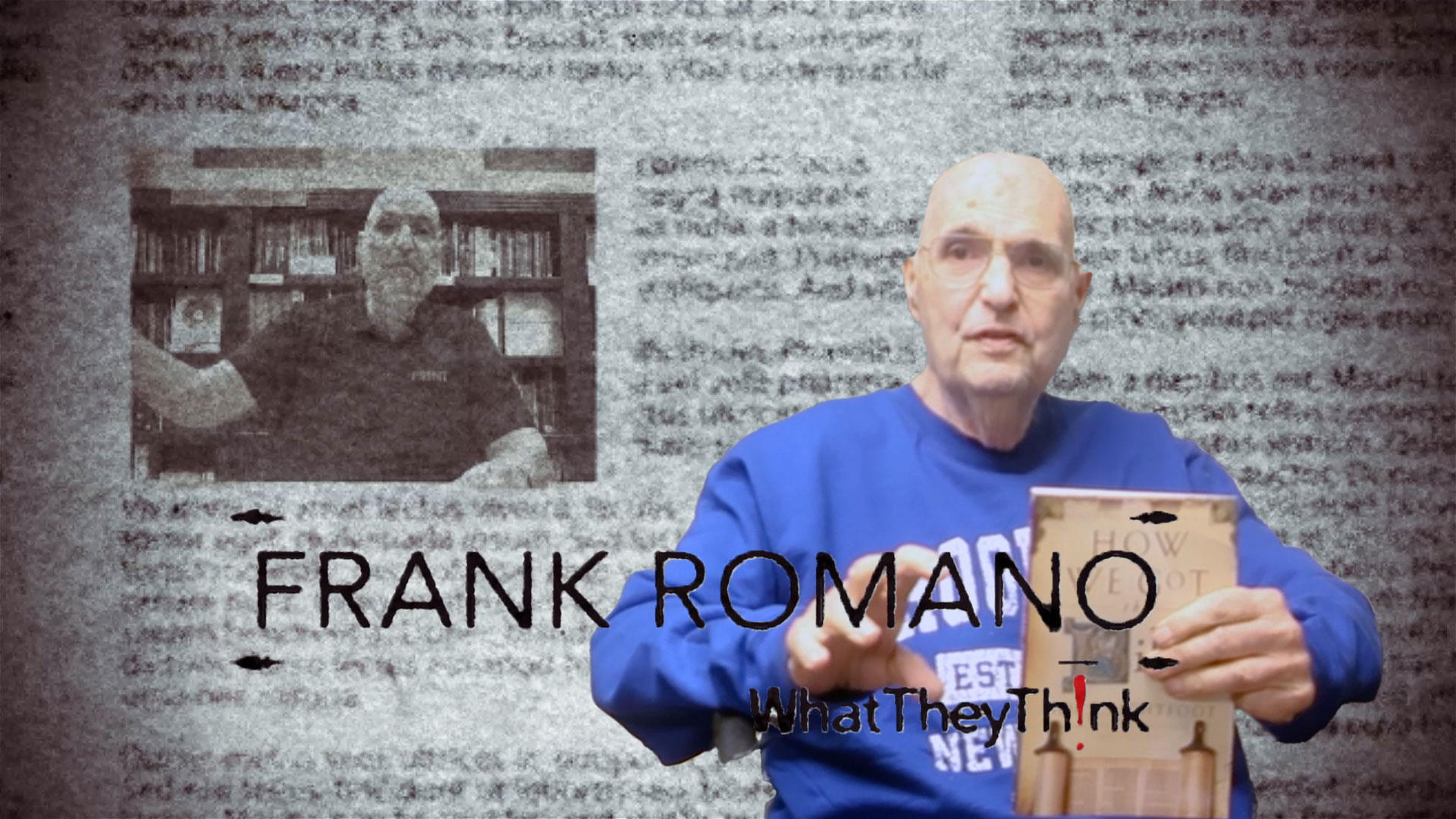
Frank traces the evolution of the printed Bible as reported in Neal Lightfoot’s book “How We Got the Bible.” The English Bible evolved from Hebrew, Greek, and Latin versions. Martin Luther’s German translation influenced other translations.
Frank Sees the Forest for the Trees
Published May 8, 2026
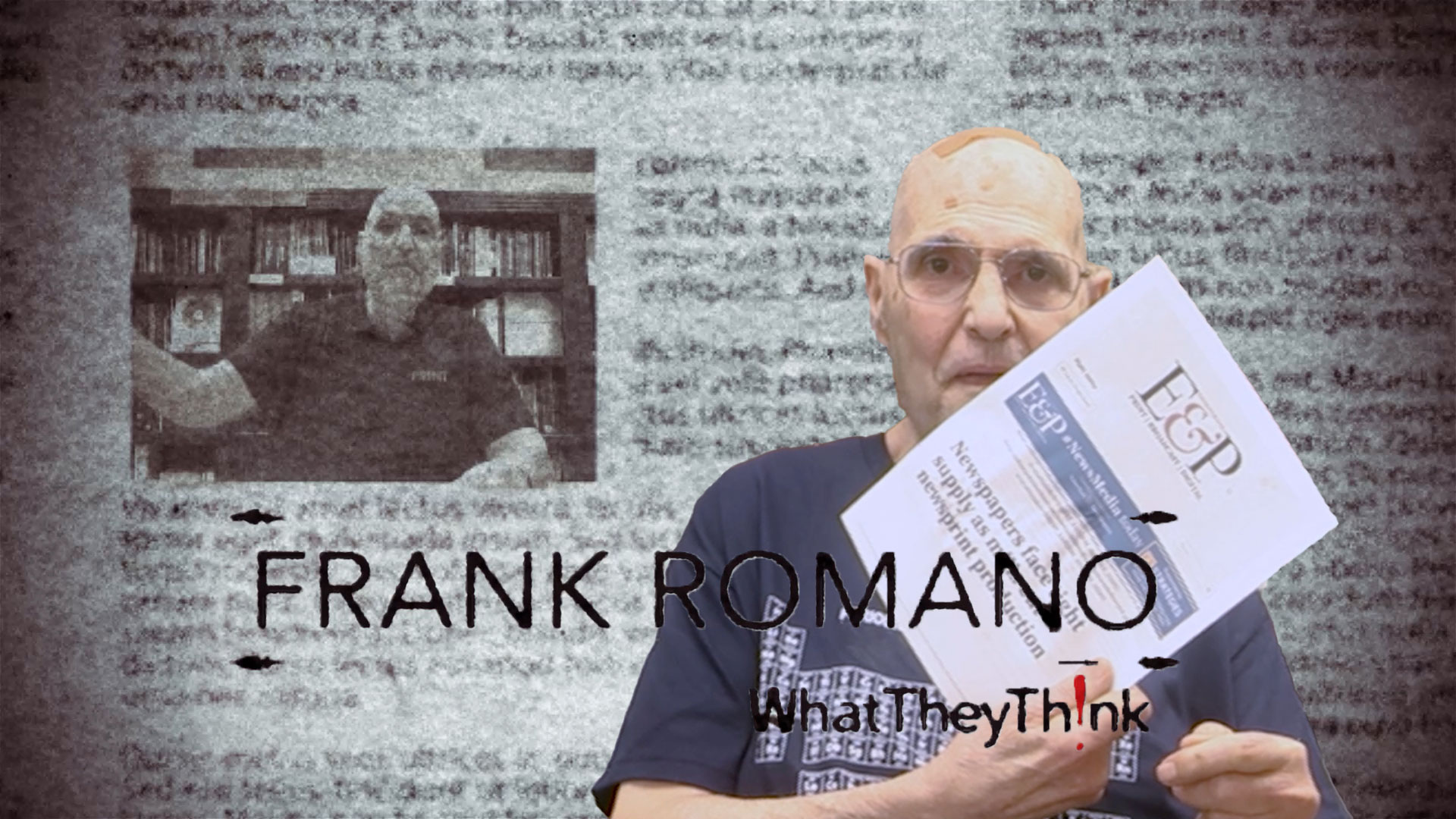
Frank notes that there are now shortages of newsprint for those newspapers that produce a paper edition. Paper production is down because we now lose more trees to fires. And paper mills are replacing newsprint with packaging papers. “Save the trees” now has a different meaning from when it meant printed page reduction.
A Typographic Explosion
Published May 1, 2026
Frank talks typefaces by showing the 1923 ATF and the 1940 Linotype specimen books. From less than 200 type families to over a million today, there are more type families available than at any time in history. Fortunately, Times Roman and Helvetica (Arial) dominate.
Dot’s All, Folks
Published April 24, 2026
Frank is excited to show the world’s first dot matrix printer. It was made by Centronics in Hudson, N.H., under the leadership of Robert Howard, who went on to produce the first color printer at Howtek and the first automated color press at Presstek. Howard’s biography was entitled “Connecting the Dots.”
We Need an American Font
Published April 17, 2026
Frank discovered that Sweden has its own national typeface and wonders why America does not. He looks at a few possible typographic contenders and provides commentary along the way.
What’s Black-and-White and In the Red All Over?
Published April 10, 2026
Frank found recent data on newspaper circulation for US newspapers. Every one of the top 25 publications was down in both print and digital versions. TV and alternative websites seem to be growing in news consumption.
You May Not Be a Winner
Published April 3, 2026
Frank waxes nostalgic about variable-data printing, which integrated your name and other personal information into direct mail. But the rise in postage has reduced direct mail in all forms. What was called junk mail is now spam.
Door Knobs?
Published March 27, 2026
Frank tells the tale of the first building built to house multiple printing companies. The 20-story Printing Crafts Building (PCB) was built in 1920. It is on 8th Avenue between 33rd and 34th Streets in New York City. The Charles Francis Press was there along with binders, typesetters, mailers, and more.
A New Life for an Old Press
Published March 20, 2026
Frank talks to Mitchell Ahearn about restoring a vintage Vandercook letterpress. Many of these presses have sat in basements and barns for years. As they are donated, they are restored for a second lifetime of use by a new generation of letterpress users.
The Heavy Metal Newspaper
Published March 13, 2026
Frank shows off the last page of the New York Times produced in metal. The 1978 lockup of Linotype lines and photo engravings was pressed to produce a stereotype mold or flong. Molten metal was poured in to make a thin plate which was curved to mount on high-speed web letterpresses. The curved plate headline says “MEN WALK ON MOON.”
Frank Remembers Paul Brainerd—He Made a Difference
Published March 6, 2026
Paul and his team at Aldus in Seattle introduced PageMaker and the term “desktop publishing.” Graphic designers could assemble pages on a computer screen. He laid the groundwork for what would become InDesign and electronic print workflows. He died recently without any acknowledgement of the difference he made.
The First Phototypesetter
Published February 27, 2026
In 1948. Intertype introduced what looked like a hot metal typecaster except that it set type photographically. As printing converted from letterpress to offset lithography, there was a need to set type on film. We call it the “first generation” of phototypesetting because it was photomechanical. Later, phototypesetters became electronic.
The Makeup of Markup
Published February 20, 2026
Frank interviews Marcin Wichary, who is researching the evolution of page markup, from typographic formatting, to SGML, to HTML. For centuries, page designers had to communicate the size, font, line length, leading, indents, and other aspects of how the page should look. And formatting web pages is no different.
Frank's Vaulting Ambition
Published February 13, 2026
Frank takes us unto his type vault and shows us the archive of every drawing for every character or symbol for every typeface produced by the Linotype Company in the 20th Century, all 400,000 sheets of them. This was the type library that every phototypesetting company used as the basis for their type library, from Baskerville to Helvetica to Palatino.
An Early American Printing Press
Published February 6, 2026
Frank shows us one of the first printing presses manufactured in America. Until the early 1800s, if you wanted a press, it came from England. Adam Ramage was the first to make presses here. The press came from the Franklin Institute in Boston, which was founded with money from Ben Franklin’s will.
Frank Has Good News and Bad News
Published January 23, 2026
Frank was sad to see the Pittsburgh daily newspaper shut down (bad news) but happy to see that printed book sales are up (good news). We are going to see more of this “print goes away” and “print makes a comeback” news as we move into the future.
Over the Cliff Notes
Published January 16, 2026
Frank shows how students “cheated” in the old days by reading Cliff Notes instead of the real book assignment. He has a whole collection of these publications. He compares all that with the new world of artificial intelligence, where you don’t have to read anything.
Frank Interviews Doug Wilson
Published January 9, 2026
Frank interviews Doug Wilson who is well known for his epic video “Linotype—The Film.” His has most recently been involved with font marketing and they discuss current typeface trends.
The Mother of All Surveys—Or the Dada of Data
Published December 19, 2025
Frank loves “The 2025 Printing Industry Census” from the Printing United Alliance using lists from Printing Impressions and other magazines. It asks questions that have never been asked in any other survey.
Frank’s Reading List
Published December 12, 2025
Frank details his current reading list: a book analyzing the first sentence of the Declaration of Independence; a book about the women involved with the Oxford English Dictionary; and a book about how Ben Franklin built his wealth.
"Don't Shoot Until You See the Whites of Their Press Sheets"
Published December 5, 2025
What was the most lethal weapon of the American Revolution? It was not a musket or a bayonet—it was the printing press. The 36 Colonial printers produced newspapers and pamphlets with articles generated by a few hundred agitators out of 1.5 million colonists. They sowed the seeds of independence. Frank believes that the printing press created America.
Saving the First Draft of History
Published November 21, 2025
Newspapers once saved their back issues on microfilm and their photos in file cabinets. Reporters and historians used that material for research. As newspapers close down, that material is disappearing. Newspapers.com has digitized almost 30,000 newspapers, but most photo collections are still analog.
Frank Says: "Antiquarian e-book is an oxymoron"
Published November 14, 2025
Frank was at the 47th Boston Book Fair where book afficinados buy and sell old books. With every passing year printed books find a second life as collections are created based on author, subject, genre, etc. You can buy, sell, share, display, and cherish old books. Try to hug an e-book.
The Press That Crossed America
Published November 7, 2025
In 1870, the Boston Board of Trade put a print shop on rails and crossed America. Railroad tracks had just connected east and west coasts. Frank tells the story and has the press to prove it.
Why do the Feds hate paper?
Published October 31, 2025
Back in 1993, the Feds implemented EDGAR for filing financial documents. Within a decade, the financial printing industry disappeared. Now they want government documents to be sent to us by electronic means. This will cut postal volume and affect Post Office deliveries. Will they sub-contract mail deliveries to amazon?
King of On-Demand Book Printing
Published October 24, 2025
Frank interviews Adi Chinai of King Printing in Lowell, Mass. King utilizes the most advanced printing and binding systems to produce books in almost any format and run length. There is growth in printed books and King is one of the reasons.
Frank Is Listless
Published October 17, 2025
Frank traces the history of lists of printing plants used for sales contacts and marketing research. At one time Yellow Pages and City Directories were used to compile contact information. Today, you would have to search the web.
All the News That’s Not Fit to Print
Published October 10, 2025
Frank goes on a rant as he bemoans the loss of another printed newspaper. This time it’s the main Atlanta, Ga., daily, The Journal Constitution. One can predict a future with no printed papers as they switch to electronic versions.
The Crisis in Printing Education
Published October 3, 2025
Frank bemoans the state of printing education. High schools have dropped printing programs in favor of “visual communications,” a euphemism for graphic design. Scholarships should increase the dollars given and focus on students going for printing degrees.
Keeping Hot Metal Hot
Published September 26, 2025
Frank interviews Dave Seat, the master mechanic who travels America to help keep Linotype and Ludlow typecasters running. They stopped making Linotypes in 1981 and Ludlows in 1988, but there still hundreds in use. Many are in museums but some are still used for production. The Museum of Printing has both machines in use for visitors.
The Rarest Typesetting Machine of Them All
Published September 19, 2025
Frank describes the Thorne Unitype, one of the earliest attempts to mechanize typesetting. It competed with the Linotype. There are only four left in the world. Linotype took them in trade for a Linotype but then destroyed them so they would not come back on the used equipment market.
Look! It’s a Magazine! No, It’s a Book!
Published September 12, 2025
Frank had some visitors who brought reading matter for him. They bought these publications at a local drug store. They appear to be magazines without ads but are actually single-topic books. It is a great idea for re-purposing content—the bookazine.
Frank Bids Farewell to ETAOIN
Published September 5, 2025
The Sun Also Rises on Old Print
Published August 29, 2025
Frank captures the interest in old print as he points his camera at the Museum of Printing Garage Sale on a recent sunny Saturday. Over 100 people came to peruse and purchase metal type, presses, cabinets, and other paraphernalia of the old letterpress world. What is old is new again.
Print Basics Are Not
Published August 22, 2025
Frank talks about printing education and bemoans the fact that there are few basics in printing any more. He harkens back to letterpress and offset education when any school could teach enough for a student to get a job.
As the World Kerns
Published August 15, 2025
Frank takes us on short tour of the VGC Photo Typositor, the machine that changed the nature of typography. Before it, hot metal and phototypesetting characters were in rectangles and not capable of tighter spacing or kerning. The Typositor opened the door to negative letterspacing and great kerning.
All the News That’s Not Fit to Print
Published August 8, 2025
Franks bemoans the loss of printed newspapers. He lists the museum artifacts that preserve the history of the newspaper, from Linotype to phototypesetting to stereotyping. Within a decade, almost all newspapers will be on screens, not paper.
Frank Pontificates About Print with Jeff Jarvis
Published August 1, 2025
Frank has a discussion with author and educator Jeff Jarvis about multiplication (print) and amplification (digital). They address the continuum from print, to radio, to TV, to the Internet—but not angels on the head of a pin.
Technology Change Begins with a Dumb Idea
Published July 25, 2025
Frank uses the advent of phototypesetting as the beginning of relentless technological change in the printing industry. He starts with the Intertype Fotosetter, which modified a hot-metal slug caster to set type on film. It was the dumbest idea ever.
The Printing Industry Should Support Print Media
Published July 18, 2025
Frank thinks that printing suppliers should support printed magazines. Video, interactivity, and web links dominate our media, but we need some print communication. There were 30 magazines for the printing industry at one time. Imagine a printing industry with no print communication.
Early Phototypesetting
Published July 11, 2025
Frank talks to Barbara Beeton who spent 56 years at the American Mathematical Association where some of the first phototypesetting machines were used. She brought some of the earliest film fonts with her.
The Overnight Sensation That Took 50 Years
Published June 27, 2025
Lithography was developed in 1798 and offset litho came around 1900, but it took 50 years for it to become mainstream. Frank holds up the 1940 Lithographers Manual which was the first to document the process. It was the Lithographic Technical Foundation, which became GATF, that transformed the process that was “only good for quick and dirty printing” into the mainstay of the printing industry.
All About the Benjamin
Published June 20, 2025
“The Religion of Nature Delineated” is a book by Anglican cleric William Wollaston, one of the great British Enlightenment philosophers. Benjamin Franklin was working in London in 1725–1726 as a 19-year old journeyman printer. He tells us in his Autobiography that he typeset one of the editions of Wollaston's book. Frank has a copy of that book and the bragging rights that go with it.
Pretty Darn Fantastic
Published June 13, 2025
Frank opines about the most important development in printing history: the PDF. Whether for ebooks, electronic documents, or printing file transfer, PDF has become an indispensable tool.
Remembering Harvey Levenson
Published June 11, 2025
Frank Romano remembers Harvey Levenson, former head of the Graphic Communication Department at CalPoly, who has just passed away.
What's in Frank's Pocket (Pal)?
Published June 6, 2025
Frank discusses the 22nd edition of the world-famous Pocket Pal publication. The pocket-sized version published in 21 editions from the 1930s is now a beautifully designed “desktop” version. Frank was the editor for over 30 years and this new version contains almost all of the content from the 21st edition.
Frank's Commencement Address
Published May 30, 2025
Frank talks virtually to the 2025 graduates of collegiate printing programs. The cost of college degrees has skyrocketed and scholarship monies are a drop in the bucket. We must do more to support students seeking higher education. They will move the printing industry into the future.
Frank’s Firsts
Published May 23, 2025
Frank has bragging rights as he talks about the first book set with a Linotype and the first book set with phototypesetting. For more than 60 years he has been collecting unique books that played a role in printing history.
Frank Joins the Club
Published May 16, 2025
Frank reads off a list of the clubs, trade associations, and fraternal organizations active around 2000 in the greater New York area. Sadly, as the printing industry has contracted, many of them have disappeared.
Frank Remembers Robert Howard
Published May 2, 2025
Frank points the camera at “Connecting the Dots,” the biography of Robert Howard. “Chairman Bob,” as he was called, started three companies that advanced graphic communication. Centronics pioneered the dot matrix printer, Howtek had an early color printer and advanced desktop scanning, and Presstek invented on-press platemaking for color printing. Bob truly made a difference in our industry.
Frank Talks Type
Published April 25, 2025
Frank holds the 1,200+ page 1940 Linotype type specimen book. It was the last major specimen book published in the U.S. Linotype’s 300 typefaces formed the basis for the first libraries of the many phototypesetting companies. Frank thinks there are now over one million typefaces.
Frank's Creative Connection
Published April 18, 2025
Frank interviews David Blatner, author, president of CreativePro a web resource for graphic designers. David and his editorial team visited the Museum of Printing and we were able to grab him for this quick interview.
Frank is Pressing the Truth
Published April 11, 2025
Frank believes in freedom of the press, which is under attack today. He recommends “Murder the Truth” by David Enrich which details the current state of affairs. “Journalism is printing something that someone does not want printed. Everything else is public relations.” That was George Orwell. Read "1984." It will sound like current events.
The Frank & Dr. Joe Show
Published April 4, 2025
Over 20 years ago, Frank and Dr. Joe Webb made this spoof of a public service announcement to increase the volume of print. Dr. Joe is still in the Witness Protection Program.
Frank Signs Off
Published March 28, 2025
Recent news has covered something called an “Auto-Pen, a device that mechanically reproduces your signature. Frank found a rare 1965 book that tells how John F. Kennedy used such a device both as Senator and as President.
Wooden Characters
Published March 21, 2025
Frank interviews James Grieshaber from Virgin Wood Type in Rochester, N.Y. This small company continues the manufacture of characters in wood. Many college art programs now have a book arts components and wood type is lighter than metal type, especially for large sizes.
The Frank and David Show
Published March 14, 2025
Usually, David Zwang is doing the interviewing, but Frank turns the tables and interviews him. David travels the world as the head of the Ghent Work Group which is creating specifications and best practices for print workflows.
Lethal Weapon 1
Published March 7, 2025
The printing press was the most lethal weapon during the American Revolution. 2026 will be the 250th anniversary of the Declaration of Independence and the Museum of Printing will celebrate this momentous document. Thirty-six printers played an important role in American independence.
Buy the Book
Published February 28, 2025
Frank ordered a book about graphic designer Saul Bass from the RITPress and discovered that it was printed by lulu.com. Rather than maintain a warehouse full of books, publishers are using on-demand services to print and mail books on demand.
Frank Charts the Past
Published February 21, 2025
Frank got to carefully hold a map made almost 400 years ago. It was the first to indicate a place called “Boston.” Its owner brought it to the Museum of Printing to review. It was carved into one block of wood.
Falling Star (Ledger)
Published February 14, 2025
Frank eulogizes the Newark Star-Ledger, which published their last printed newspaper recently. That issue was sold out and our friend Bob Wislocky found an issue at a local funeral home. How fitting.
Non-Printing United
Published February 7, 2025
Frank bemoans the loss of the United Airlines' “Hemispheres” magazine. Like many magazines and newspapers provided free by hotels, airlines, and trains, Untied (that’s not a typo) says it is going away. You can always read the type on the barf bag and actually read the safety instructions.
Frank Talks Typos
Published January 31, 2025
When Gutenberg invented moveable type, he also invented the typographical error. Typos are the result of the typesetting process as we convert one form of copy to a typographical form. New typesetting technology just makes making typos faster.
Frank Tilts at the Windmill
Published January 24, 2025
Frank notes the 175th anniversary of Heidelberg as he sits in front of a Heidelberg Windmill letterpress. He reminds us of the 211 years of Koenig & Bauer, and Komori which began in 1923. Analog printing technology seems to go on forever.
Frank's Presidential Font
Published January 17, 2025
Frank tells of his consulting project in 1977 that involved President Jimmy Carter and a type font. He explains the unit system for type design.
Frank Takes a Shelfie
Published January 10, 2025
Frank waxes poetic as he takes a quick spin around his library of 11,000 books about printing, graphic arts, and typography. Visitors are always welcome.
Frank: Buy the Book
Published December 20, 2024
Frank talks about how we acquire books and consume information. Barnes & Noble changed the bookstore business and Amazon changed everything else. Frank hopes everyone got at least one book as a gift this holiday season.
Color Frank Quizzical
Published December 13, 2024
Frank learned that the color of chocolate was once red. This took him down a rabbit hole of "Color of the Year" by over 20 painters, inkmakers, decorators, and others. He thinks the American printing industry should compile data on ink purchases and produce a real color of the year.
Frank's Belief in Providence
Published December 6, 2024
What’s black and white and printed all over? Frank bemoans the closing of the Providence Journal printing plant. It was the last and only plant that used flexography for printing. This esteemed Rhode Island newspaper will now be printed in New Jersey. Many papers are no longer printed in their own state.
3D Printing—Dumb, Dumb, and Dumber
Published November 22, 2024
Frank goes on a rant about the term “3D Printing.” Call it Additive Manufacturing or even just Jetting. Frank believes it is not printing. Gutenberg is rolling over in his grave.
Frank’s Radio Daze
Published November 15, 2024
Frank tracks the movement of advertising dollars from radio to television to cable and now to email and the Web. Ads in publications as well as direct mail are migrating to the digital world. We need to rejuvenate print advertising.
Frank Finds the Right Words
Published November 8, 2024
Frank reviews a book about the evolution of the dictionary—“Hardly Harmless Drudgery: A 500-Year Pictorial History of the Lexicographic Geniuses, Sciolists, Plagiarists, and Obsessives Who Defined the English Language" by Bryan A. Garner and Jack Lynch.
Frank's All About the Benjamin
Published November 1, 2024
Frank talks about Ben Franklin. His collection of books and other items about this famous printer is voluminous, and the collection of Franklin statues is unique. He also shows a few of the many statues he photographed as he crisscrossed America. We need more Ben Franklins.
Frank's Got a List
Published October 25, 2024
Frank talks about the sources of mailing lists of printing companies for promotion and research—from industrial directories to the phone book to proprietary supplier lists.
Frank On Demand
Published October 18, 2024
Frank reflects on the evolution of “on-demand” book printing technology, beginning with the Xerox 914 plain paper copier and culminating in the Docutech digital printing system.
The Plate Conundrum
Published October 11, 2024
Frank talks about the recent tariffs on aluminum printing plates from China and Japan. He feels that it will adversely affect small printers and especially many newspapers.
Frank's Thanks
Published October 4, 2024
Frank thanks Chris Curran for the PRINTING United show directories, Warren Werbitt for his new book, and Gary Field for his TAGA history. All are now part of the history of the printing industry.
Frank Remembers Strippers
Published September 27, 2024
Remember film—and film strippers? The switch from letterpress to offset litho brought us into the world of graphic arts cameras, darkrooms, and chemical processing. Workers were hunched over light tables cutting goldenrod and rubylith sheets. Ah, memories.
Frank Shows His Papers
Published September 20, 2024
Frank bemoans the changes in the paper industry. He shows some vintage paper samples. We went from 80 companies making paper for printing to less than 20. Remember paper distributor showrooms with paper samples and especially paper sample books?
Remembering PRINT 01 and September 11
Published September 13, 2024
It was toward the end of the PRINT 01 trade show when the tragedy of the Twin Towers occurred. It was destined to be the largest print show ever.
Requiem for the Typesetting Service
Published September 6, 2024
Frank talks about the typesetting service, a category of the printing industry that is virtually gone. Graphic designers now produce their own type with desktop publishing.
Don't Gamble on your Future
Published August 30, 2024
Frank suggests that you visit the upcoming Printing United Expo in Las Vegas, September 10-12. As usual, he waxes nostalgic about past trade shows.
Frank and Mystery Lovers Ink
Published August 23, 2024
Frank bemoans the loss of the independent bookstore. Some lost to the large discounters and others to the online services.
Eric—Hail and Farewell
Published August 16, 2024
Frank talks about WhatTheyThink’s coverage of drupa and wishes Eric Vessels a fond farewell.
The future of newspapers
Published August 9, 2024
Rupert Murdoch says that printed newspapers have 15 years max. Of course, Frank has something to say about this.
Frank Talks Type
Published August 2, 2024
Frank discusses the 1764 Manuel Typographique by Pierre Simon Fournier. It was the first book to document the making of type.
What Do Printers Print?
Published July 26, 2024
Frank wants to know what printers are actually printing. Certain categories of print like “Financial” went electronic with the EDGAR and “Catalogs” are mostly online. So what are we printing and where are the growth areas for printing companies?
Too Much Type?
Published July 19, 2024
Gutenberg had one font. By 1900, there were 480 handset type fonts. Linecasting had 410. Phototypestting had over 1,000. Today, there are over 1 million digital fonts. Frank thinks we need a better classification system for them.
Frank and Ukrainian Textbooks
Published July 12, 2024
Frank talks about textbooks and Ukraine. One of the major plants that printed them was destroyed and our government is funding Ukrainian printers to produce them.
Frank Fakes It
Published June 28, 2024
Frank is fascinated by the way movies and TV shows portray counterfeiting. He uses two movies and one TV episode to demonstrate. He is happy that they do not quite get it right.
Frank's Dead Tree
Published June 21, 2024
Frank uses the book “Dead Tree Media” by Michael Stamm to discuss the grim state of mass media newspaper publishing. Pretty soon, you may have to start a fire by burning your iPhone.
Frank's drupa Chronicles
Published June 14, 2024
Frank places drupa 2024 in historical perspective. He tracks and compares attendance and number of exhibitors over the last 24 years. Although the number of exhibitors has remained over 1,600, the number of attendees has dropped from 450,000 to 170,000. It is still a substantial and significant audience.
Frank Hails the WhatTheyThink Team
Published June 7, 2024
Frank inflates our editorial team's egos by talking about how well-documented drupa 2024 was.
Frank Bets on Benny
Published May 31, 2024
After Benny Landa invented digital color printing in 1993 with the Indigo press, he went on to up the ante with Landa Nanographic Printing. Landa Nanographic ink is a magic elixir and Frank expects more about this unique technology at drupa.
Frank's drupa Advice
Published May 24, 2024
Frank offers some advice on what to look for at drupa. He suggests you seek out systems that advance automation, integration, and embellishment. He also has some suggestion about food.
Frank Gets Acrobatic
Published May 17, 2024
What was the most important development in the printing industry? Frank says: PDF. It became the way we deliver print jobs as well as being a publication and document format.
The Notorious DOV
Published May 10, 2024
Frank had a visit from Dr. Dov Isaacs, a 30-year veteran of Adobe and a frequent participant in international standards groups. He is probably the world expert on PostScript.





10 Things PSPs Should Consider Before Adopting Robotics: What You Need to Know to Begin the Journey
Why Highly Targeted Communications Make Digital Print Essential to Modern Marketing
Wide Format in 2026: How Technology Is Reshaping Competitive Advantage
© 2026 WhatTheyThink. All Rights Reserved.